What lokum actually is
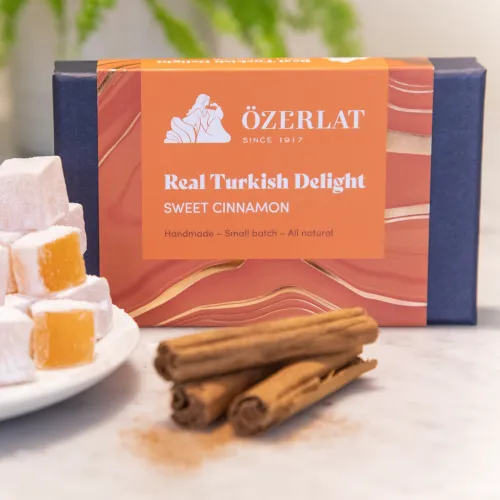
At its simplest, lokum is starch and sugar cooked together until they form a dense, pillowy gel. No gelatine, no cream — just two pantry staples transformed by time and heat into something that holds its shape yet yields completely under the tooth. The finished pieces are dusted in a mixture of icing sugar and cornflour, which keeps them from sticking and gives that characteristic powdery exterior. Quality versions are generous with the dusting; if you pick up a piece and it immediately feels tacky, the balance is off.
Flavourings are few and deliberate. Rosewater is the classic, producing a faintly perfumed, floral sweetness that divides opinion neatly. Lemon is the other great tradition — sharper, more immediately legible to British palates. Mastic, the resinous sap tapped from trees on the Greek island of Chios, appears in some formulations, lending a quietly piney, almost medicinal note that is hard to place until someone names it. Pistachios and hazelnuts are the most common inclusions, pressed into the gel before it sets.
The Ottoman original
Lokum is an Ottoman confection from the imperial kitchen tradition of Istanbul. Long before chocolate came to dominate European confectionery, sugar-and-starch sweets were the refined gift of choice across a wide stretch of the world from the Levant to the Balkans. The craft required skill: the mixture had to be stirred for hours over low heat to avoid scorching, and the set judged precisely — too short and it would not hold, too long and it would turn hard and dense rather than soft and yielding.
The word lokum is a contraction of an Arabic phrase meaning roughly throat ease — a clue that these sweets were once considered soothing. Whether the name shaped the reputation or simply described the texture is impossible to say now.
How it reached the British Christmas table
Lokum arrived in Britain during the nineteenth century, carried along trade routes by travellers who had encountered it in Constantinople or the broader Ottoman world. It was exotic enough to feel like a treat, familiar enough in its sweetness to be immediately appealing. Gift boxes — wooden or tin, lined with tissue, pieces nested in clouds of white powder — became a recognisable feature of Christmas giving.
The name Turkish delight was the British rebranding, and it stuck. By the time C. S. Lewis wrote The Lion, the Witch and the Wardrobe, the association between this sweet and winter luxury was established enough to feel natural. Edmund, offered enchanted lokum by the White Witch in a snowy Narnian forest, is promised as much as he could want — a promise that doubles as a measure of his greed, because Turkish delight was understood as genuinely desirable. The scene only works if the reader feels the temptation.
That passage has introduced generations of children to the name, though often to disappointment: the mass-produced version that tends to appear at the bottom of Christmas stockings — firm and slightly rubbery in foil-wrapped squares — is some distance from what a good lokum should be.
What to look for, and how to keep it
Properly made lokum is soft and chewy — it should give without resistance and melt as you eat it. Rubberiness is the enemy, usually a sign of too much starch or a shortcut in cooking. The dusting should be thick enough that the pieces look almost snowy; a thin coating that the sugar has already absorbed is a bad sign.
Rose and lemon remain the benchmarks for a reason. Both flavours are clean and uncomplicated, which means there is nowhere for a mediocre base to hide. Pistachio-studded pieces offer a pleasing contrast — the nuttiness cutting through the sweetness — but the gel itself should be the main event.
Storage is straightforward: keep lokum at room temperature in a dry place. The refrigerator is the wrong choice. Cold and humidity both work against the texture, making pieces dense and causing the dusting to dissolve into the surface. A tin or airtight box somewhere cool and dry will see it through several weeks without trouble.