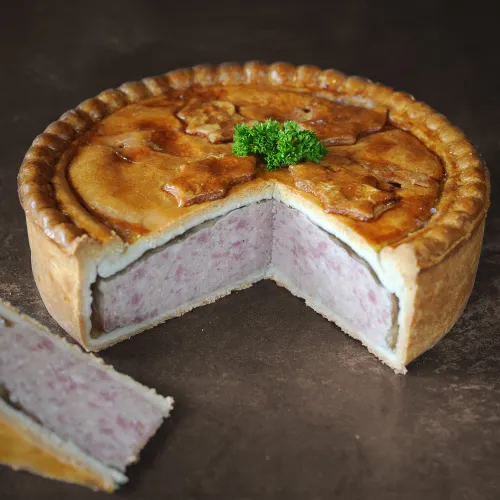
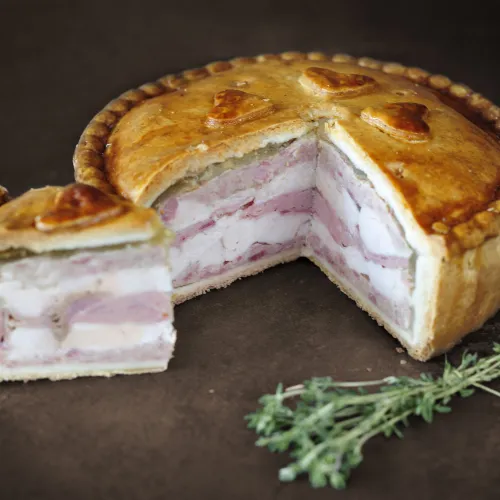
What fidget pie is
At its simplest, fidget pie is a deep pastry pie filled with gammon or bacon, apple and onion. Some versions include potato and a splash of cider; others keep to those three core elements. The result is savoury, a little sweet and distinctly autumnal — which is exactly when it was traditionally eaten, as a supper dish during harvest time in Shropshire and the wider West Midlands.
It belongs to a category of farmhouse baking that was never fashionable but has always made practical sense. The filling draws on whatever was abundant and shelf-stable: cured pork from the pig killed earlier in the year, stored apples from the orchard, onions from the kitchen garden. A pastry crust stretched the filling further and kept it warm long after it came out of the oven — useful when farm workers were eating in shifts.
Why pork and apple work together
The combination of cured pork and apple is one of those pairings that seems obvious once you taste it. Apples carry a mild acidity that cuts through the salt and fat of gammon or bacon without overpowering the meat. It is the same logic behind apple sauce with roast pork — except that in fidget pie, the apple cooks inside the crust and becomes soft, almost jammy, melting into the cooking juices rather than sitting alongside them.
Cider, when it appears in the recipe, amplifies this. It adds depth and a faint bitterness that stops the filling tasting too sweet, and it helps everything braise gently under the pastry lid. The onion provides a savoury backbone that ties sweet and salty together.
Shropshire has long been both apple and pig country. The Welsh Marches — where Shropshire sits — was a productive cider-making region for centuries, and smallholder pig-keeping was a near-universal part of rural life well into the twentieth century. Fidget pie is a direct expression of the local larder rather than a recipe invented for its own sake. See our Shropshire heritage article and the gammon cure article for more on both traditions.
The name and its theories
Where "fidget" comes from is genuinely contested. One theory holds that it is a corruption of "fitched" or "fitchett", old dialect words associated with the polecat — though the connection to the filling is unclear. Another suggestion is that the word derives from "five-sided", describing an old shape in which the pie was occasionally baked. A third possibility is that it is simply regional dialect for something that fidgets or moves — a reference to the way the filling bubbles and shifts inside the crust during baking.
None of these explanations is provably correct, and food historians have not settled on one. What can be said with confidence is that the dish is well-documented in Shropshire, and that the name, whatever its origin, has stuck to this county and its neighbours rather than spreading into broader British cookery vocabulary.
Fidget pie among the farmhouse pies
British farmhouse pie-making has a long tradition of using cured pork as a filling anchor. The hand-raised pork pie of the East Midlands, the Bedfordshire clanger (a suet roll with pork at one end and jam at the other), the Cornish pasty with its beef, turnip and potato — each developed not as a chef's creation but as a working solution to feeding people who needed food that travelled well or kept warm.
Fidget pie sits firmly in this tradition. Where the Melton Mowbray pie is cold-eaten and jellied, fidget pie is a hot supper dish, closer in spirit to a cottage pie than a picnic staple. The shortcrust pastry is less about preservation and more about structure, holding the steam in and letting the filling braise together rather than separately.
The pie belongs to the same late-summer and autumn calendar as other harvest foods: the pickles, the preserves, the fruit cheeses made when the season's produce came in at once and needed using or storing before it turned. Eating fidget pie at harvest supper was as seasonal as eating simnel cake at Easter — a dish tied to a particular moment in the agricultural year.
Where it stands now
Fidget pie never disappeared, but it did retreat. You are more likely to find it at a Shropshire food event or made at home by someone with a regional connection than to see it on a pub menu. A handful of Shropshire butchers and farm shops still make it, particularly in the run-up to autumn, and food festivals in the county occasionally feature it.
That relative obscurity is partly what makes it worth knowing. It has not been smoothed into a generic product; it remains recognisably itself — plain-faced, functional and very good. Find one made by a local butcher using a properly cured piece of gammon and orchard apples from the same county, and the logic of the dish becomes completely apparent from the first mouthful.