Dormant until wet
Dry mustard flour sits quietly on the shelf, harmless. Sniff it and you'll catch something green and faintly bitter, but nothing close to the eye-watering heat of a finished English mustard. That heat doesn't exist yet. It has to be made.
Inside ground mustard seed, two things are kept apart by the cell structure of the powder: a set of compounds called glucosinolates, and an enzyme called myrosinase. When cold water is introduced, the powder hydrates, the cells break down, and the two meet. The enzyme acts on the glucosinolates to produce allyl isothiocyanate — the volatile compound responsible for that fierce, nasal heat. The whole process takes a few minutes to reach its peak, which is why freshly mixed mustard flour needs to sit before serving.
The word cold matters here. Myrosinase is heat-sensitive. Add boiling water — or stir the powder straight into a hot pan sauce — and the enzyme is destroyed before it can do its work. The result is mild, flat, slightly bitter. Add vinegar too early and the acidic environment similarly halts the reaction. The correct approach is to mix the flour with cold water first, leave it for several minutes, and only then combine it with anything hot or acidic.
What's actually in the tin
English mustard flour is typically a blend of ground brown and white (sometimes called yellow) mustard seed. Brown seed — Brassica juncea — contributes the sharper, more piercing heat. White seed — Sinapis alba — provides warmth and body. Milled together into a fine yellow powder, often with a little turmeric for colour depth, the blend produces that characteristically bright, aggressive condiment.
Norwich and the surrounding county have long been associated with English mustard milling — the flat arable land and local growing traditions made it a natural fit — and the association endures in the cultural identity of the place.
Why English mustard hits differently
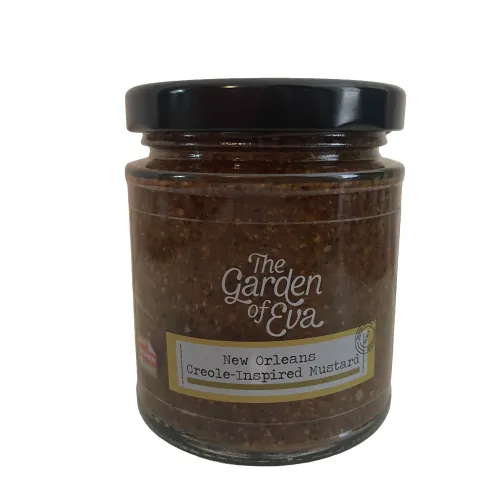
Compare it with the two other mustards most commonly found on British tables. Dijon-style mustard uses ground seed mixed with white wine or verjuice, with the acid added during processing: the enzyme reaction is curtailed early and deliberately, giving a smooth, rounded warmth rather than fierceness. Wholegrain mustard keeps many of the seeds whole or cracked rather than finely milled, which limits enzyme activity, and the seeds are typically preserved in vinegar. Both are excellent. Neither will clear a sinus.
English mustard's heat is also notably nasal rather than oral — it rises through the back of the palate and into the nose, more like horseradish or wasabi than like chilli. That's because allyl isothiocyanate is volatile; it reaches the nose as vapour. The effect is quick, intense and relatively short-lived, registering as momentarily overwhelming rather than a lingering burn.
Where it earns its place
The pairings that have stayed the course are not accidental. Roast beef and English mustard work because the fat and protein in the meat temper the heat while the mustard cuts the richness. The same logic applies with a thick slice of ham or a good banger — the mustard sharpens attention to the meat rather than competing with it.
In cooked applications, that same heat-sensitivity makes English mustard surprisingly useful. Stirred into a cheese sauce at the end of cooking rather than at the start, a small amount deepens the overall flavour without making the dish noticeably mustardy. It is the backbone of a proper Welsh rarebit — as we cover in our Welsh Rarebit article — working alongside Worcestershire sauce to give the cheese its edge. Added too early, much of the effect is lost.
Tewkesbury mustard, explored in our Tewkesbury Mustard article, takes a different historical path: blended with horseradish, it compounds the nasal heat in a way that is distinctly its own.
Buying and keeping it
Dry mustard flour keeps well in a sealed tin away from light and moisture — the enzyme is stable when dry and the powder stays potent for a long time. Ready-mixed English mustard in a jar has already undergone the enzyme reaction and been stabilised with vinegar, so the heat is fixed at whatever level the manufacturer chose. Both have their uses, but the powder lets you control the intensity in a way a jar does not.
Once mixed from powder, English mustard is fiercest when freshly made and mellows gradually as the volatile compounds dissipate. Made a day ahead and refrigerated, it becomes noticeably gentler — which is either a problem or a solution, depending on what you're making.