What makes fondant different from ordinary sugar
Fondant begins with a sugar syrup boiled to a specific concentration — hot enough to drive off most of the water, but the real transformation happens on the way down. As the syrup cools, it is worked continuously, usually on a marble slab or in a machine, agitating the mass so that sugar molecules crystallise all at once rather than gradually. The result is an enormous number of extremely tiny crystals suspended in a saturated syrup — so small that the tongue cannot detect them individually, which is why fondant feels smooth and almost melting rather than grainy. Stop working too early and you get large crystals; work at the wrong temperature and the whole batch can seize.
Well-made fondant is opaque and white, giving chocolatiers a clean canvas. Colour, flavour and any additional ingredients are folded in once the base is made, not cooked into it — heat at that stage would dissolve the crystal structure you have worked to create.
Flower waters, oils and flavour
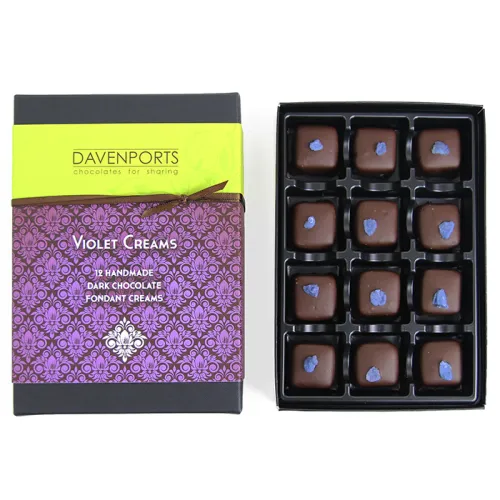
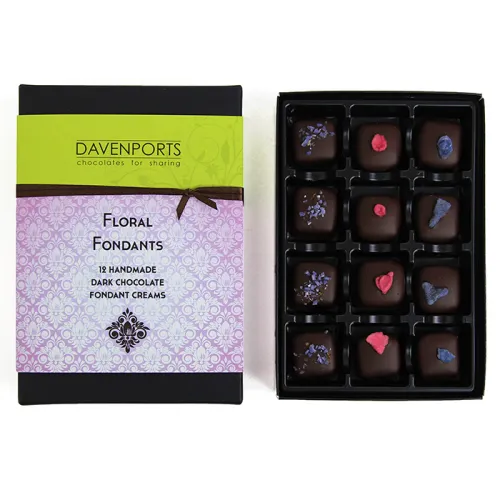
Rose and violet creams are flavoured with what you would expect: rose water and violet extract or essence, respectively. Rose water — distilled from rose petals — lends a floral delicacy that reads clearly without tipping into soap if used with restraint. Violet flavouring has a slightly powdery, almost sweet-woody character quite distinct from rose. Both are added in small quantities to the fondant base, along with colouring: pale pink for rose, lilac or pale purple for violet, so a glance at a chocolate box tells you what you are about to eat.
Peppermint creams take a different route. The flavouring is peppermint oil rather than a flower water — far more concentrated and sharp, with the cool sensation that comes from menthol. The oil is dispersed through the fondant during mixing, producing a more assertive centre than the floral versions. Where rose and violet creams tend to be soft and yielding, a good peppermint cream has a slightly firmer bite before it gives way.
Crystallised rose and violet petals are the traditional decoration, pressed onto each centre before or after enrobing depending on the maker's method. They signal the flavour before you have tasted anything, and on a violet cream a single crystallised petal suggests the maker has taken the longer route.
The enzyme that changes texture after enrobing
One of the more quietly fascinating aspects of fondant-based chocolates is the use of invertase, an enzyme that gradually breaks down sucrose into its component sugars — fructose and glucose — after the chocolate shell has been applied. Those smaller sugar molecules hold onto water differently, so over days or weeks the centre softens noticeably, shifting from a firmer fondant towards something closer to a liquid or semi-liquid cream. Chocolatiers who use invertase are building time into the sweet: a fresh box will have firmer centres; an older one, softer. For rose and violet creams especially, that softened, almost flowing centre is considered the ideal texture by many makers, and it is only achievable because of chemistry happening slowly inside a sealed chocolate shell.
We have written elsewhere in this journal about the broader world of filled chocolates and the sugar stages that underpin confectionery work — both give useful context for understanding where fondant sits in the wider craft. In terms of technique, fondant belongs to the demanding end of sugar work, even if the sweets it produces look deceptively simple.
A thoroughly British sweet
Rose and violet creams occupy a particular place in British confectionery culture. They appear in chocolate boxes alongside truffles and caramels, but their lineage is distinct — connected to flower waters in English cooking long before modern flavouring existed, and to a fondant tradition that arrived via French and Belgian confectionery before becoming thoroughly domesticated here. Peppermint creams have a more vernacular feel: school fetes, home kitchens, the kind of sweet people have made for generations using bought fondant or icing sugar as a shortcut.
What all three share is the balance between sweetness and flavour. Fondant is essentially nothing but sugar, so the flavouring must be distinct enough to carry the whole experience. A rose cream with a real floral note, a violet one with that strange powderiness, a peppermint with genuine sharpness — in each case, the simplicity becomes the point.