A name that travels
Halva — or halwa, halvah, helva, depending on where you encounter it — refers to two structurally distinct things that share an Arabic root meaning 'sweet'. Which kind you are looking at changes everything about how you buy it, store it, and eat it.
The two main families are tahini halva, made from sesame paste and cooked sugar syrup, and flour or semolina halva, cooked soft in butter and sugar and served warm. They overlap only in name and in a certain satisfying richness.
Tahini halva: the sesame block
This is the version most likely to appear on a British deli counter, sold in a dense block and sliced to order. Tahini — ground sesame seeds — is blended with a hot sugar syrup aerated using either soapwort root extract or whipped egg white. That aeration produces the characteristic texture: fibrous and slightly crumbly rather than chewy, with an interior that almost pulls apart in thin strands. The flavour is deeply nutty, with a mild bitterness from the sesame that keeps the sweetness from becoming cloying.
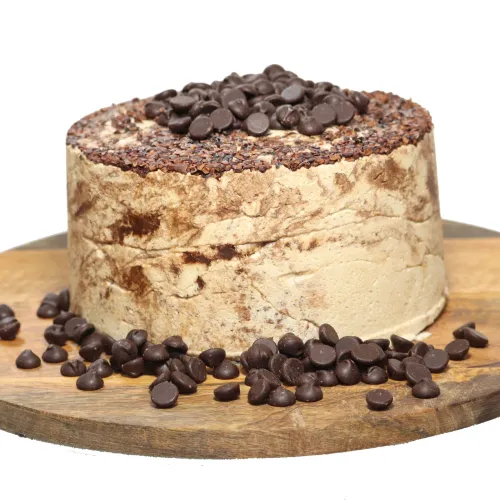
Marbling with cocoa is one of the most common variations — the dark cocoa cuts through the pale sesame in both colour and flavour. Pistachios, whole, chopped, or pressed into the surface, are another classic addition, their green against the ivory-gold of the sesame making the block look as good as it tastes. Regional producers also work in vanilla, coffee, or citrus depending on tradition.
Tahini halva contains no dairy and stays shelf-stable for months at room temperature, making it unusually forgiving by the standards of artisan confectionery — a sweet historically practical enough to be traded and carried across long distances.
Semolina and flour halva: the warm cousin
Semolina halva — common across South Asia, the Eastern Mediterranean, and Central Asia — is cooked fresh, closer to a pudding than a confection. Semolina or flour is toasted in butter or ghee until golden, then sweetened and finished with water, milk, or syrup. The result is soft, warm, and spoonable: nearer in texture to a set pudding than anything crumbly.
Indian halwa takes this tradition in multiple directions. Gajar ka halwa — carrot halwa — is perhaps the most recognisable internationally: grated carrot cooked slowly with butter, sugar, and milk until jammy and deep orange. Served warm, often at celebrations, it bears almost no resemblance to a sesame block beyond the name. The semolina version, sooji halwa, is similarly warm, often made for religious occasions or as a simple home sweet.
What connects these variants is technique: each involves cooking a starch or nut paste with fat and sugar until the mixture transforms into something unified and deeply flavoured. The attention to heat is where the craft lives.
How to eat tahini halva
Sliced thin alongside strong coffee, tahini halva works as it has for generations across the Middle East and the Balkans — the bitterness of the coffee and the sesame pulling each other into balance. A thicker slice crumbled over vanilla ice cream is less traditional but no less good; the halva softens slightly against the cold and the contrast of textures is quietly excellent.
At room temperature, a good block should slice cleanly without shattering, and the cross-section should show that fibrous, almost flaky interior. If the block is grainy and dry throughout with no visible structure, it has either dried out or was not made carefully. The flavour should be rounded — dominant sesame, clean sweetness, nothing waxy or stale.
Once cut, wrap the block tightly to prevent the cut face drying out.
Finding good halva in Britain
Specialist Middle Eastern grocers and Turkish food shops are the most reliable sources, and many sell halva by weight from large blocks, letting you try before committing to quantity. Greek and Cypriot delicatessens often stock their own regional versions. British-based artisan producers now make small-batch tahini halva, and it appears at independent food markets and through artisan online retailers.
Semolina and flour versions are less common ready-made in shops but are found in South Asian sweet shops, often made fresh and sold by weight alongside other mithai. If you encounter either style for the first time, buy a small amount: the gap between expectation and reality is part of what makes halva worth knowing about.