What baklava actually is
Baklava is an exercise in repetition and patience. Sheet after sheet of filo — each one close to translucent — is brushed with butter, usually clarified so the milk solids don't interfere with the crunch, then layered into a tray with chopped nuts in the middle. The whole thing goes into the oven, and the moment it comes out, still fiercely hot, cold syrup is poured over it. That thermal shock drives the syrup deep into the layers without turning them soggy.
The result, done well, is a piece of pastry that manages to be simultaneously crisp and saturated. The top layers shatter slightly under a fork; the interior is dense, sticky, fragrant. Getting that balance right — syrup absorbed evenly rather than pooling in the base — is the difference between something memorable and something you leave half-finished.
The pistachio question
Ask someone where the best baklava comes from and you'll start an argument that spans at least three countries. The city of Gaziantep in south-east Turkey has the strongest claim for pistachio baklava. Antep fıstığı baklavası — baklava made with pistachios grown in that region — holds a protected designation in the EU, meaning the name can only be used for the genuine article. The pistachios are small, intensely green, and noticeably less sweet than varieties that often appear elsewhere. A good piece should show that colour clearly: bright, almost jade green through the layers, not the dull khaki of a nut that has sat around too long.
Pistachios are far from the whole story. Greek baklava typically uses walnuts, with a syrup built on honey rather than plain sugar, and cinnamon worked through the filling — earthier and more aromatic, the spice cutting through the sweetness in a way that feels quite different from the Turkish style. Move into the Levant and the nut question softens further. Here the syrup shifts most noticeably: rose water or orange blossom water gives it a floral quality that is either beguiling or overwhelming depending on how heavily the maker's hand falls.
Shape, name and what it tells you
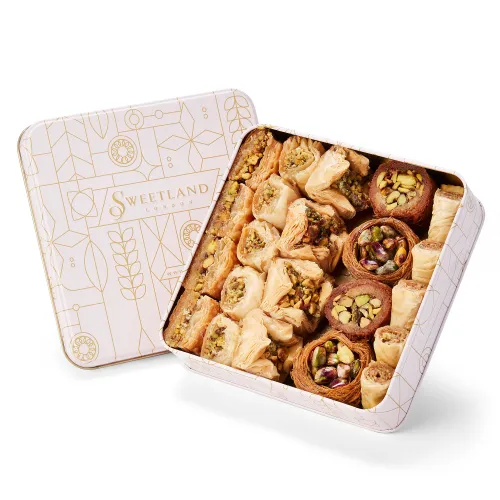
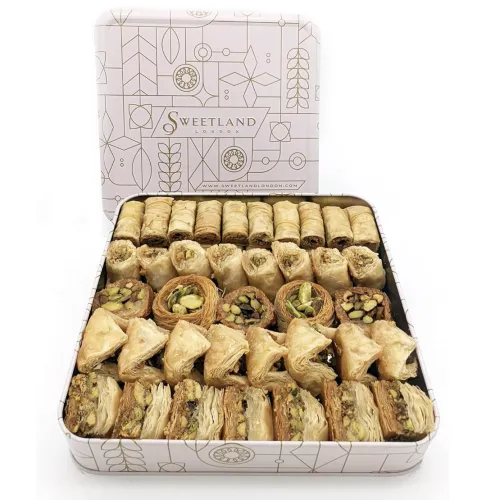
Baklava is not always the familiar diamond-cut square. Shapes have specific names across the region, and they are not purely decorative. The sarma is a rolled version, filo wound tightly around a narrow cylinder of nuts, sometimes pencil-thin, with a higher pastry-to-filling ratio and a different texture from a cut square. The bird's nest — filo coiled into a shallow ring with nuts piled at the centre — is denser and chewier at the base. Diamond cuts are probably the most common commercially, but the square is equally traditional in many parts of Turkey.
Knowing the shapes matters when buying from an independent maker or a specialist shop, because it is often how the trays are labelled. It is also a quick way to gauge how seriously a producer takes the craft — a shop that uses the proper names usually cares about the other details too.
How to judge what you're buying
The signs of quality are mostly visible before you take a bite. The top layer should look properly crisped — a uniform, pale gold rather than patchy or pale at the edges. The cut sides should show distinct, compressed layers rather than a collapsed mass. If there are pistachios on top, their colour is a reliable indicator of freshness: vivid green means the nuts are recent; a brownish or yellowed surface suggests they have been exposed to air and heat for too long.
Once you are eating it, the syrup should be present throughout without being wet underfoot. A piece that leaves a puddle on the plate was either over-syruped or not hot enough when the syrup went on. One that feels dry or crumbles without any chew was probably under-syruped or has been sitting uncovered too long.
Keeping it
Baklava stores well at room temperature — a week to a fortnight is a reasonable expectation, kept covered and away from direct heat. Avoid the refrigerator: cold air firms the butter and dulls the crunch, and condensation makes the surface tacky. If you have bought a whole tray, leave it in the box or tin it came in rather than transferring it somewhere airtight, which traps moisture. The syrup acts as a preservative, so baklava is more forgiving than most pastry in that respect.