What York ham actually is
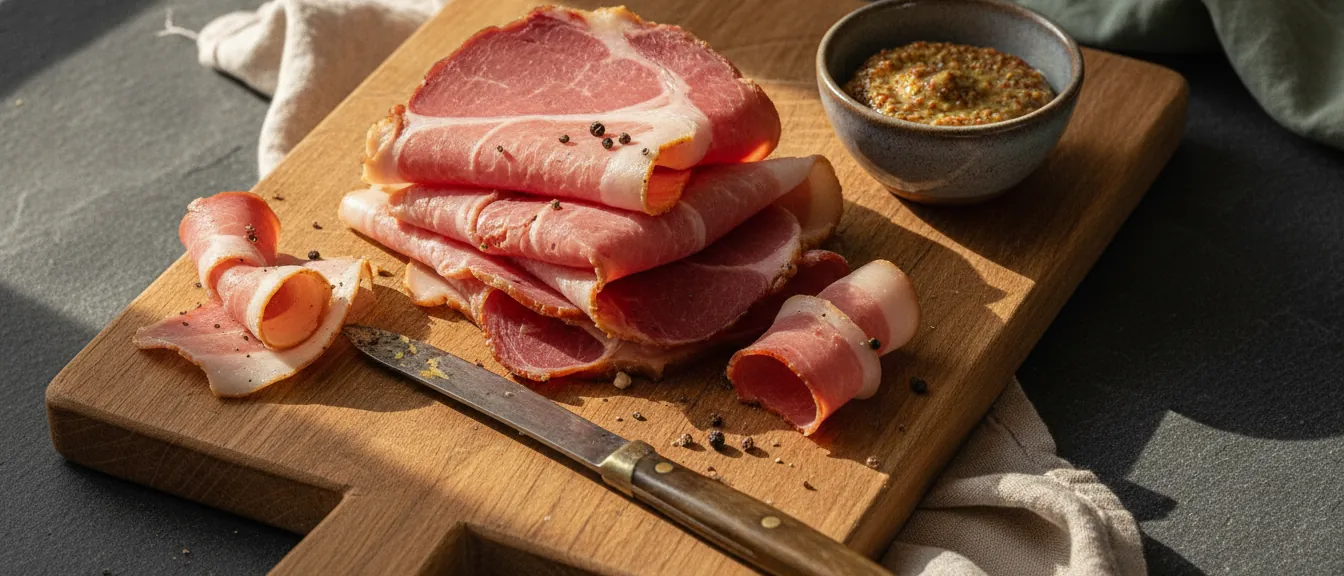
Strip away the mythology and York ham is a dry-cured leg of pork, produced with a light hand. The cure is salt-based and unhurried, drawing moisture from the meat gradually to concentrate flavour without aggression. Some versions are lightly smoked; others go unsmoked entirely. Either way, the result is pale, close-grained flesh with a mild, clean savouriness — the opposite end of the spectrum from the robust, heavily smoked hams of Germany or the long-aged, intensely salty products of the Mediterranean.
That mildness is the point. York ham was never about loudness. It was prized precisely because it didn't overpower — a quality that made it the instinctive choice for cold collations, wedding breakfasts and the kind of formal English table where subtlety was read as sophistication.
The legend of York Minster
No account of York ham is complete without the oak sawdust story, though it should be taken as folklore rather than history. The tale holds that the ham-curing tradition in York grew from an abundance of oak sawdust left over from building the Minster — that local curers began smoking their hams over this material and found the results exceptional. It has been repeated so often that it has taken on a life of its own, and whether it contains a grain of truth is another matter.
What the legend usefully conveys is the deep local identity attached to the product: this is a ham people wanted to root in a specific place, a specific material, a specific moment in the city's history. Oak, incidentally, remains the wood most associated with British ham smoking more broadly. Its smoke is relatively gentle compared with stronger woods, which aligns neatly with the mild profile York ham is known for — legend or not.
A Victorian byword for quality
By the Victorian period, York ham had become a firmly established name in the English food vocabulary. It appeared on hotel menus, in grocers' advertisements and in the prose of writers who used it as shorthand for a certain kind of refined, unpretentious English eating. To serve York ham was to signal something about standards without making a fuss.
This was an era when British cured meats were more varied and regionally distinct than they are today. Bradenham ham, Suffolk cure, Wiltshire bacon — each county had its own approach, and York's contribution was understood to be the gentler, more distinguished option. The association between the name and quality became so strong that it outlasted many of the regional traditions around it.
The question of protection
Unlike Melton Mowbray pork pies or Stilton cheese, York ham holds no protected geographical indication status. There is no legal definition restricting who can use the name or where the pigs must come from. A ham labelled York ham may have been made to very different standards by different producers.
For the shopper, the name is a starting point rather than a guarantee. The things worth looking for are the method — genuine dry-curing rather than brine injection — and the cure time, which in a properly made York-style ham should be measured in weeks. A reputable independent butcher or specialist deli is more likely to stock a version that honours the tradition than a supermarket own-label.
How it is traditionally served
York ham is almost always served cold or at cool room temperature, sliced thin enough to show some translucency at the edges. The classic treatment is straightforward: good bread, mustard, perhaps a few cornichons. It sits well on cold buffet tables alongside other cured meats, where its pale colour and delicate flavour provide a counterpoint to richer or smokier companions.
Boiling the whole joint before glazing and finishing — a method associated with traditional English ham cookery generally — is also part of the York ham story. A long, gentle simmer in water, sometimes with aromatics, softens the salt and produces a tender, yielding result quite different from a ham sliced from a cured raw leg. The defining characteristic remains either way: restraint, and a flavour that rewards attention rather than demanding it.