
A pie with a legal address
Not every pork pie can carry the Melton Mowbray name. Like Champagne or Stilton, it holds Protected Geographical Indication status, which means production must take place within a designated zone centred on the Leicestershire market town of Melton Mowbray. That boundary is not bureaucratic pedantry — it ties the pie to a specific tradition of making that developed in that place and nowhere else. Buy a supermarket own-label pork pie made in a factory outside the zone and you are eating something in the same broad family, but not the same thing.
The protection matters because it gives producers a reason to maintain the methods that define the pie, rather than drifting towards the cheaper, faster alternatives the wider industry long ago adopted.
The meat inside
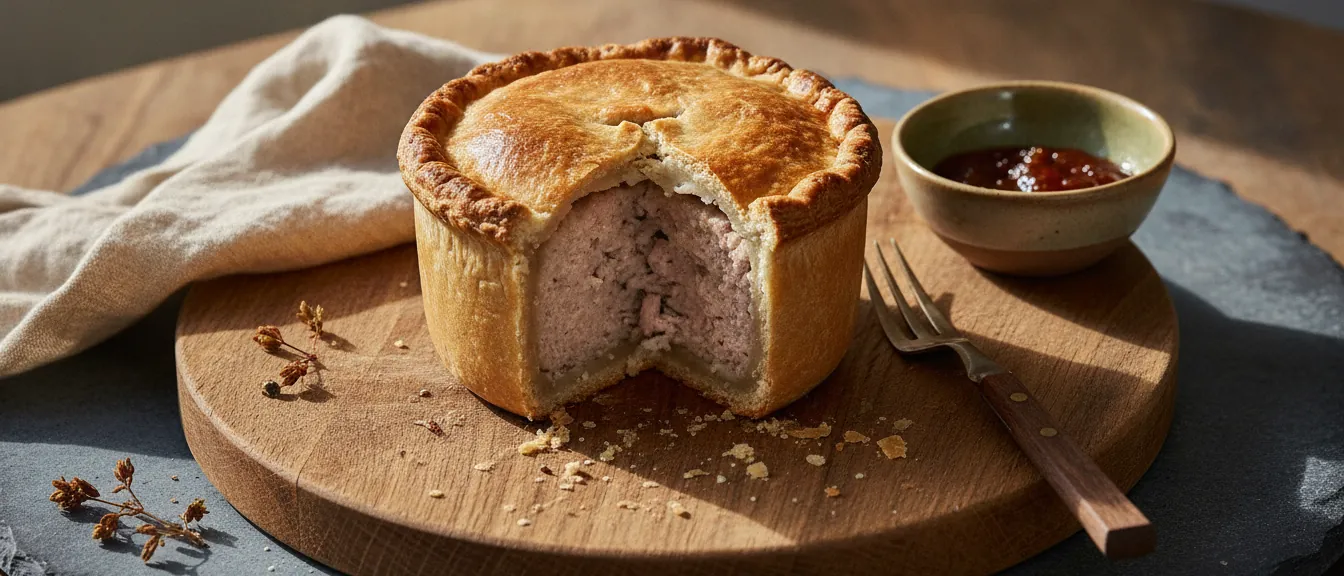
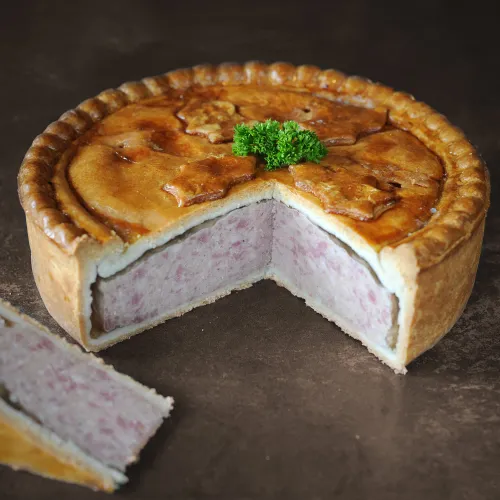
Slice a genuine Melton Mowbray pork pie and the filling is grey. This surprises people who are used to the blush-pink interior of most commercial pork pies, but grey is correct — and the difference comes down to curing. Standard pork pie recipes use cured or brined pork, and the nitrates in the cure preserve the pink colour through cooking. Melton Mowbray pies are made with uncured fresh pork, which turns grey when baked, exactly as a pork chop does in a pan.
The flavour difference is real. Uncured pork has a cleaner, more straightforward taste — closer to a roast than to a cured meat — and the seasoning added to the filling can come through more clearly without the background salt of a brine.
The texture matters too. The pork must be chopped rather than minced, which gives the filling a coarser, more irregular structure. Minced meat packs densely and uniformly; chopped meat retains more variation, so the eating has a rougher, meatier character that is quite distinct from the smoother, almost pâté-like texture of cheaper alternatives.
The pastry and how it is built
Hot-water crust pastry is the standard for raised pork pies across Britain — the fat and water are heated together before mixing with flour, producing a dough stiff enough to be shaped by hand. What distinguishes the Melton Mowbray method is that the pie is hand-raised and baked without a supporting hoop or tin.
Most commercial pork pies are baked inside a metal mould that holds the sides straight and vertical. Remove the hoop from a Melton Mowbray pie and the sides are free to move during baking, which is exactly what they do: the crust bows outward slightly as the pie cooks, giving the finished pie its characteristic curved profile. That bow-walled shape is not a design flourish. It is simply what happens when a hand-formed pie is baked unsupported — it is the visible evidence of the method.
The base and sides must be thick enough to hold their structure without a mould, which means the pastry tends to have more substance to it than the thinner shells of hoop-baked pies.
Why the combination matters
Each of these features — the PGI zone, the uncured meat, the chopped texture, the hand-raised hoopless crust — could be considered separately, but they belong together. They are the characteristics of a pie made in a particular way for a particular reason, and they reinforce each other. The uncured meat produces a filling that is wetter than a cured one, which works well inside a robust hand-raised crust. The chopped texture means the filling has structural presence rather than slumping. The bowed sides are both a consequence and a marker of the hoopless method.
When you eat one, traditionally at room temperature with a little of the set jelly that forms between meat and crust, those details translate into something quite specific: more clearly savoury than sweet-cured, more textural than smooth, a pastry that holds its own against the filling rather than just containing it.
That is the pie as it was made in Melton Mowbray — not as a premium variation on a theme, but as the original from which the cheaper, pinker, hoop-moulded versions are the departure.
_jpgq80.webp)