Where it came from
The Chelsea Bun traces its origins to the Chelsea Bun House, a bakery that stood in what was then a fashionable, semi-rural part of west London. Georgian Londoners — including, if the stories are to be believed, members of the royal household — would make the trip specifically for these buns. Whether the royal connection is embellished or not, it speaks to how seriously the place was taken. This was not a humble street snack; it was a destination.
That kind of pull, sustained over generations, is how a regional speciality crosses into something more durable — a shape and a flavour absorbed into the general vocabulary of British baking.
What makes it a Chelsea Bun
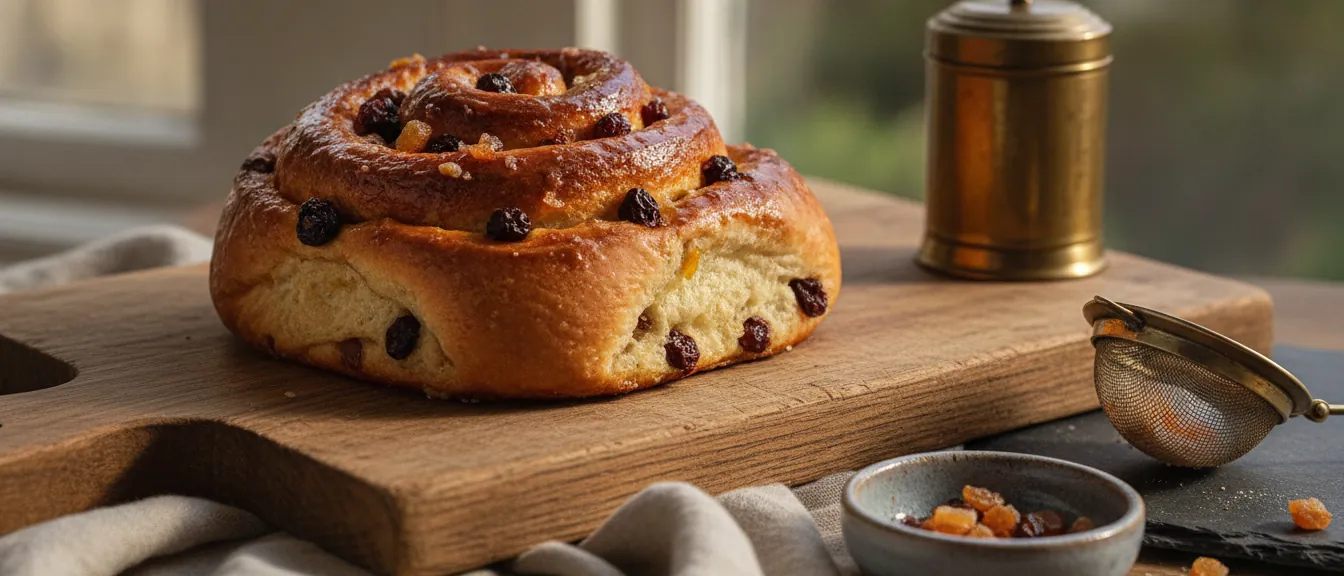
The form is distinctive and consistent. A sweet, enriched dough is rolled flat, spread with butter, sugar and dried fruit — currants being the traditional choice — then rolled into a log and cut into thick slices. Those slices are placed cut-side up, touching one another, in a square tin. As they prove and bake, they fuse at the sides and rise upward, producing the characteristic spiral top and a pull-apart structure: each bun arrives with a soft, slightly sticky edge where it met its neighbour.
The square shape separates it immediately from a standard fruit bun or a Bath Oliver. The spiral also determines how fruit distributes through the dough and how the sugar caramelises at the centre during baking — it is structural, not decorative.
A proper glaze, applied while the buns are still warm, gives the top its characteristic shine. Some bakers use a simple sugar syrup; others add a touch of honey. What it should not be is thick or fondant-heavy — the glaze here is a finish, not a coating.
The Cambridge connection
The bun's roots are London, but Cambridge has become its most ardent custodian. One bakery in the city has made Chelsea Buns so central to its identity that they are practically a civic institution, drawing students and visitors much as the original Bun House drew Londoners. A good regional speciality does not always stay in its region; sometimes it finds a second home that suits it just as well.
The Cambridge versions tend to be generous in size and properly sticky, and they are taken seriously as a point of local pride. Eating one still warm from the oven with a cup of tea is one of those understated British food pleasures that needs no further explanation.
How it fits into British baking
The Chelsea Bun sits within a wider tradition of British enriched doughs — related to the Bath Bun, the hot cross bun and the lardy cake, all of which use fat, sugar and fruit to transform a simple bread dough into something richer. What distinguishes it within this family is its precision of shape. The spiral is not incidental; it is what the bun is.
That clarity of identity has helped it survive. Sourdough loaves, laminated pastries and elaborate celebration cakes cycle in and out of fashion, but the Chelsea Bun has stayed on bakery shelves largely unchanged because there is nothing to improve. The ratio of dough to fruit to glaze, the square form, the pull-apart structure: these things work, and bakers who understand them tend to leave well alone.
A good one is worth seeking out. Look for visible layers in the spiral, a properly sticky underside, and currants that have plumped during baking rather than dried out. A pale, dry Chelsea Bun is a disappointing thing; the real version should feel rich without being cloying, and sweet without being sugary all the way through.
_(3)_kfw4-y9_jpgq80.webp)