A cure with a specific address
Most smoked salmon carries a regional identity in only the loosest sense. London Cure is different. It holds Protected Geographical Indication status, meaning the name is legally tied to a defined tradition rather than simply a place of sale. That tradition traces back to Jewish immigrant smokehouses in London's East End, where curing and smoking fish was both a livelihood and a cultural practice carried over from central and eastern Europe.
Those smokehouses were working to satisfy a community that knew exactly what good smoked fish should taste like. The method was refined by that expectation — careful, measured, producing something that complemented the fish rather than announcing itself.
What the cure actually involves
The defining characteristic of London Cure is restraint. Salt is applied to draw out moisture and firm the flesh, then the salmon is oak-smoked at a deliberately gentle level. The smoke is present — you notice it — but it sits behind the salmon rather than in front of it. The fish remains the primary flavour, with the smoke lending depth rather than dominance.
This is where London Cure parts company with many Scottish-style smoked salmons, which tend toward a more assertive, peatier character. They are genuinely different styles, and the distinction matters when buying for a specific purpose. London Cure behaves more softly on the palate, so the salmon carries the whole moment rather than sharing it with a heavy smokiness.
The PGI and what it protects
PGI status, as applied to London Cure smoked salmon, protects the method and the connection to its East End origins — not simply the geography of where the fish is smoked today. It functions more as a guarantee of traditional practice than a strict postcode requirement, ensuring that producers using the name work within the parameters of the original cure: the salt, the oak, the light touch.
For the buyer, this offers something genuinely useful — a standard that has been externally defined, not a marketing claim. It places London Cure alongside other British protected foods such as Stilton or Cornish Clotted Cream, products where the name carries legal meaning rather than mere suggestion.
How it is traditionally eaten
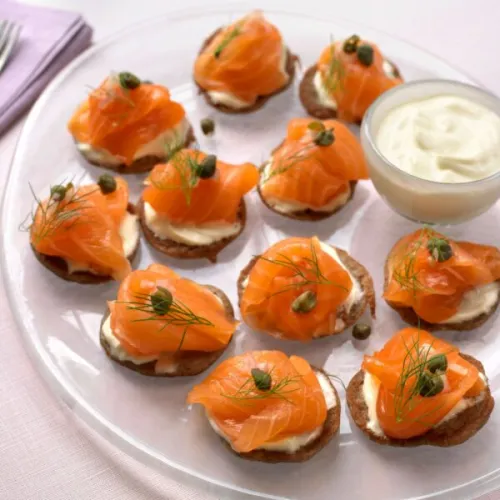
London Cure smoked salmon is most at home eaten simply. Thin slices on good bread — rye or a dense sourdough are natural companions — with crème fraîche, capers and a wedge of lemon. The aim is not to build around it but to let it be. Because the smoke is so considered, each element alongside it registers clearly; nothing is drowned out.
It appears on Jewish Sabbath tables and high holiday spreads as a matter of tradition. This is food that was eaten at significant moments, prepared with attention, and that history is embedded in the cure itself — it was never meant to be background food.
Finding the real thing
When buying smoked salmon labelled as London Cure, look for explicit mention of PGI status or the East End smoking tradition. The phrase alone is not protected in casual commercial use the way the formal designation is, so it pays to check. A good fishmonger or specialist deli is often the most reliable source; they tend to know their suppliers' practices in a way a supermarket shelf label cannot convey.
The salmon itself should be a deep, translucent rose — not aggressively orange, not grey at the edges. The surface will have a slight sheen from the cure. The texture should give cleanly without being wet or slack. If the smoke hits you before the fish does, it is probably not a true London Cure style, whatever the label says.