What it actually is
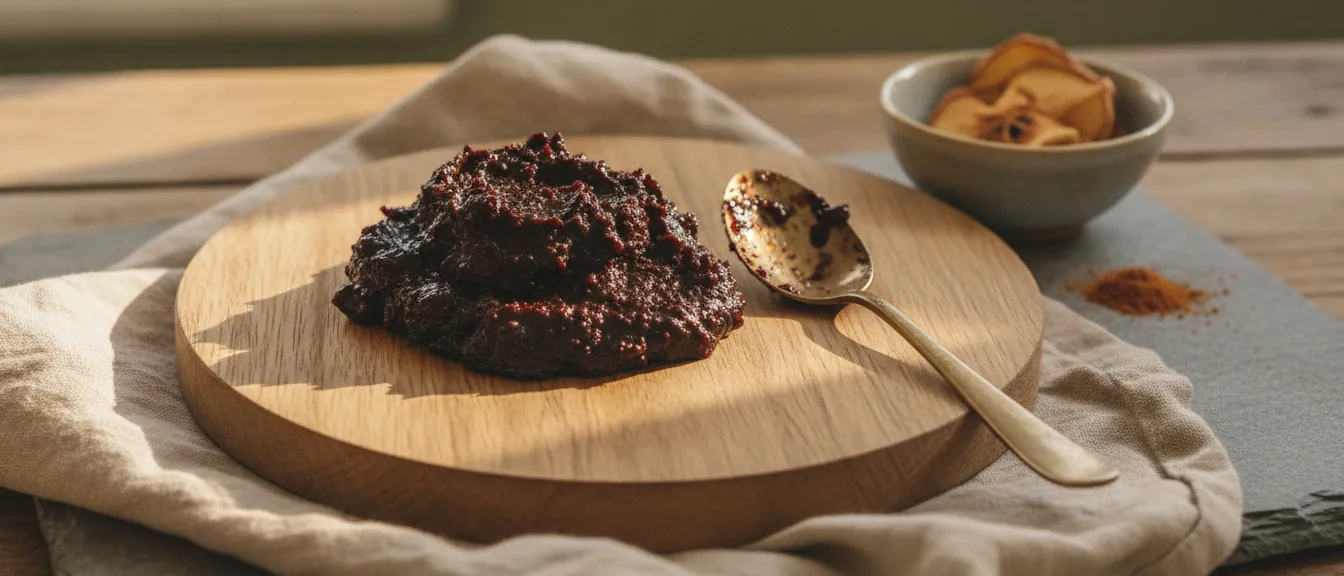
Despite the name, there is no butter here. Jersey black butter — lé nièr beurre in Jèrriais, the island's native Norman tongue — is a dense, deeply spiced apple preserve, dark as treacle and richly aromatic. The colour comes not from any added colouring but from the sheer length of time the apples are cooked down, concentrating their sugars until the whole mass turns a deep, glossy brown.
Think of it as sitting somewhere between a fruit cheese and a very thick apple butter in the American sense, though neither comparison quite captures it. The texture is smooth and spreadable, the flavour complex — sweet, warmly spiced, faintly caramelised. It is spread on bread, paired with cheese, or eaten alongside cold meats, and it keeps well.
The tradition behind it
What makes Jersey black butter genuinely distinctive is not just what it is but how it has always been made. Traditionally, the preserve was produced at communal gatherings known as black butter nights — long, sociable autumn affairs during which neighbours came together to stir vast cauldrons of apples over an open fire for many hours, sometimes through the night.
This was never a purely practical arrangement. The stirring cannot stop; the mixture must be kept moving to prevent it scorching. That necessity made it a collective task, and the collective task became an occasion — for conversation, music, storytelling, and the kind of sustained communal effort that builds and maintains community bonds. The apples were often local varieties harvested specifically for the purpose, and the spicing was a matter of household tradition rather than a fixed formula.
The scale of the operation demanded cooperation in a way that most domestic preserving does not. A single household could not easily sustain a night of continuous stirring over a large fire, manage the fuel, and still produce a worthwhile quantity. So they didn't try to do it alone.
A living tradition, not a museum piece
Black butter nights still happen in Jersey. They are not a heritage re-enactment performed for tourists but a genuine continuation of a practice that communities have kept alive through successive generations. The gatherings can run well into the early hours, and the stirring — rhythmic, necessary, oddly meditative — remains central to the whole event.
That persistence matters. Many food traditions of this kind survive only in memory or in archives. Jersey black butter survives in practice, in the smell of spiced apples over a fire and in the rhythm of a long wooden paddle against a heavy pot.
How to buy and use it
Jersey black butter is produced commercially on the island and can be found through specialist British food retailers and online suppliers, though availability outside Jersey itself varies. If you are visiting the island, it is widely stocked in local shops and markets — far more easily sourced there than anywhere else.
As a spread, it works particularly well on good sourdough or a dense wholemeal loaf. It is also a natural partner for strong, aged cheeses — the kind where a little sweetness and spice cuts through the richness. Some people use it much as they would a chutney, alongside cold cuts or a cheese board, and it handles that role well.
The jar tends to last, given both the sugar content and the extended cooking. But it rarely stays unopened for long once you have started using it.
Why it carries protected status
Jersey black butter holds a protected designation under geographical indication rules, which means that to be sold under that name, it must be produced in Jersey according to the established tradition. That protection is significant — it safeguards both the name and, to a meaningful degree, the method and origin behind it.
This is not a product that can be efficiently replicated on an industrial scale somewhere else and sold under the same name. The geographical tie is real: the tradition belongs to Jersey, the autumn gatherings are a Jersey institution, and the designation keeps it that way.