A blue that doesn't behave like one
Most people reaching for a British blue want something bold — crumbly, with heat at the back of the throat, with the sharpness of a long-established territorial tradition. Dovedale is none of those things, which is precisely what makes it worth knowing.
Made on the edges of the Peak District, its texture alone sets it apart. Where Stilton or Shropshire Blue develop a dense, close-grained paste, Dovedale stays yielding — spoonable in the way a young Gorgonzola can be, with a thin, unassertive rind. The flavour follows suit: mild, distinctly buttery, the blue veining present but measured rather than dominant. This isn't a less accomplished version of a punchier cheese. It's a different idea entirely.
Why brine changes the result
The defining technical distinction is in the salting. Most British blues are dry-salted — the curd is rubbed or packed with salt during the making process. Dovedale is brine-dipped instead: the formed cheese is submerged in a salt solution, which draws moisture to the surface more gently than hand-rubbing and contributes to the soft, open texture the cheese is known for.
That moisture retention keeps the paste pliable and encourages a mild, lactic, slightly creamy character — placing Dovedale closer in spirit to certain continental soft blues than to the robust aged territorials most shoppers already know. The blue mould, introduced by needle-piercing to let in oxygen, develops in soft pockets of curd rather than the firm channels of a harder paste, keeping it subtle.
What PDO protection means here
Dovedale holds Protected Designation of Origin status, meaning it can only be produced in a defined area and must follow a specific registered method. PDO is the stricter of the two main UK geographical food marks — stricter than Protected Geographical Indication, which allows more flexibility around ingredient sourcing and processing location. For a PDO product, the connection between place and product must be genuine and verifiable at every stage.
For Dovedale, that protection locks in a recipe and a geography that would otherwise be vulnerable to quiet erosion. When a cheese sells in relatively small volumes and is made by only a handful of producers, there is no commercial mechanism forcing consistency. The PDO provides that instead. It isn't a quality guarantee in the sense of a competition award — it's a guarantee of identity, of the specific thing you're buying when you see the name.
Britain's protected food register contains a surprising number of cheeses most shoppers have never encountered in a mainstream supermarket aisle. That isn't an accident of snobbery or obscurity. Protection is granted on the distinctiveness of a product's link to its place and method, not on sales volume. A cheese can be PDO-protected and genuinely rare at the same time — the two are not contradictory. Dovedale sits in that category, and its relative scarcity is partly what the protection exists to preserve.
Where it fits on the table
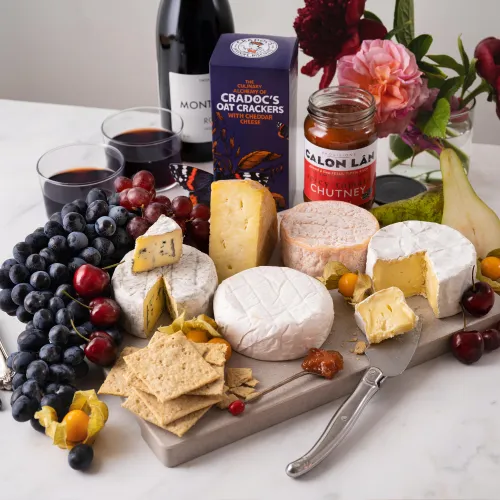
Because Dovedale is soft and mild, it suits occasions where a harder, sharper blue would overpower. It works spread rather than crumbled — on good bread or oatcakes, alongside something sweet that a more aggressive cheese would flatten. Pears, fresh figs, or a little clear honey are natural companions. The mildness also makes it an easy choice for a cheeseboard when guests are uncertain about blue cheese.
If you build a board around contrasts — a firm, tangy territorial alongside something soft and fresh — Dovedale can occupy the blue slot without dominating everything beside it. That's a more useful role than it might sound.
Finding it
Dovedale rarely appears in large supermarket chains. Specialist cheesemongers, farmers' markets in the Midlands and North, and online retailers focused on British artisan cheese are the better routes. Production volumes are small and the cheese is soft, so availability can be patchy. If a cheesemonger stocks it only occasionally, ask when the next delivery is likely — soft blues don't travel as well as hard ones, and a good monger will know exactly how a batch is ageing.
The PDO mark on the label is the most reliable piece of information on the packaging. If it says Dovedale and carries that mark, the method and origin are what they should be.