What makes a Craster kipper
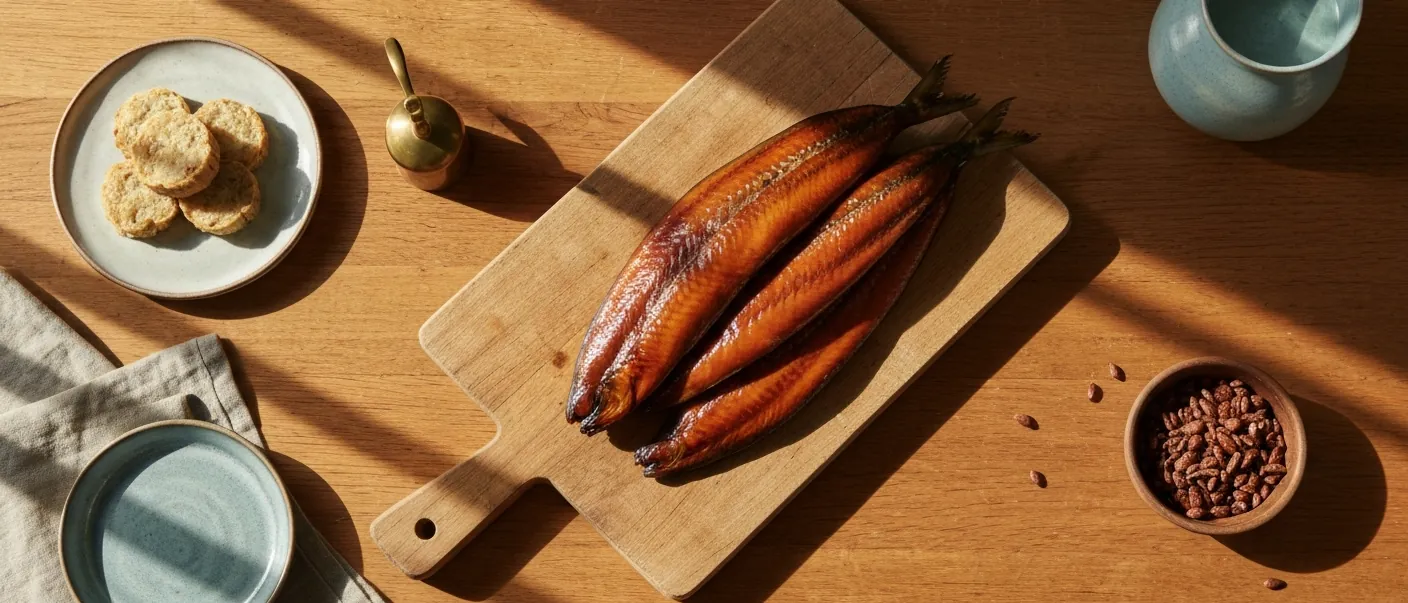
A kipper is a herring that has been split, salted, and smoked — but that plainness is deceptive. The quality of the fish, the salt cure, the wood, and the patience of the smoker all shape what ends up on the plate. At Craster, herring are cold-smoked over oak, a process that preserves rather than cooks the fish, leaving the flesh with a deep amber colour and a flavour that is savoury, rich, and faintly resinous without being aggressive. The gentleness comes from time and from knowing exactly how long to leave the fish in the smoke.
Cold-smoking is the more demanding method. The fish must sit in smoke held at a low temperature for long enough to absorb flavour and lose the right amount of moisture — but not so long that the texture suffers. No mechanical process can substitute for an experienced smoker reading the colour of the fish and the quality of the smoke coming off the oak.
The village and its smokehouse
Craster is a small fishing village on the Northumberland coast — windswept, spare, and unhurried. The smokehouse there has been in operation for over a century, run by the same family throughout. Its continued presence owes less to heritage tourism than to the fact that demand for properly smoked Craster kippers has never gone away.
The herring are landed from the North Sea, the reason so many English kipper traditions are coastal. Herring is an oily fish, which is precisely why it takes so well to smoking — the fat carries and holds the flavour of the wood in a way that leaner fish cannot.
Kippers and the British breakfast
Across the north-east, kippers have long been part of the morning meal in a way they never quite became further south. The Craster kipper sits at the centre of that tradition: bones and all, served as they come, with bread or toast to mop up the cooking juices. Butter is not incidental. A kipper grilled or gently heated and finished with a knob of good butter is the traditional way of bringing out everything the smoking process has contributed.
Beyond breakfast, kippers appear on lunch menus throughout Northumberland — flaked cold over a simple salad, or alongside scrambled eggs at a weekend brunch. The fish is versatile in the way that only something very well-flavoured can be; it asks little of what accompanies it.
Provenance and what it means
The name Craster is associated with a specific place and a specific method, and that matters in a market where smoked herring can be produced anywhere and labelled loosely. Buying from the Craster smokehouse, or from a supplier who can trace the fish there, is the only way to be certain of what you are getting. The difference between a Craster kipper and a mass-produced alternative is not subtle — it is the difference between a fish smoked slowly over real oak and one that may have spent a fraction of the time in an industrial unit, sometimes with added colour to compensate.
This is not snobbery. It is a practical point about a product where the process is the product. The smokehouse has spent generations refining something that works. Replicating the name without the method produces something else entirely.
Buying and keeping them well
Craster kippers can be ordered directly from the smokehouse and travel well — cold-smoked fish keeps reliably, and the family have been sending kippers by post for many decades. If you are on the Northumberland coast, the smokehouse sells directly. Kept refrigerated, kippers should be eaten within a few days of purchase; they also freeze without significant loss of quality, making a larger order sensible when buying from a distance.
Kipper bones are fine but plentiful, and working around them is part of eating a whole fish. Boneless kipper fillets are available for those who prefer them, though the whole fish tends to retain moisture better through smoking and subsequent cooking.