The name is younger than it sounds
Cornish Yarg has the ring of something ancient — a word from the old Cornish language, perhaps, or a fishing village. It is neither. Yarg is simply the surname of the couple who revived the recipe, Gray, written backwards. That small piece of wordplay has aged well: most people who buy the cheese assume they are picking up something with roots stretching back centuries. New traditions have to start somewhere, and this one has stuck.
What the nettles actually do
The defining feature of Cornish Yarg is the jacket. Each young cheese is wrapped by hand in stinging nettle leaves, brushed on in overlapping layers, working outward from the centre like a kind of vegetable tiling. As the cheese matures, the leaves become the site of a slow, natural rind development. Moulds colonise the leaf surface, the green darkens, and what was a collection of individual leaves becomes a continuous, edible coat with a distinctly mushroomy quality.
The rind is not merely decorative. Eating it alongside the paste changes the experience — the earthiness of the mould meets the brightness underneath, and you get contrast where a conventional waxed cheese gives you nothing but the cheese itself.
The nettles are picked in late spring, when the young leaves are at their most tender, then frozen. Freezing kills the sting entirely — the formic acid that makes a fresh nettle so unpleasant breaks down quickly at low temperatures — so the wrapping team work without gloves or gritted teeth. It also means the cheese can be made year-round from a single seasonal harvest, which is a practical rather than romantic reason for the method, but no less satisfying for that.
The paste inside
Beneath the rind, Cornish Yarg splits into two distinct zones. At the centre, the paste is fresh, crumbly and noticeably lemony — the clean acidity you associate with younger, higher-moisture cheeses. Moving outward toward the rind, a breakdown layer forms as the cheese matures: creamier, softer, closer in character to a young brie than to the crumbly interior it borders. A well-aged Yarg, cut open, shows this gradient clearly, with the prominence of that outer layer depending on how long the cheese has been kept.
This dual texture is one of the reasons Yarg tends to appeal to people who might otherwise find British territorial cheeses a little earnest. The lemony snap of the centre and the yielding creaminess of the edge make it a more varied eat than a uniform block of cheddar or red Leicester.
How to serve it
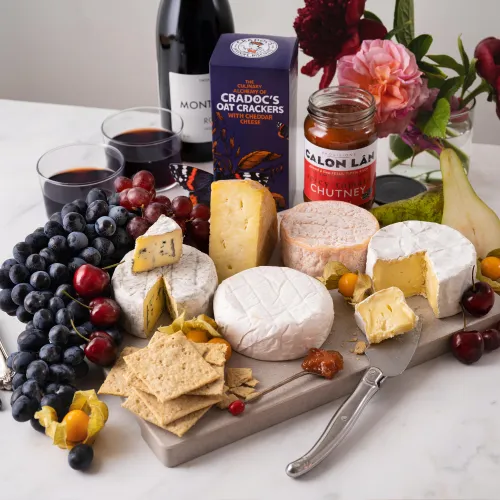
Cornish Yarg sits well on a cheeseboard where it can be seen properly — the nettle jacket is part of what you are offering, and hiding it under a dome does it no favours. Crackers with a clean, neutral flavour let the cheese lead rather than compete. Chutney made from apple or rhubarb works well with the lemon notes in the paste. Some people eat the rind, some don't; both are reasonable positions, though eating it gives you the full picture of what the cheese is doing.
The cheese appears in independent cheesemongers across Britain and in a reasonable number of supermarkets. Buying from a cheesemonger who will let you taste before you commit is worth the effort — the difference between a young, bright Yarg and a more mature, rind-forward one is significant.
Beyond the novelty
It would be easy to read Cornish Yarg as a marketing story dressed in folklore: a reversed surname, some foraged leaves, a good-looking rind. But the wrapping is not a gimmick in the sense of being non-functional. The nettles genuinely shape the rind that forms, and that rind genuinely changes the cheese. Using leaves to encourage rind development has European precedent; adapting it to a British context, with a wild ingredient that grows abundantly in hedgerows across the country, was a considered choice rather than an accident.
What Cornish Yarg demonstrates, without fanfare, is that British cheesemaking need not reach back to medieval records to produce something with character. Sometimes the tradition is made in the making.