Where the Romans ate first
The River Colne empties into the North Sea through a shallow, tidal estuary that has been producing oysters since before England was England. Roman settlers prized them so highly that shells have been found in archaeological sites across the empire — carried from Colchester to tables in Rome itself. That lineage gives Colchester a reasonable claim to being the oldest continuously worked oyster fishery in the country.
The beds that sustained those Roman appetites are still productive today, managed by a fishery whose rights stretch back through centuries of local governance. The town has never stopped harvesting them.
Native versus rock: the distinction that matters
Most oysters sold in Britain today are Pacific rock oysters, Crassostrea gigas. They grow quickly, tolerate a wider range of conditions, and are available year-round. They are very good. But they are not what Colchester is known for.
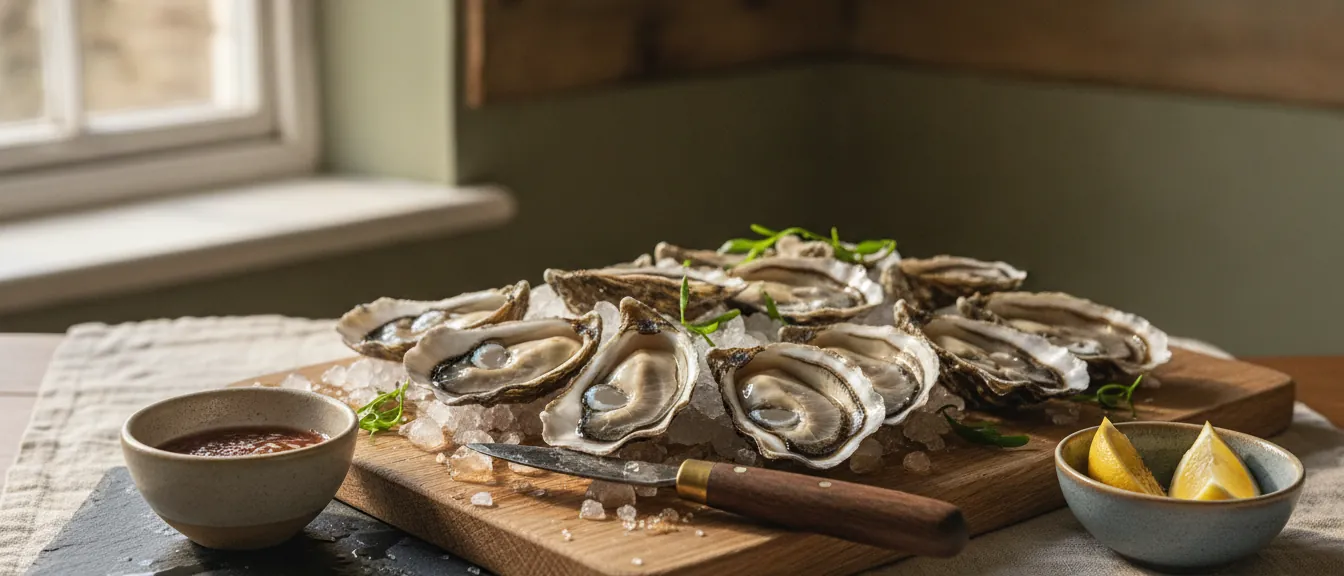
The Colchester native, Ostrea edulis, is a different creature entirely. It grows far more slowly — several years from spat to table size — in the cold, clean water of the Colne estuary. The shell is rounder and flatter than a rock oyster's characteristically rough, elongated form. The flavour is mineral-forward, with a sweetness and depth that increases as the season moves through autumn into winter.
Natives are also considerably more delicate to farm. Unlike rock oysters, which brood their larvae externally, native oysters incubate their young inside the shell — a process that takes real energy and leaves the oyster temporarily milky and soft. This is why the old guidance about eating only in months with an 'r' exists: it points, roughly, to the period after spawning when the oyster has recovered its condition. Responsible fisheries now observe a formal closed season to protect stocks and let the beds recover properly.
The civic ceremony
Colchester marks the opening of the native oyster season with a civic ceremony that reflects how seriously the town takes its connection to the fishery. The mayor and other local dignitaries traditionally take part, the first oysters of the new season are eaten, and the day is treated as a genuine occasion rather than a marketing exercise. It usually falls in early autumn — check the official programme for this year's dates, as they can vary.
The ceremony's origins are difficult to pin down, but the principle has always been consistent: to acknowledge that the oyster beds are a shared, managed resource, and that the season's opening is worth marking properly.
How they are best eaten
The traditionalist answer is raw. A freshly opened Colchester native, eaten on the shell with nothing more than a squeeze of lemon or a few drops of shallot vinegar, lets the flavour of the estuary come through without interference. The liquor — the natural seawater retained inside the shell — is part of the experience and should not be discarded.
Natives have a long history of being cooked too. Grilled briefly, or folded into a sauce, they take on a fuller, richer character that suits the colder months when the season is at its height. The aim is not to be prescriptive but to eat them fresh, from a source that can tell you when they were harvested.
Finding and buying them
The best Colchester natives are sold by fishmongers with a direct relationship to the Colne fishery, or at markets in and around Essex. Outside the region, a good fishmonger in any major city should be able to source them during the season — ask when the next delivery is due rather than buying from stock that has sat too long.
Look for tightly closed shells, or shells that close promptly when tapped, and a fresh, clean smell of the sea. Any oyster with an open shell that does not respond, or one that smells of anything other than seawater, should be left alone. These are not rules specific to natives, but they matter more when the oyster you are buying has taken several years to reach the right size.