What Carmarthen ham actually is
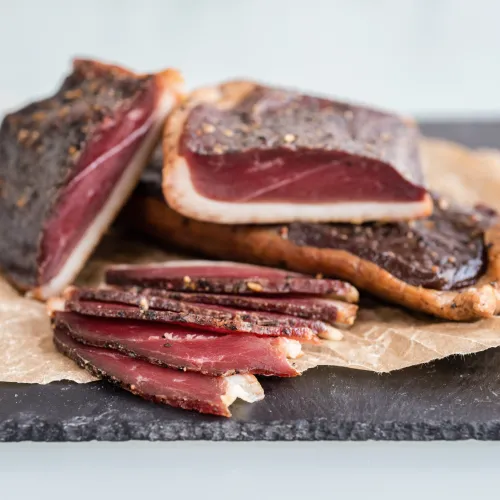
Strip away the mystique and you have something pleasingly straightforward: a whole leg of pork, salt-cured and then air-dried until the meat firms, deepens in colour, and develops the concentrated savouriness that only time and salt can produce. The result is sliced thin — translucent, almost — much as you would find a good Serrano or Bayonne ham on a continental counter. That comparison is useful, but only up to a point. Carmarthen ham has its own character: a flavour that is assertive without being aggressive, and a texture that holds a little more chew than some of its Southern European counterparts.
It carries Protected Geographical Indication (PGI) status, which means production is tied by law to defined methods and, critically, to Carmarthenshire itself. PGI does not require every ingredient to originate in the area, but it does mean the curing and air-drying must happen there. That geographical anchor preserves a method rather than simply a name.
A tradition with deep local roots
Local accounts trace the recipe back a very long way, though precisely how far is difficult to verify. What we can say with confidence is that Wales has always been good pig country. Smallholdings across the south-west kept pigs as a matter of course, and the practical need to preserve a whole animal through winter naturally encouraged salt-curing. Air-drying in the cool, damp air of Carmarthenshire may sound like an unlikely environment for cured meat — you might expect somewhere warmer and drier — but the tradition persisted, presumably because it worked.
The specific curing method is what sets Carmarthen ham apart from generic salt pork or boiled gammon. This is a dry cure, not a brine, and the drying phase is extended rather than rushed. The process demands patience and a practised eye — qualities that do not lend themselves to industrial shortcutting, which is partly why genuine Carmarthen ham remains a speciality rather than a supermarket staple.
How it differs from what you might already know
Most British cured ham ends up cooked: boiled, glazed, roasted. Carmarthen ham does not. It is eaten raw, straight from the slice, in the same way you would eat any quality air-dried ham — a fact worth stating plainly, because it catches some people off guard. The texture and salt level are calibrated for eating as-is, not as a starting point for a hot dish.
Compared to Parma or Ibérico, the flavour profile leans slightly earthier and less sweet. There is no acorn-fed heritage or mountain air involved; this is Welsh pastoral farming, and the ham tastes like it, in the best possible sense. It pairs naturally with good bread, sharp pickles, or a hard, crumbly cheese. Welsh rarebit alongside Carmarthen ham on a board is a combination that needs no further argument made for it.
Finding and buying the genuine article
Because production volumes are modest and the curing process is lengthy, Carmarthen ham rarely appears in mainstream retail. Independent Welsh food producers, specialist online delis, and farmers' markets in south-west Wales are the most reliable sources. When buying, look for the PGI mark — it is the clearest guarantee that what you are getting has been made to the defined standard in the right place, rather than being a loosely labelled imitation.
It is typically sold pre-sliced and vacuum-packed, which suits postal sales well. If you can find it freshly sliced at a deli counter, the texture is noticeably more supple before the slices have had time to dry further under packaging. Either way, bring it to room temperature before eating. Cold fat from the fridge tells you almost nothing about a cured meat's actual flavour.
Why it deserves more attention
Britain has a complicated relationship with its own charcuterie traditions. We have ceded the popular imagination to France and Italy, while quietly sitting on our own versions that have been here just as long. Carmarthen ham is a genuinely distinctive Welsh product with legal protection, a specific method, and a flavour you will not find elsewhere — yet it remains largely unknown outside a fairly narrow audience.
That obscurity is not a permanent condition. Interest in British-made charcuterie has grown steadily, and the PGI designation gives Carmarthen ham a platform that other regional British cured meats lack. For anyone who finds the continental air-dried ham section interesting, the Welsh version is worth seeking out on its own terms.