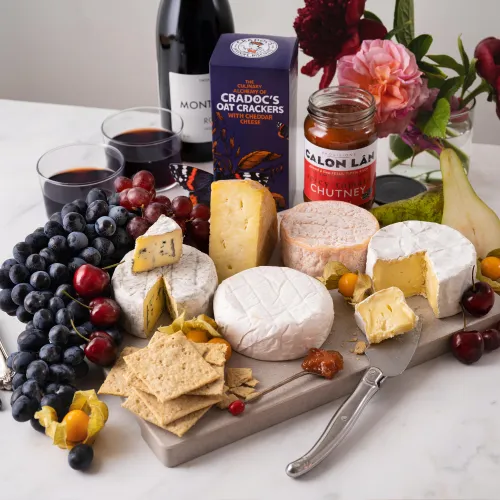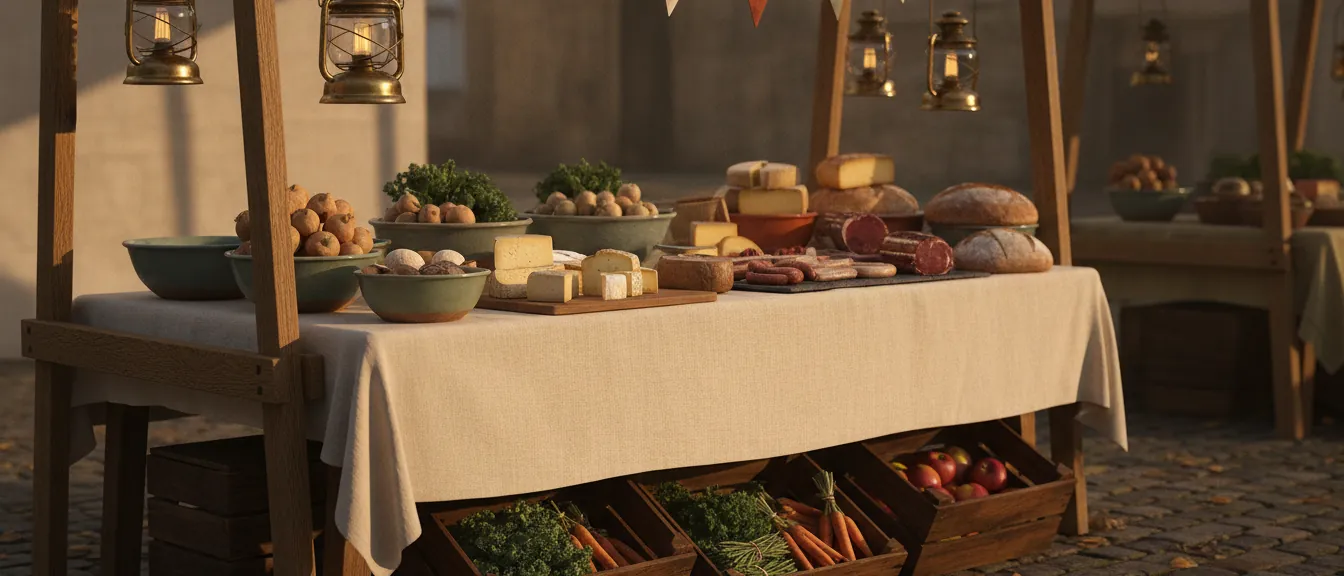
The market halls of Cardiff and Swansea
Cardiff Market and Swansea Market are the kind of covered halls that remind you what a food market is actually for. Both are working, everyday places rather than weekend events dressed up for visitors — and that distinction matters. You'll find local traders alongside fishmongers and butchers who have been supplying the same families for years. Swansea Market has a strong claim as the home of laverbread in Welsh public life: the dark, mineral-rich seaweed paste sits on deli counters alongside cockles and salt marsh lamb, a combination as specific to this part of the world as any food in Britain.
Cardiff's indoor market occupies a fine Victorian building in the city centre and pulls in a genuinely mixed crowd — locals doing the weekly shop, visitors wanting Welsh cakes hot off the griddle, and traders who have held their pitches for generations. The range is broad enough to fill a larder and specific enough to feel distinctly Welsh.
Riverside: Cardiff's farmers' market
A short walk from the city centre, the Riverside Farmers' Market operates on a different principle to the halls. It is smaller, seasonal in emphasis, and built around direct relationships between growers, producers, and the people who cook with what they buy. On a good morning you might find raw-milk cheeses, heritage-breed pork, small-batch preserves, and overnight-fermented breads. The producers are mostly Welsh, often from south-east Wales, and they tend to be on hand to talk about what they make — which is half the point of a farmers' market done well. Check the official site for current dates and hours before you go.
Abergavenny and the market town tradition
Abergavenny sits in the Usk valley at the edge of the Brecon Beacons and has the feel of a town that takes food seriously without making a performance of it. The covered market runs through the week and covers fresh produce, local meat, cheese, and baked goods. The town's rhythm — market days punctuating ordinary life rather than replacing it — distinguishes it from a food-festival destination. Abergavenny also hosts one of Wales's most prominent food events, usually held in autumn; confirm current dates on the official festival site before planning a visit around it.
The surrounding area feeds the market in the most literal sense. Black Mountains lamb, Monmouthshire soft fruit, and farmhouse cheeses from the Usk valley appear with a regularity that reflects the agricultural landscape rather than a buyer's catalogue. Shopping here feels connected to the countryside in a way that is harder to manufacture in a city.
Narberth and west Wales's food-town markets
Pembrokeshire has built a quiet reputation as one of the best places in Wales to eat and shop independently, and Narberth is a focal point. The town is small — a high street, a castle ruin, and a cluster of independent shops and food businesses that far outstrip the population. The local market draws producers from across west Wales: Pembrokeshire early potatoes (one of the few Welsh foods with protected designation status), Cardigan Bay seafood, and charcuterie and dairy from a new generation of small-scale producers who have settled in the region.
West Wales more broadly has the texture of a food destination that hasn't been over-organised. Markets here tend to feel genuinely local rather than staged, which means the range shifts with the seasons and whoever turns up. That unpredictability is a feature rather than a flaw — it's what makes returning worthwhile.
What to look for across all of them
Welsh food markets share certain qualities regardless of size or setting. Lamb is almost always present, reflecting the dominance of upland sheep farming across much of the country. Seafood — cockles, mussels, crab, and sometimes sewin (sea trout) — appears wherever there is proximity to the coast or major estuaries. Laverbread, bara brith, Welsh cakes, and farmhouse cheeses from both cow's and sheep's milk are regular features, as are a growing number of producers working with older Welsh grain varieties and fermentation traditions.
The practical advice is simple: go on a market day rather than a Saturday when the main footfall is from out of town, arrive early for the pick of the fresh produce, and talk to the traders. The knowledge behind a well-stocked Welsh market stall is often extraordinary — and usually offered freely to anyone who asks.
_9e2b-71_pngq80.webp)