The word 'farmers' is doing a lot of work
Walk through most town centres on a weekend and you'll find stalls selling olives, street food, imported cheeses and mass-produced jam alongside someone who actually grew the carrots. All of it might be labelled a farmers' market. Some of it is, some of it isn't, and the difference matters if you're trying to shorten the distance between field and fork.
A genuine farmers' market operates on a producer-only principle: the person behind the stall grew the vegetables, reared the animals, baked the bread or made the preserve themselves. They are not a middleman, reseller or wholesaler who has bought in stock and repackaged it. When you pick up a bunch of kale and ask about it, the person answering you planted it. That direct accountability is the whole point.
Radius rules and what they mean
Many certified or well-run markets go further than the producer-only rule by adding a geographical limit — often called a radius rule. This typically caps how far a stallholder can travel from their farm or production site, keeping the market genuinely local rather than national in all but name.
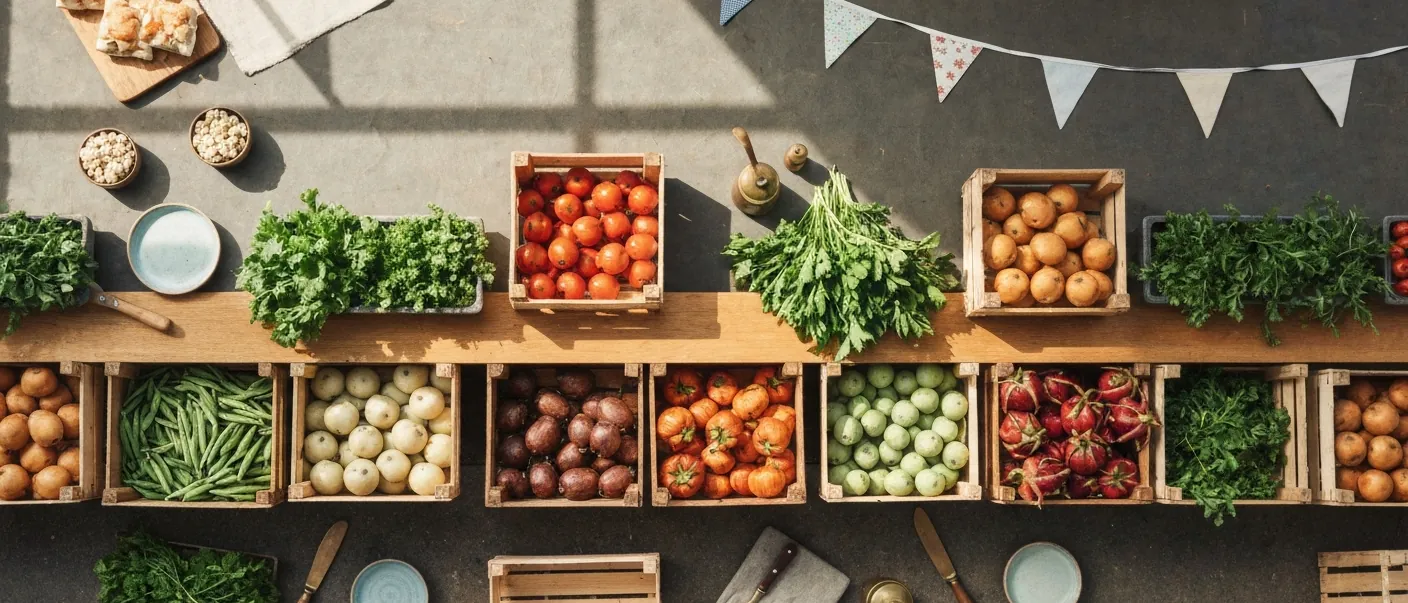
The practical effect is that produce shifts with the seasons and with the landscape. A market in coastal Suffolk will look different from one in upland Derbyshire. What you buy reflects where you actually are, not a homogenised selection drawn from across the country.
Contrast this with a general street market, which may be excellent in its own right but operates under no such restrictions. A street market stall might sell beautiful things; it simply isn't bound by the same principles of provenance and direct production. Neither format is dishonest — but they're answering different questions.
How certification works in practice
In the UK, FARMA — the National Farmers' Retail and Markets Association — provides a certification scheme that gives consumers a degree of confidence. A FARMA-certified market has been assessed against defined criteria, including the producer-only rule. Certification is a useful starting point, not a guarantee of everything. Some good markets run on the same principles without formal accreditation; some certified markets are better managed than others.
If a market displays no certification, the most direct approach is to ask the stallholder where they're based and whether they made or grew what they're selling. Most genuine producers are glad to talk about it. Anyone evasive about basic provenance is worth treating with caution.
What you actually get when you buy direct
The practical advantages go beyond knowing your money reaches the grower. Produce sold at a farmers' market is typically harvested closer to the point of sale than supermarket equivalents, which means it can be picked at a more appropriate stage of ripeness rather than engineered to survive a long cold chain. Soft fruit, in particular, is a different experience when it hasn't spent days in refrigerated transit.
Producers often bring cuts, varieties and grades that never reach retail — misshapen tomatoes that taste exactly right, lesser-known apple varieties bred for flavour rather than shelf life, mutton that large retailers rarely stock because the market for it isn't big enough. Farmers' markets are frequently where you find things the mainstream trade has quietly dropped.
Buying direct also opens a conversation. If you want to know how the pigs were kept, whether the flour is stoneground, or when the cheese was made, you're talking to the person who can actually tell you. That knowledge is built into the transaction in a way that a supermarket shelf simply cannot replicate.
Finding one worth the trip
FARMA's website maintains a directory of certified markets across the UK, searchable by location — that's the most reliable starting point. Local food networks, county agricultural societies and council websites often list additional markets, certified or otherwise.
The signs of a well-run market are fairly consistent: stalls where the producer is present and knowledgeable, clear labelling of farm or production site, and a range that shifts month to month with the season. A stall selling the same imported tropical fruit every week, year-round, at a market claiming to be local should prompt a question or two.
Most producers running honest stalls will make their provenance obvious without being asked. It's simply worth knowing what to look for before you go.