A county shaped by its land
Wiltshire sits in the South West of England, a county of chalk downland, river valleys and open farmland. That geography shaped its food heritage directly: pigs were kept here in large numbers, fed cheaply on surplus whey from dairy farms. The county built a serious tradition around cured pork at a time when preserving meat was a practical necessity, and the result was a curing method distinctive enough to carry Wiltshire's name across the whole of Britain.
The Wiltshire cure
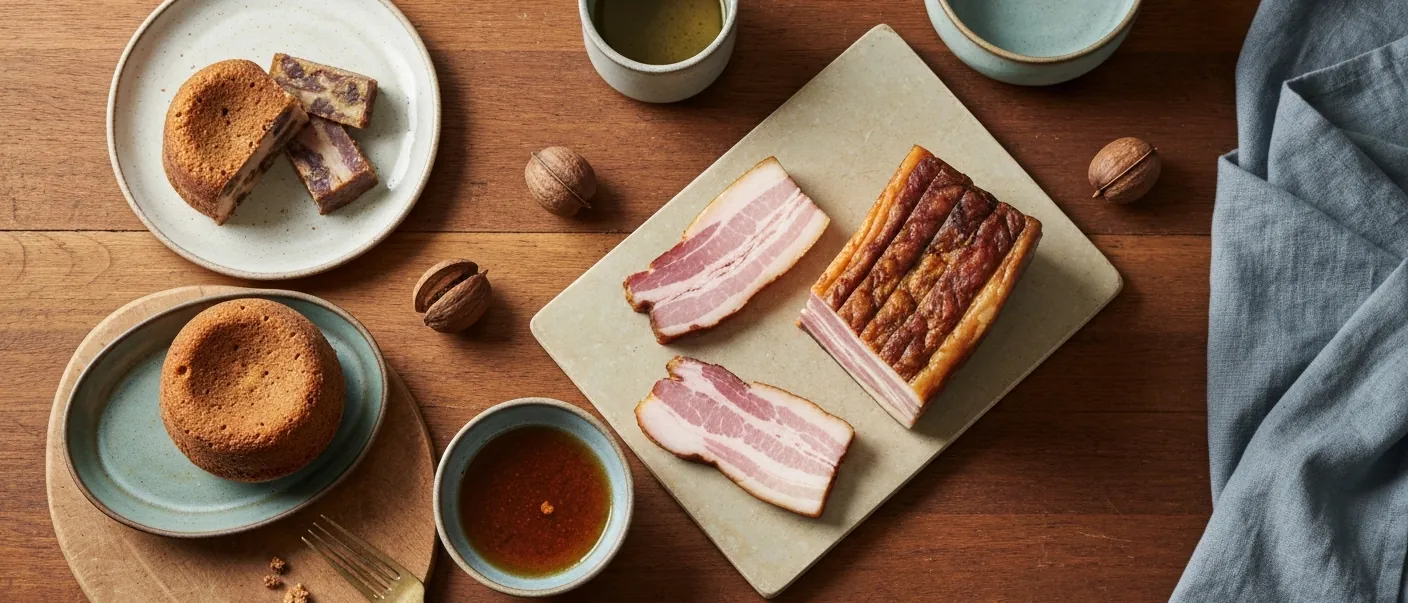
The Wiltshire cure is a specific method of curing bacon and ham that became the dominant technique in British commercial pork production. Where older methods dry-rubbed salt into the surface, the Wiltshire cure submerges the whole side of pork in a brine solution for an extended period. The cure penetrates slowly and evenly, producing bacon that is milder, less aggressively salty, and longer-lasting than most dry-cured alternatives.
Its influence came as much from efficiency as from flavour. A single brine could be used repeatedly, with the curer topping it up and managing it carefully over time. That mature brine — sometimes called the mother — was thought to carry flavour from one batch into the next, and traditional facilities would maintain the same brine for years.
As Britain industrialised, the technique spread well beyond the county. For much of the twentieth century it was simply how back bacon was made in this country, the name persisting even as production moved elsewhere. Smaller producers with genuine connections to Wiltshire have since returned to it as a point of craft pride.
Lardy cake
Wiltshire also has a strong claim on lardy cake, though several counties will argue the point. It is an enriched bread dough baked with layers of lard, sugar and dried fruit folded through it — heavy, sticky on its base where the lard caramelises in the tin, and deeply caloric in a way that makes sense when you consider the agricultural labourers it was made to feed.
The Wiltshire version is generally held to be among the most traditional, made without the spices other regional variants sometimes include. The texture sits between bread and pastry: the crumb retains some structure, but the fat renders through during baking so each piece is dense and glossy. It is usually eaten at room temperature, cut into squares, needing nothing beyond a cup of strong tea.
Lardy cake was bakers' food in the practical sense — a way of using lard that butchers and bakers had in quantity, combined with dried fruit that kept well in a larder. It was never fancy, and that is the point.
Market towns and what they kept alive
Marlborough and Devizes are two of Wiltshire's most significant market towns, and their weekly markets have historically been the mechanism by which local producers reached local buyers. Markets of this kind kept regional food traditions visible and commercially viable when larger distribution networks might otherwise have swept them aside.
Devizes sits at a geographical crossroads that made it a natural trading point, drawing producers from across the county. Marlborough, with its unusually wide high street designed to accommodate market stalls, still holds regular markets rooted in the county's agricultural output. The relationship between these towns and their surrounding farmland is easy to underestimate: a strong local market means a farmer can sell properly cured bacon or a batch of lardy cakes without needing a national retailer, and that commercial independence is often what keeps traditional methods alive across generations.
What connects it all
Wiltshire's food identity is not built on luxury ingredients or restaurant culture. It comes from a farming county that learned to preserve, to bake with what was available, and to trade through towns that still function as food markets. The Wiltshire cure spread because it worked. Lardy cake survived because it was good and genuinely useful. That pragmatic thread runs through the county's food history and is what makes it worth understanding.