One tin, many traditions
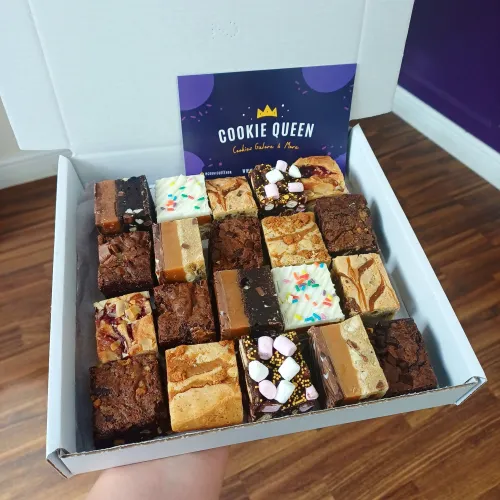
The defining logic of a traybake is simple: everything goes into a single tin, bakes or sets, and is cut into portions afterwards. No piping, no layers to assemble, no fiddly decoration. What sounds like a shortcut has produced some of the most beloved things on the British café counter — flapjacks dense with golden syrup, brownies that walk the line between cake and confection, lemon drizzle fingers with a crust that crackles when you bite through it.
A traybake travels well, portions predictably, and survives a cake tin for days. These are practical virtues, and British baking has always respected the practical.
From church hall to café shelf
Traybakes have long been the backbone of the church sale and the village fête, where a baker needs to feed thirty people without producing thirty individual cakes. The sturdy, sliceable format also makes them suited to posting — a tradition of care packages and gifts by post that predates online food gifting by generations.
The café counter gave traybakes a more permanent home. Walk into almost any independent café in Britain and you will find at least three or four: a rocky road studded with biscuit and marshmallow, a Bakewell slice with its frangipane and icing, perhaps a tiffin — that no-bake mixture of cocoa, syrup, biscuit and dried fruit pressed cold into a tin. They sit at room temperature, need no fork, and hold their shape through a lunchtime rush. For café owners, that reliability matters.
Scotland and the shortbread question
Millionaire's shortbread has become so ubiquitous it is easy to forget it has a geography. Its roots are Scottish: the base is proper shortbread, buttery and crumbly, topped with thick caramel and finished with chocolate. The same thing appears on some menus as caramel shortcake, the names used interchangeably depending on where you are.
What makes it distinctly Scottish, beyond its origin, is the seriousness with which the shortbread base is treated. Elsewhere, biscuit bases can be an afterthought — crushed digestives pressed flat. In a good millionaire's shortbread, the base is baked separately before the caramel goes on, with the same care given to a proper shortbread round.
Northern Ireland's particular devotion
No part of Britain takes traybakes quite as seriously as Northern Ireland, where they appear at almost every social occasion and the repertoire runs deeper than most visitors expect. Fifteens — a no-bake traybake made from digestive biscuits, marshmallows and glacé cherries, rolled in desiccated coconut — are the most distinctively Northern Irish of all. The name comes from the quantities: fifteen of each main ingredient. No oven, no melted chocolate, no caramel; the mixture is rolled into a log, chilled and sliced. The result is pink-flecked, bouncy and intensely sweet in the way that genuinely regional baking tends to be — not designed for a national audience, just made the way it has always been made.
Northern Ireland's traybake culture seems rooted in the same values that underpin its broader food traditions: home baking as hospitality, the idea that arriving somewhere with a tin of something you have made yourself is a form of welcome that shop-bought cake cannot replicate.
What makes a traybake worth eating
The flapjack is perhaps the most revealing test. At its worst — individually wrapped at a petrol station — it is dry, aggressively sweet and held together with what tastes like ambition alone. Made properly, with good oats and enough butter and syrup to keep it chewy rather than crumbly, it is one of the finest things to eat alongside a strong cup of tea.
The gap between a mediocre traybake and a good one comes down to the quality of a few key ingredients and the confidence not to overcomplicate them. Brownies illustrate this well: the best use real chocolate rather than cocoa powder alone, and are pulled from the oven while the centre still looks slightly underdone. The result is dense and fudgy rather than cakey — a distinction that sounds small and tastes enormous.
Britain's independent bakers and café owners are keeping these distinctions alive, much as regional bakeries keep particular bread traditions going. A tiffin or a Bakewell slice made with care in a small kitchen is a genuinely different thing from its mass-produced equivalent, and the café counter — still, in most towns — is the best place to find one.