A word that travels badly
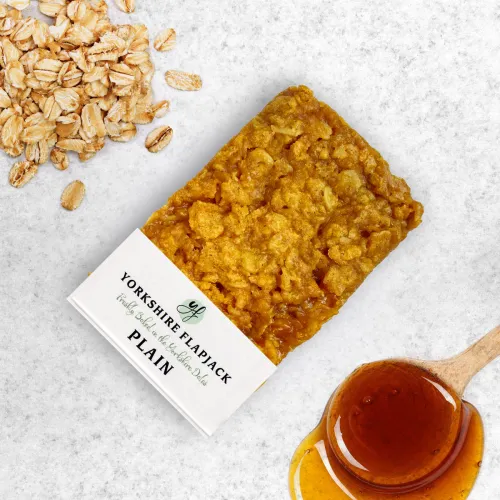
Order a flapjack in a British café and you'll receive a dense, golden bar of baked oats. Order one in a diner in Vermont and a stack of pancakes will arrive. The word is the same; the food could not be more different. For anyone searching online, that confusion is worth clearing up immediately: this article is about the British flapjack — the oat bar, baked in a tin, cut into rectangles, carried in a lunchbox or posted across the country as a gift.
Why the same word drifted so far apart is one of those linguistic puzzles that food history rarely resolves neatly. What we can say is that in British English the meaning has been settled for generations, and it has nothing to do with batter or griddles.
What actually goes into one
At its simplest, a flapjack is four ingredients: rolled oats, butter, sugar, and golden syrup. The golden syrup is the ingredient that makes the British version what it is. That thick, amber sugar syrup — a by-product of refining cane sugar — carries a low, buttery toffee note that plain sugar cannot replicate. It also acts as a binder, holding the oats together as the mixture bakes and then firms on cooling.
The ratio of syrup to oats, and the length of time in the oven, determines whether you end up with something chewy or something that snaps. More syrup and a shorter bake keeps the bar soft and yielding in the middle; less syrup and a longer bake drives out the moisture and produces a crunchier, more biscuit-like result. Neither is wrong — they're just different preferences, fiercely held.
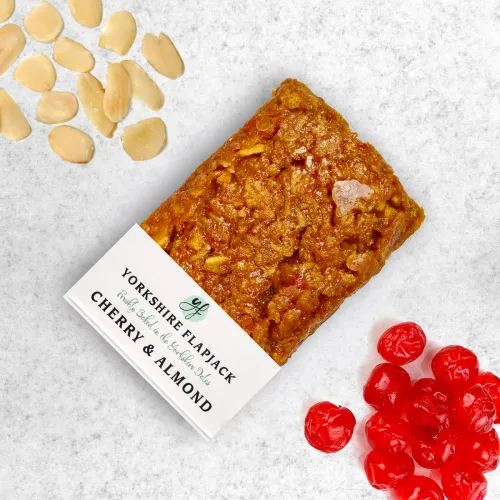
Beyond the base recipe, makers diverge widely. Dried fruit — raisins, cranberries, apricot — adds acidity and sweetness. Seeds bring texture and nuttiness. A layer of dark chocolate on top is common enough to feel almost traditional now, though it is clearly an addition rather than a founding ingredient. The oat bar is an accommodating canvas.
Oats, gluten, and what the label tells you
Oats are not wheat. The grain itself contains no gluten, which makes flapjacks a frequent choice for people avoiding wheat flour. However — and this matters — standard commercially milled oats are routinely processed in facilities that also handle wheat, barley, or rye, meaning cross-contamination is widespread in the industry. Flapjacks made with standard oats cannot be assumed to be gluten-free, whatever their ingredient list says. Dedicated gluten-free oats, milled in segregated facilities, exist specifically to address this, and any flapjack labelled gluten-free should use them. If you are buying for someone with a sensitivity or coeliac diagnosis, the label needs to say gluten-free explicitly — the presence of oats alone tells you nothing about the production environment.
For anyone with a diagnosed allergy or medical condition, the NHS and the Food Standards Agency are the right places to check guidance, not a food article.
Why they keep and travel so well
One of the flapjack's practical virtues is longevity. The low moisture content of a properly baked bar means it stores well in an airtight tin for well over a week without going stale. This is partly why flapjacks became a staple of school bake sales and village fêtes — they can be made days in advance without losing quality.
It also makes them one of the more reliable things to post. A securely wrapped flapjack arrives in much the same condition it left, which cannot be said of most home baking. Small producers across Britain have worked this out, and the flapjack has become a mainstay of artisan postal hampers and gift boxes, often with regional twists — Welsh oat varieties, Scottish heather honey in place of some of the syrup, Cornish sea salt scattered on top.
What to look for when you're buying
The difference between a good flapjack and an indifferent one is usually in the oats and the syrup. Cheap bars can taste flat and waxy; the oat flavour disappears behind an excess of refined sugar. A well-made flapjack should taste of the oat itself — slightly nutty, slightly grassy — with the syrup providing depth rather than pure sweetness.
Texture is a matter of taste, but structural integrity is not. A good flapjack holds together when you pick it up. If it crumbles into dust, it has either been baked too long or the syrup ratio is wrong. If it sticks to the wrapper and feels wet, the opposite problem applies.
Independent bakers tend to put more butter and better syrup in than mass-produced versions, and you can usually taste the difference. It is one of those products where paying a little more typically means getting something that tastes like the real thing rather than a simulation of it.