A county with serious food credentials
Suffolk tends not to shout about itself, which is part of why its food culture remains so intact. The farming land is rich, the coastline is still working rather than merely scenic, and several of its specialities carry formal protected status — the kind that comes from making something correctly, in a particular place, for a very long time.
That combination of agricultural depth and coastal access gives Suffolk an unusual range. You can move in a single day from a butcher's counter selling properly cured local ham to a fish hut on a shingle beach where the catch arrived that morning. Not many English counties can say the same.
Newmarket sausages and the meaning of PGI
The most formally protected of Suffolk's food specialities is the Newmarket sausage, which holds Protected Geographical Indication status — the same designation that covers Champagne and Parma ham. Only sausages made to a specific recipe within Newmarket itself can carry the name.
It is a coarse-cut pork sausage, typically made with a higher meat content than a standard British banger and seasoned simply, without the rusk-heavy padding that defines cheaper versions. The flavour is clean and distinctly porky. Its association with Newmarket almost certainly reflects the town's long connection to horse racing and the appetite of stable workers and trainers who needed something substantial. The sausage has outlasted any single era of the town's history and is now one of the county's most recognisable food exports.
Suffolk cure and the art of the ham
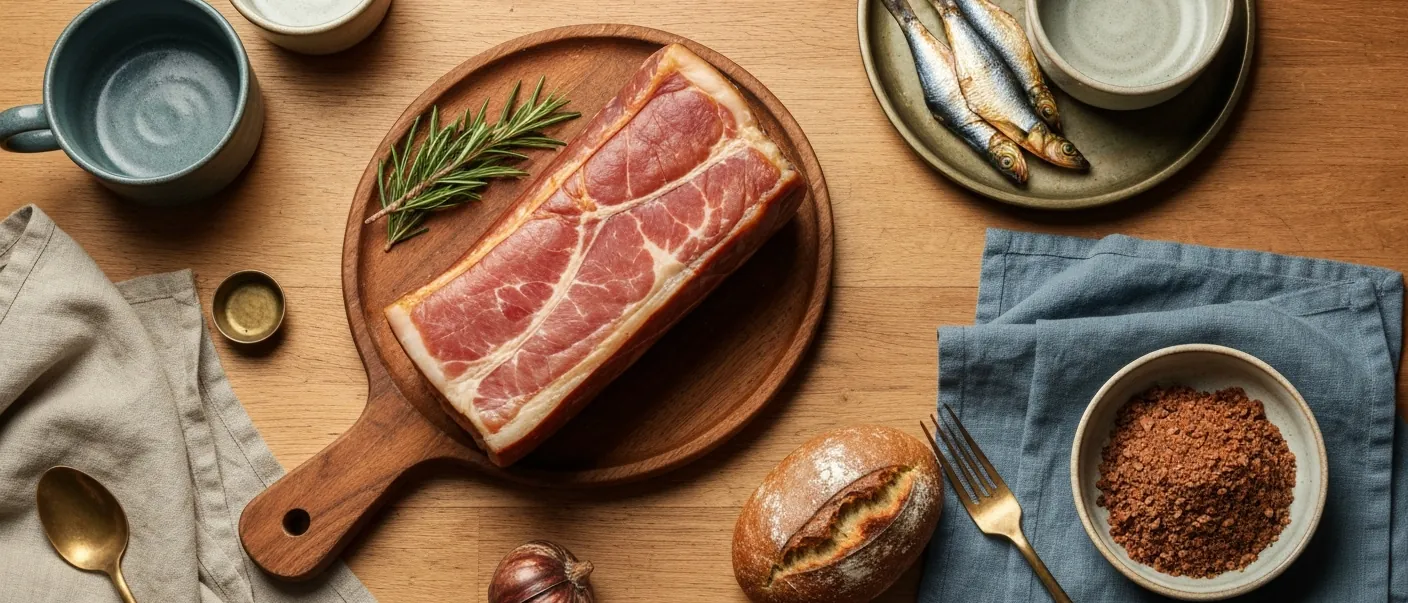
Less formally protected but arguably more deeply embedded in Suffolk's food identity is the Suffolk cure — a method of curing pork, particularly hams and bacon, that traditionally involved immersing the meat in a sweet brine based on stout, treacle or molasses. The result is a ham with a dark, glossy rind and a flavour that sits somewhere between savoury and gently sweet, with none of the aggressiveness of a salt-heavy cure.
The tradition has thinned out over the decades, but a handful of producers still work to it. Finding one is worth the effort. Eaten cold in thick slices, the ham needs nothing beyond good bread.
Aldeburgh and the fish huts
The Suffolk coast is one of the few stretches of English shoreline where you can still buy fish directly from the boats that caught it. Nowhere makes that more vivid than Aldeburgh, where fish huts at the top of the shingle beach sell whatever came in — typically cod, sole, herring and sprats depending on season, along with smoked haddock and kippers from nearby smokehouses.
There is no theatre to it. The huts are functional, queues form early on weekend mornings, and fish is priced according to what it costs to land rather than what the tourist market might bear. Smoked sprats from this stretch of coast have a particular intensity — cold smoke and small, oily fish combining in a way that rewards anyone willing to approach them without prejudice.
Southwold and Snape: brewing and beyond
Adnams has shaped Southwold's identity for well over a century. Their beers — particularly the bitters — and more recently their spirits are brewed using water drawn from local sources. The brewery has long positioned itself as part of the Suffolk landscape rather than apart from it. Walking into Southwold without encountering Adnams in some form takes a deliberate effort.
A few miles inland, Snape — best known for the Maltings concert hall — has developed a quieter but increasingly serious food scene around its converted agricultural buildings. The complex draws producers, food events and independent retailers to a site that still carries the grain-and-industry atmosphere of its working past. Check what is on before visiting, as the food offering shifts across the seasons.
How these specialities connect
What runs through Suffolk's food is a preference for the direct and unfussy. The sausages are made to a tight local specification. The hams use traditional curing methods rather than shortcuts. The fish is sold where it was landed. Even Adnams, for all its growth, remains rooted in a single small coastal town.
Suffolk has not reinvented its food identity for trend cycles — it has maintained it, which is a harder thing to do.