A deceptively simple thing
The Scotch egg asks very little of its maker and forgives almost nothing. Sausage meat, a boiled egg, breadcrumbs, hot oil. Four components, no hiding place. The versions that have given it a bad name — pale, rubbery, cold, wrapped in cling film — aren't bad because the idea is flawed. They're bad because each of those four things was done badly, or done days in advance, or both.
Getting it right is less about technique than about caring at each small step — which is, of course, the harder thing to ask of a motorway forecourt.
The sausage meat question
The meat layer is where most of the flavour lives, and it's where the difference between a good Scotch egg and a forgettable one is most obvious. Seasoned pork sausage meat — properly seasoned, with enough fat to stay yielding after frying — should taste like something in its own right. Not a neutral wrapper. Makers worth their salt often work in a small amount of mustard or mace, or use a house blend of pork cuts that gives the finished layer a coarser, more interesting texture than the homogenous paste found in commercial versions.
Thickness matters too. Too thin and the egg dominates; too thick and you lose the ratio that makes each mouthful work. A well-judged layer holds the egg without smothering it.
The yolk is not negotiable
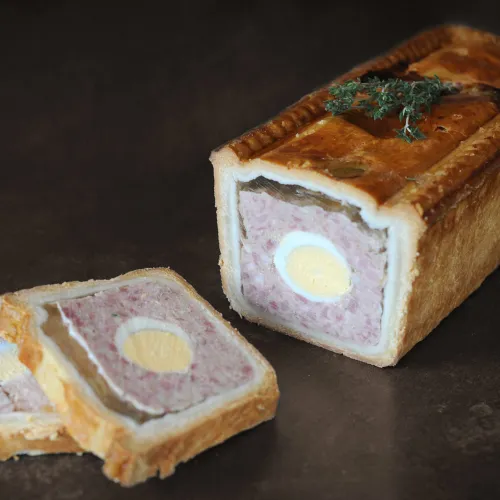
This is the point on which serious Scotch egg makers are least willing to compromise. A fully hard-boiled yolk — dry, grey-edged, chalky — is not a proper Scotch egg. The target is a yolk just set at the centre, ideally with a slight softness or even the faintest jammy give. Achieving this while cooking the surrounding meat through entirely is the one genuinely difficult thing about making a Scotch egg well.
It requires careful timing and a consistent oil temperature. Too hot and the meat browns before the egg has done anything; too cool and the egg overcooks while the meat struggles to colour. There is no shortcut, which is why fried to order is such a meaningful phrase. It means someone is paying attention.
Real breadcrumbs, properly applied
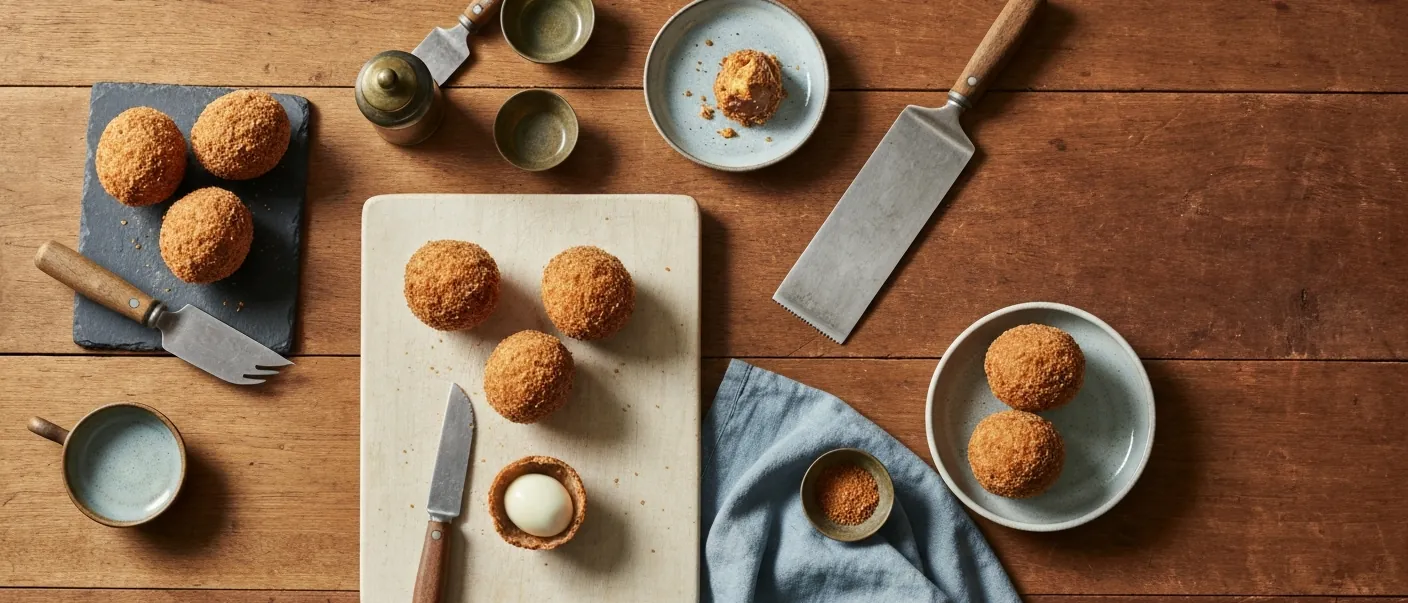
The crust should shatter slightly when you bite through it, then give way cleanly. That texture comes from proper dried breadcrumbs — ideally made from good bread with some structure — rather than the ultra-fine commercial alternative, which tends to fry into a smooth, flavourless shell.
Application matters as much as the crumb itself. A thin, uneven coating will blister and gap in the oil; a thick, compressed one turns stodgy. The best versions have a crust that is golden and audibly crisp, with enough substance to carry some of the oil's heat and flavour through to the meat beneath.
How the Scotch egg came back
The Scotch egg never disappeared entirely, but for a long time it existed almost exclusively as a convenience food — sealed in plastic at a service station or stacked in supermarket chiller cabinets, bought out of mild desperation rather than genuine appetite. Its rehabilitation as serious bar food came through London pub kitchens deciding that British classics deserved the same attention being paid to everything else on the menu. The result was a Scotch egg served warm, freshly fried, cut in half so the yolk was visible — a small piece of theatre that also made a practical point about what had gone into it.
That approach spread. It is now possible to find a genuinely good Scotch egg in pub kitchens, at farmers' markets, and from independent charcutiers and butchers who treat it as a showcase for their sausage-making rather than an afterthought. The service-station version still exists. It no longer defines what the thing is.
How it's traditionally eaten
Warm, halved, with a decent mustard alongside — English or wholegrain, depending on preference. Cold, it works as part of a proper picnic spread, where the firmness of a rested egg is less of a problem and other components on the plate provide contrast. What it doesn't need is elaborate adornment. A Scotch egg that requires fussy accompaniment is usually one that isn't quite good enough on its own.