A different grain altogether
Pick up a bag of rye flour and it looks, at a glance, much like any other wholegrain flour. Tip it into a bowl with water, though, and the resemblance ends. Where wheat dough pulls and stretches, rye paste sits there — sticky, dense, almost reluctant. Rye contains very little of the protein that forms gluten. Instead, it is loaded with pentosans: complex gums that soak up water and hold it, giving rye dough its particular, almost porridge-like character.
This affects everything. It is why you will never shape a rye loaf the way a baker shapes a baguette, why tins are used rather than free-form scoring, and why the crumb stays moist long after a wheat loaf has dried to a doorstep. The pentosans that make rye sticky in the bowl are the same ones that make rye bread keep for a week on the counter without going stale.
Why the sour is structural, not optional
Rye carries a high level of amylase enzymes that break starch down aggressively when the dough heats up. Left unchecked, those enzymes keep working as the loaf goes into the oven, degrading the starch structure before it can set. The result is a gummy, collapsed interior that no amount of extra baking will rescue.
Acidity suppresses those enzymes. A well-maintained sourdough starter produces lactic and acetic acids during fermentation, and that drop in pH holds the amylases in check long enough for the loaf to bake through properly. This is why virtually every traditional rye bread — from a light deli loaf to a dense Scandinavian or Eastern European-style slab — is made with a sour starter rather than commercial yeast alone. It is not a nod to fashion. It is the only reliable way to get a rye loaf that does not collapse.
The high pentosan content of rye flour makes it particularly good at feeding the bacteria responsible for acidity, which is why bakers who specialise in rye often maintain a dedicated rye starter alongside a wheat one. The same principles that govern any live-culture leaven apply here — see our sourdough and long fermentation articles for the underlying mechanics.
Light rye to dark: what the spectrum means
Most rye bread sold in Britain sits somewhere along a spectrum from lightly flavoured to deeply assertive. A loaf sold as light rye may contain only a modest proportion of rye flour blended into a predominantly wheat dough — enough for a gentle tang and a slightly denser crumb, but still recognisably a sandwich loaf in texture. These breads are often leavened with a combination of sourdough starter and commercial yeast.
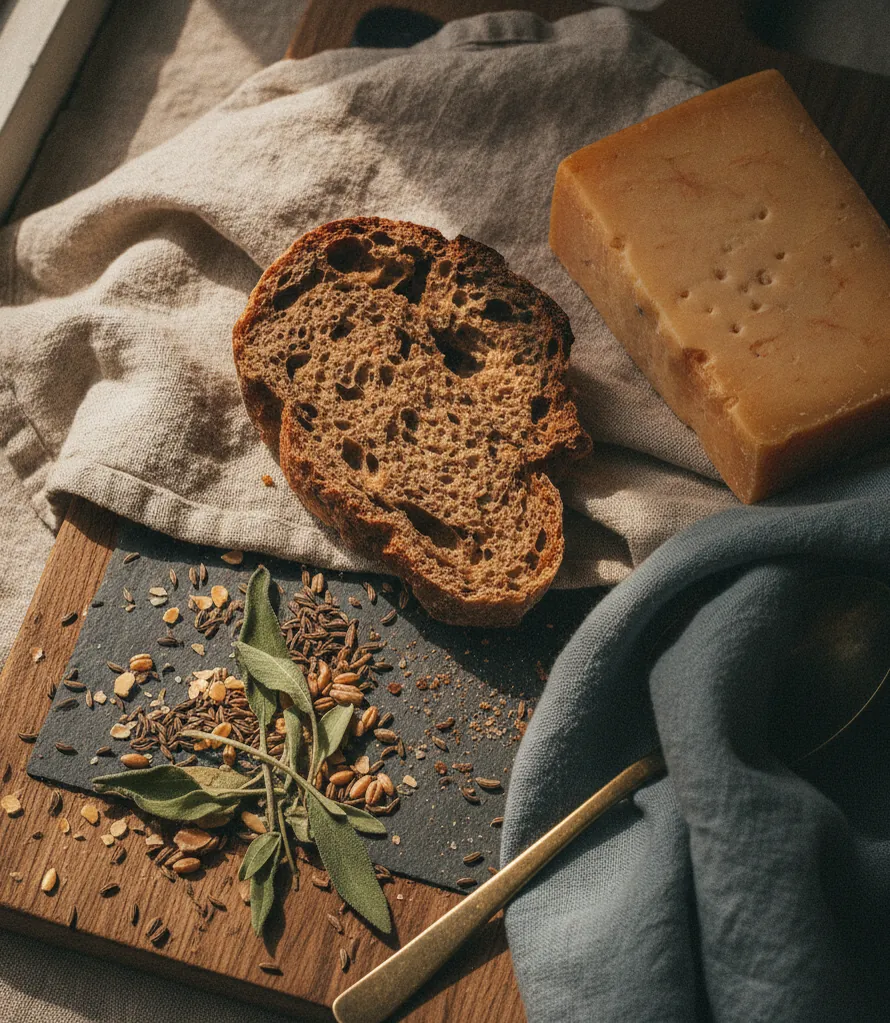
A whole-grain rye or 100% rye loaf is a different proposition altogether. The crumb is tight and moist, the crust firm, and the flavour complex in a way that deepens over time. These loaves are baked in tins, and the structure they rely on is almost entirely the pentosan network rather than any gluten framework.
The most concentrated rye breads — made from a high proportion of whole-grain rye with a long, cold fermentation — need to rest for a full day after baking before they are sliced. This allows the crumb to firm and stabilise. Cut too early and the interior will be gummy regardless of how well the loaf was made. Patience here is part of the process, not a suggestion.
Keeping quality and storage
A good rye loaf keeps in a way a white tin loaf simply does not. The pentosan structure that retains water during baking continues to hold moisture in the finished crumb, slowing staling considerably. A whole-grain rye loaf sliced on day two will often be at its best on day four, and still good a week after baking if kept wrapped at room temperature.
The acidity from the long sour also plays a role. A lower-pH crumb is a less hospitable environment for mould — which is partly why traditional rye breads were practical in households without refrigeration, and why some styles were baked in large quantities to last a week or more.
A cloth or paper wrap is better than a sealed plastic bag, which traps condensation and softens the crust. Rye bread also freezes well — slice it first, and individual pieces can go straight from the freezer to a toaster or a cool room.