Clean water, patient evaporation
Every grain of British sea salt begins as seawater. That sounds obvious until you consider how much depends on the quality of what comes in with the tide. Producers from Anglesey in the north-west to the Essex marshes in the south-east are farming a liquid: drawing in clean Atlantic or North Sea water and coaxing out the moisture until salt crystals remain.
The mechanics of evaporation vary by site and season. Some operations rely almost entirely on wind and sun working across wide, shallow pans — slow, weather-dependent, and sensitive to the mineral character of a local stretch of coast. Others introduce controlled heat to extend production beyond the warmer months. What they share is the core principle: concentrate the brine, encourage crystal growth, harvest carefully, dry gently. Interfere too aggressively at any stage and you alter the crystal structure, which changes how the salt performs in food.
Why Maldon matters to the story
The Essex town of Maldon is the name most British cooks reach for first, and its long association with salt production is genuinely rooted in the landscape. The Blackwater estuary provides clean, mineral-rich water, and the flat marshland around it has supported salt-making for centuries. The distinctive hollow, pyramid-shaped flake Maldon is known for is a direct consequence of how crystals grow when brine is heated slowly in open pans — the flake forms at the surface and is raked off by hand before it sinks and compacts. It is a fragile thing, which is precisely the point.
This is not simply heritage brand recognition. It anchors an important point: British sea salt production has never been a single, uniform industry. Different estuaries, different evaporation methods, and different local climates produce salts with genuinely distinct textures and mineral profiles. The revival of small-scale coastal salt-making across the British Isles has made that variety far more visible to ordinary shoppers.
Flake, fine and rock: not interchangeable
The three main forms of salt behave differently in the kitchen because their physical structures differ — not because of marketing.
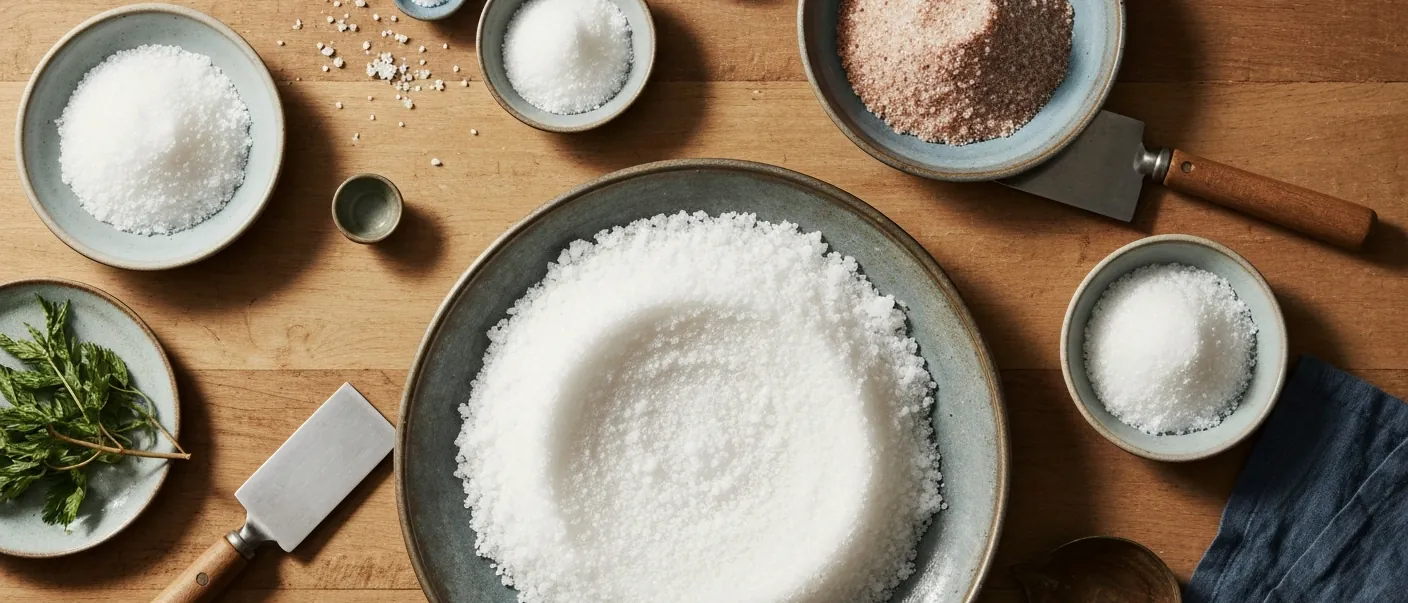
- Flake salt is made by surface evaporation in open pans. The crystals are large, irregular, and hollow or pyramid-shaped, dissolving quickly on contact with food and the tongue. Their low density means a pinch by volume contains less sodium by weight than the same volume of fine salt — worth knowing if you season by feel rather than by weight.
- Fine sea salt is either milled from coarser crystals or produced through faster, more controlled evaporation. The granules are small and uniform, dissolve evenly in wet mixtures, and are what most recipes mean when they say "salt".
- Rock salt is a separate category altogether — mined from ancient underground deposits, the compressed remains of seas that evaporated long ago. Cheshire has significant deposits and a long history of rock salt extraction. It is not, strictly speaking, a sea salt, though it shares the same geological origin.
The distinction matters most when choosing a finishing salt — one applied after cooking, often at the table, to add texture and a burst of flavour rather than to season throughout. A delicate flake outperforms fine salt here every time: its structure creates a short, bright hit rather than a diffuse background saltiness.
The coastal craft behind the flake
What makes British sea salt production compelling as a craft is how little the fundamental method has changed, even as the industry has modernised around it. Hand-raking, careful low-temperature drying, and minimal post-harvest processing remain the marks of a quality finishing salt. Over-drying or milling a flake destroys the very structure that makes it worth using.
Producers on Anglesey work with the clean waters of the Irish Sea; those on the Hebridean coast draw on some of the least polluted Atlantic water around the British Isles. Each site brings its own mineral balance — calcium, magnesium and potassium alongside sodium chloride — contributing subtle differences to the finished product. Whether those differences register in everyday cooking is debatable, but in a cold finishing application, on raw food or on the rim of something baked, the texture and rate of dissolution differ unmistakably from one salt to another.
British sea salt is one of those rare ingredients where the production method is inseparable from what ends up in your food. Buy a good flake salt, keep it in a pinch pot rather than a mill — grinding destroys the flake structure — and use it where it can be tasted directly: on a piece of good butter, across sliced tomatoes, or pressed lightly into the crust of bread just before it goes into the oven.