Two methods, one goal
Every filled chocolate poses the same problem: how do you surround something soft, liquid or intensely flavoured with a shell that snaps cleanly, doesn't leak, and tastes better than either component alone? Chocolatiers have arrived at two distinct answers, and they produce results so different in look, feel and eating quality that understanding them turns a lucky dip into an informed one.
How enrobing works
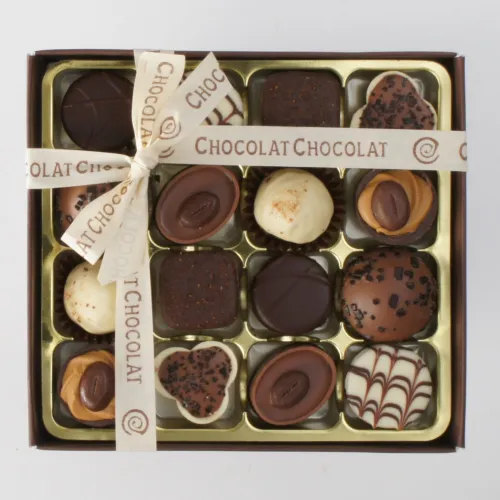
Enrobing is the older approach. The centre — a firm ganache, praline, moulded fondant or a caramel that has been allowed to set solid — travels along a wire conveyor through a falling curtain of tempered liquid chocolate. The chocolate coats all sides; the base is smoothed as the piece exits. Most enrobed chocolates then get a brief human touch: the chocolatier drags a fork across the top or presses on a decoration before the shell sets, producing those characteristic loops and swirls.
The results are charmingly imperfect. Enrobed pieces tend to have slightly rounded edges, a shell that varies in thickness, and a surface that reads as handmade. Because the centre must be firm enough to survive the process, enrobing works best with ganaches and pralines that have been chilled and cut. A runny caramel won't hold its shape long enough to be coated — which is why enrobed caramels are almost always chewy rather than liquid.
The balance of cream, chocolate and emulsification that gives a ganache its particular texture is covered in our separate ganache article.
How shell-moulding works
Shell-moulding inverts the process entirely. Rather than building outward from a centre, the chocolatier starts with the shell. Tempered chocolate is poured into a rigid polycarbonate mould and tipped out almost immediately, leaving a thin, even layer coating the inside of each cavity. Once that sets, the filling goes in — and here the freedom is considerable. Because the shell will be sealed with a separate chocolate cap, the filling needn't be firm at all. Liquid ganaches, flowing caramels, fruit purées: none need to hold their shape, because the shell does that work.
The cap is applied last — a flat layer of tempered chocolate scraped clean across the base — then left to set. When the chocolatier flexes the mould, the pieces fall out base-side up, finished on every face. The result is what you'll recognise from the glossiest artisan boxes: geometrically precise domes or squares with mirror-smooth surfaces. Because polycarbonate releases so cleanly, chocolatiers can paint cocoa butter colourants directly into the mould before the chocolate goes in. Those vivid jewel-coloured bonbons that look almost too striking to eat? Shell-moulded, every one.
Why tempering underpins both
Neither method produces a good result without properly tempered chocolate. Tempering melts and cools chocolate through controlled stages to encourage stable cocoa butter crystals. Well-tempered chocolate sets hard, snaps cleanly and has a glossy surface; it also unmoulds without sticking. Poorly tempered chocolate blooms grey, feels waxy, and in shell-moulding may refuse to release from the mould at all. We cover tempering in depth in a companion piece. As a quick guide: a dull, streaky surface on an enrobed chocolate may be a cosmetic imperfection, but the same on a shell-moulded piece points to something going wrong at the tempering stage.
Reading the box
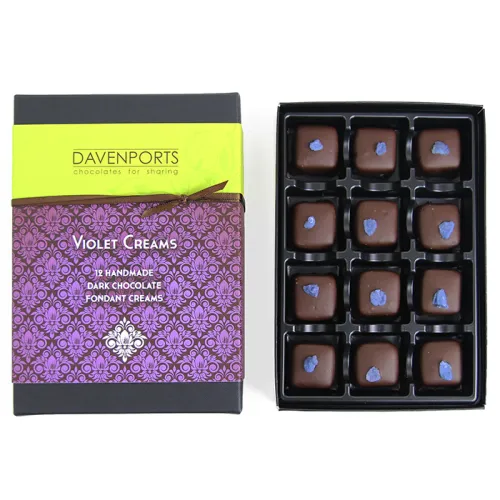
Enrobed pieces will have a slightly textured or hand-decorated top and edges that aren't quite uniform — signs of craft, not carelessness. Press gently on the surface: it should give a little, hinting at the ganache or praline within, though a firm fondant won't yield much.
Shell-moulded pieces should be perfectly smooth and glossy with sharply defined edges. Bite in and the shell should snap — that decisive crack is the temper working as intended — while the filling is noticeably softer or even liquid by contrast. If the shell crumbles rather than snaps, or the filling is grainy, those are signs of rushed work or unstable emulsification.
- Irregular edges and a decorated top: almost certainly enrobed
- Perfectly smooth, geometric and possibly coloured: shell-moulded
- Flowing or liquid centre: can only be shell-moulded
- Chewy caramel or firm praline: more likely enrobed, though not exclusively
Neither method is superior. Enrobing suits certain textures and has a warmth to its finish that many chocolatiers deliberately preserve. Shell-moulding allows a precision and range of fillings that enrobing cannot match. The best chocolate boxes often contain both.