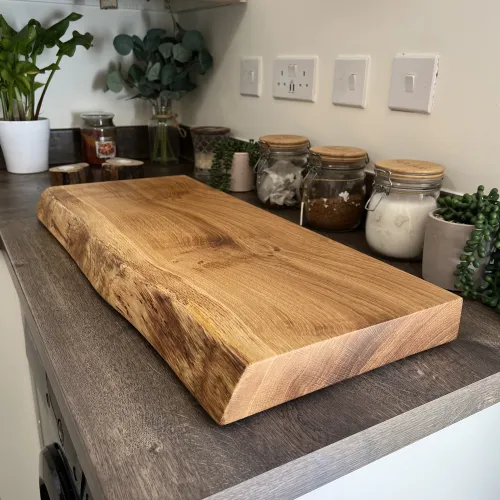
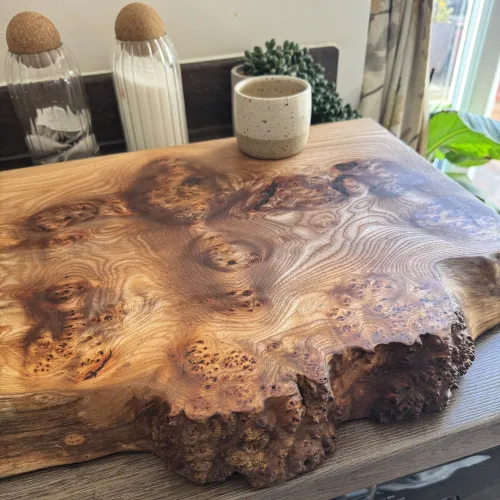
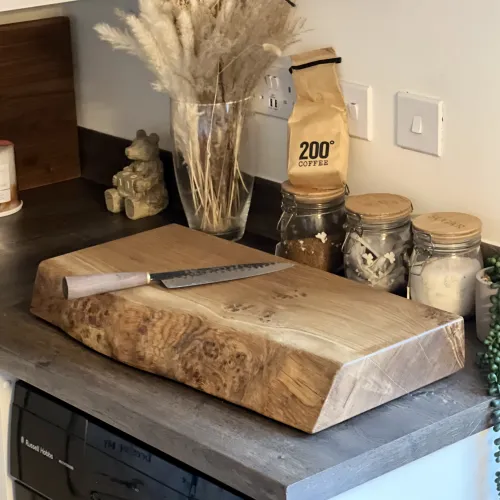
Three boards, three different cuts
The distinction that matters most when buying a wooden chopping board is grain direction — specifically, which face of the timber ends up as the cutting surface.
A face-grain board is the simplest: a single plank, flat side up. The wide, figured face makes it the most visually striking of the three, and the lightest to pick up. It also marks most readily. Knives score the surface along the grain, and those cuts don't close. Face-grain boards earn their place as serving platters or bread boards, but under daily prep work they show their age quickly.
Edge-grain boards are built from strips of timber glued together with the long grain running upward. That harder surface resists marking better than a single plank, the construction is more dimensionally stable, and because the method uses wood efficiently and demands less labour, they cost less. Most good everyday boards are edge grain.
Then there is the end-grain board — the one people tend to mean when they say a wooden board is worth investing in.
What end grain actually does
To picture end-grain construction, imagine a bundle of drinking straws standing upright: you're cutting down into the open ends of the tubes rather than across their sides. In a tree, those tubes carried water from root to canopy. In an end-grain board, they're oriented vertically, and a knife blade parts them rather than slicing across them.
The practical effect is real. The fibres give way slightly under the blade and then spring back — which is why end-grain boards are described as self-healing. Cuts close rather than gape. A knife's edge, meeting the end of a fibre rather than its flank, stays sharper for longer. Traditional butcher's blocks have always been built this way, for exactly these reasons.
End-grain boards are not indestructible. They need more oil to stay in good condition, because those open fibres absorb moisture readily. They also demand considerably more timber and labour to make: blocks must be cut, arranged for the chequerboard pattern, glued with a food-safe adhesive, then jointed and sanded flat on both faces. End-grain construction produces more offcuts relative to usable board, which pushes the raw material cost up before labour is even counted.
How they're finished
Whatever the construction, a wooden board needs a finish that is food-safe and able to penetrate the wood. Mineral oil is the standard choice — odourless, tasteless, and it soaks in rather than forming a film that could crack and flake. Beeswax, often blended with oil, adds water resistance and a slight sheen. Both need reapplying periodically; a board allowed to dry out will eventually crack along its glue lines regardless of how it was built.
What you won't find on a well-made board is varnish or lacquer. These sit on the surface, look attractive when new, and then chip — after which the board becomes difficult to re-treat and the finish can work loose around knife cuts.
Choosing between them
Edge grain suits a workhorse board that needs to be light enough to lift, easy to store, and straightforward to maintain. It will mark over time, but with reasonable care it will last years.
End grain rewards anyone who uses a good knife regularly and wants a surface that actively preserves it. A large end-grain board in a dense hardwood is a substantial object, but that mass also means it stays put on the counter. The chequerboard face records exactly how the board was built, which for many people is part of the point.
Both, at their best, are made from sustainably sourced hardwoods — oak, walnut, maple, cherry, and ash are all common in British-made boards — joined with food-safe glue and finished with nothing a kitchen can't handle. What differs is the construction logic, and once you understand it, the price difference between a decent edge-grain board and a serious end-grain one makes complete sense.