Why rinds matter
A cheese without its rind would be an unfinished thing. The outer layer — whatever form it takes — isn't simply a boundary between paste and air. It regulates moisture loss, hosts the microorganisms that drive ripening, and in many cases contributes directly to the flavour you taste. Understanding rind types is one of the quickest ways to understand why cheeses behave as they do, and why a properly aged wheel can taste so different from a young one of the same variety.
There are five main rind families. Each is the product of deliberate choices made by the cheesemaker, not accidents of storage.
Bloomy rinds: soft, white, and very much alive
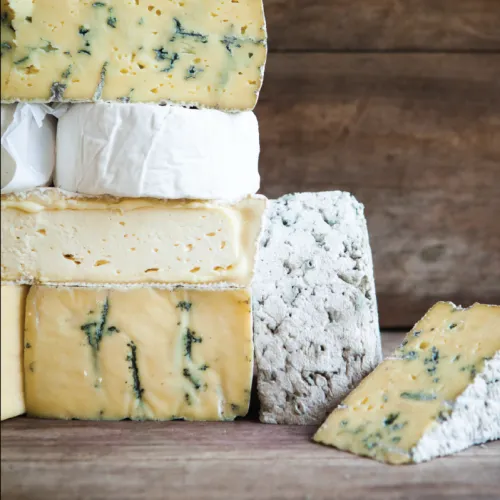
Bloomy rinds are the white, downy coats you find on Brie, Camembert, and their British counterparts. They form when cheesemakers introduce specific mould cultures — most commonly Penicillium camemberti — to the surface of young, soft cheeses. The mould blooms outward and establishes a firm white crust.
What happens inside is the interesting part. The mould releases enzymes that break down proteins in the paste, working inward from the outside. This is why a young bloomy-rind cheese has a chalky core and a creamy ring just beneath the rind, while a fully ripe one becomes uniformly soft. The rind is essentially digesting the cheese from the outside in.
Bloomy rinds are entirely edible — and with a well-made cheese at the right stage of ripeness, worth eating. They carry a mild, mushroomy flavour and hold the paste together as you eat it. Cutting around them is a waste.
Washed rinds: orange, sticky, and frankly pungent
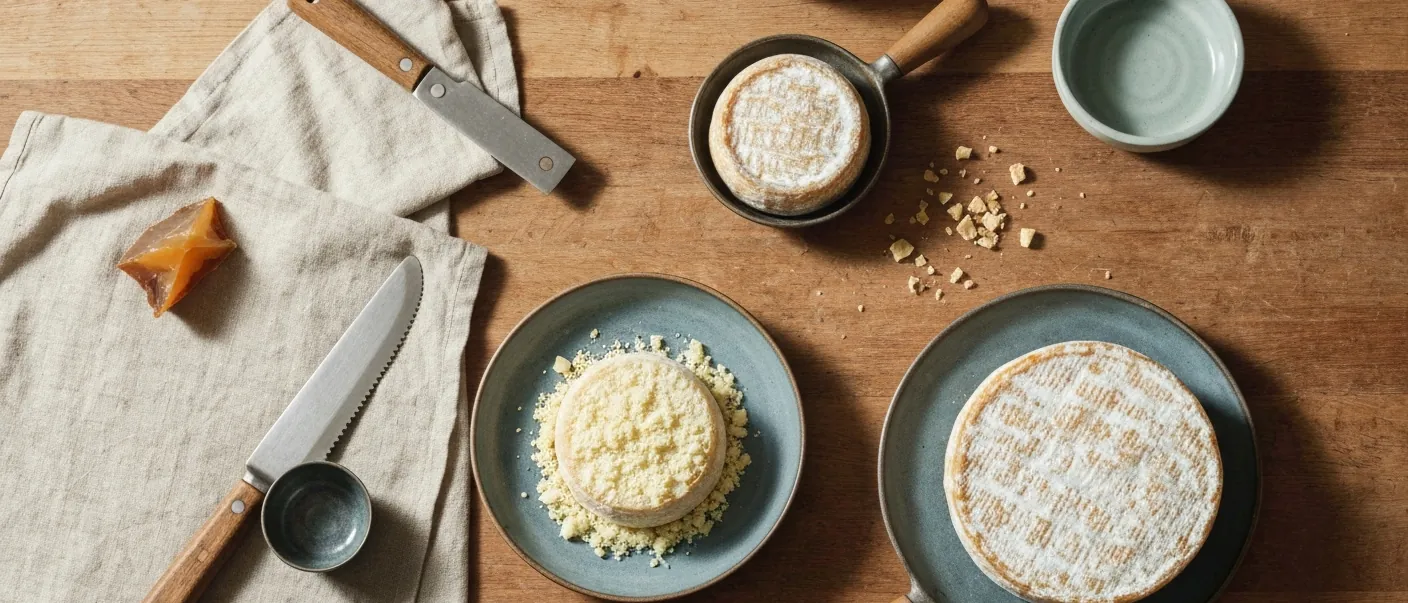
Washed-rind cheeses are regularly bathed during ageing — in brine, beer, cider, wine, or spirits — which encourages the growth of bacteria called Brevibacterium linens. These produce the orange, rust-coloured, often sticky surface you see on cheeses such as Époisses or British examples like Stinking Bishop.
B. linens belongs to the same bacterial family found on human skin, which explains why washed-rind cheeses smell as they do. The aroma is far more aggressive than the flavour inside, which tends to be rich, savoury, and considerably more yielding than the nose suggests. Washing keeps the surface moist and suppresses competing moulds, creating exactly the environment those bacteria prefer.
Whether you eat a washed rind depends on the individual cheese. Many are perfectly edible — pleasantly salty and funky — though some become thick or intensely flavoured as ageing progresses. Taste a small piece and let the cheese decide for you.
Natural rinds: the result of leaving well alone
Natural rinds form without deliberate inoculation or washing. The cheesemaker turns and tends the cheese as it ages, and whatever moulds and yeasts are present in the environment — the cellar, the air, the hands of the people working there — colonise the surface over time.
The results are enormously variable: pale and dusty, patchy grey-blue, or nearly black, depending on the moulds present and the length of ageing. Cheshire, Lancashire, and many traditional farmhouse cheeses develop natural rinds, as do longer-aged alpine styles. The rind slows moisture loss from the paste, gradually concentrating flavour as the cheese matures.
Most natural rinds are edible, though rougher or thicker examples can be tough enough that most people cut them away. Younger cheeses with thin, delicate natural rinds are generally good to eat alongside the paste.
Clothbound and waxed: the mechanical rinds
Clothbound cheeses — traditional Cheddar being the most obvious British example — are wrapped in cloth that is often larded or greased to help it adhere. The cloth acts as a permeable barrier, letting the cheese breathe and lose moisture slowly, which supports the long, gradual maturation that gives properly aged Cheddar its crumble and depth. Natural moulds develop beneath and through the cloth and contribute to flavour, but the cloth itself does the structural work.
Waxed rinds operate on the opposite principle. A coat of wax seals the cheese almost entirely, preventing moisture loss and inhibiting mould growth. This makes for consistent, predictable cheeses that travel and store well, but very little further development happens once the wax is applied. The rind is purely protective — useful, but inert. Nobody eats waxed rinds.
Clothbound rinds sit in the middle: the outer layer of cloth and any mould growth on it isn't generally eaten, but the cheese immediately inside it is often the most characterful part of the whole wheel.
Which rinds should you eat?
The simplest rule: if a rind is soft, thin, and smells appealing, try it. Bloomy rinds and the milder washed rinds almost always repay eating. Natural rinds vary — taste first. Clothbound exteriors and waxed coatings are best left aside.
Rind-eating is also a matter of balance. A small amount of bloomy rind with a generous piece of paste gives you the full range of what the cheesemaker intended. Eating the rind stripped from the paste tends to be an unpleasant experience with most types. Context matters — as it usually does with cheese.