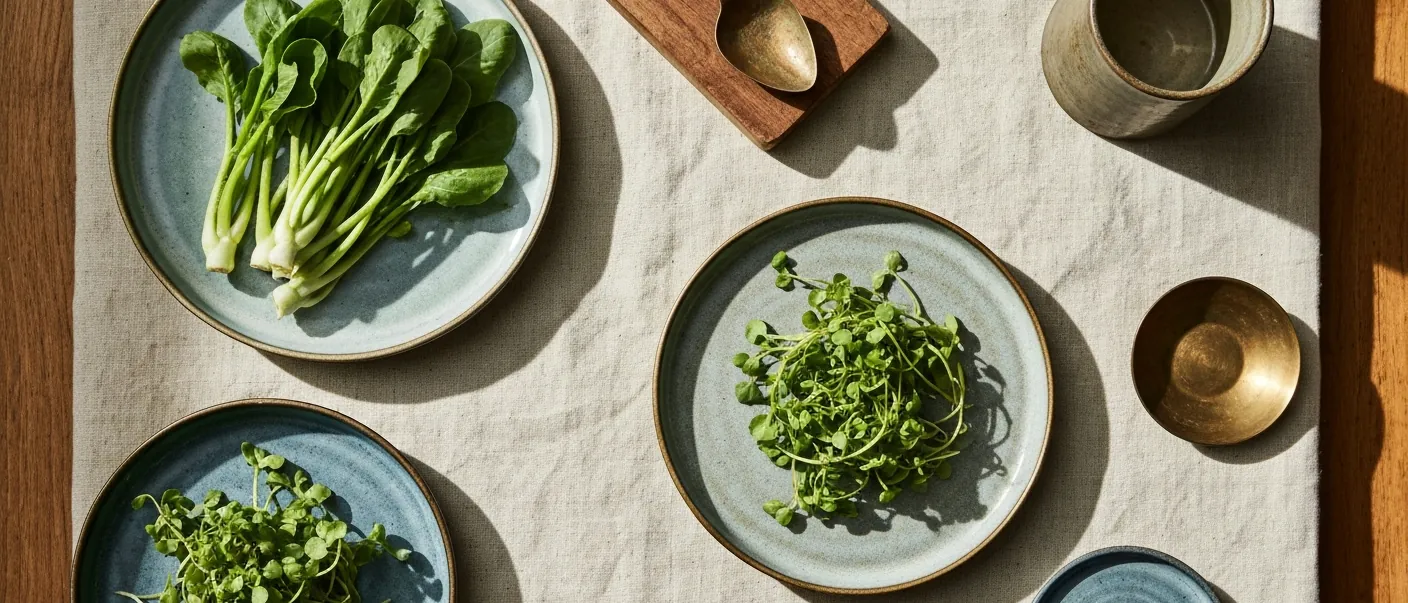
Where good watercress comes from
The chalk streams of Hampshire and Dorset are among the most specific growing environments in British food. Fed by water filtering slowly through chalk aquifers, they run clear and cold at a remarkably steady temperature year-round — precisely the conditions that give watercress its clean heat and mineral depth. The beds around Alresford and the Test valley have been producing it for generations, and that geography still matters. Chalk-stream watercress tastes different from generic hydroponically grown leaf: firmer stems, a more persistent pepper, and a freshness that fades quickly once cut.
The season runs from spring through to autumn. Early in the year the leaves are tender and the bite is relatively gentle; by midsummer the flavour intensifies. If you can find watercress still bundled with its stems rather than pre-bagged and trimmed, that's generally a sign of fresher, more carefully handled produce.
A breakfast for working people
Victorian Londoners knew watercress as the poor man's bread. Street sellers carried bunches through the city in the early morning, and for many working families those bunches were breakfast — eaten as they were, wrapped around nothing, just stem and leaf. The phrase stuck because it was accurate: watercress was cheap, filling enough to take the edge off hunger, and available even in cities through a chain of overnight supply from the Hampshire beds.
What that history actually tells us is something useful. Watercress is substantial. It holds its own as a central ingredient rather than a garnish — which is how it tends to be used now, scattered over things as a finishing touch. Eaten in quantity, as those Victorian bunches suggest, the peppery quality becomes something you eat around rather than merely taste.
How it's eaten at its best
The most enduring British use is the simplest: watercress soup, made from the whole plant including the stems, which carry most of the flavour. Served hot it is warming and slightly grassy; served cold it sharpens considerably. Either way, the quality of the watercress itself is the only thing that matters.
Beyond soup, watercress pairs naturally with strong, savoury companions — rare beef, blue cheese, smoked fish. The peppery bitterness cuts through fat and salt in a way that milder salad leaves don't. A watercress and orange combination, which appears in older British cookery, works on the same logic: the sharpness of one meeting the acidity of the other. These aren't arbitrary pairings; they're a consequence of what the leaf actually does.
What watercress doesn't need is heavy dressing. A little good oil and something acidic — a splash of cider vinegar, a squeeze of lemon — is enough. Anything creamy or sweet tends to flatten the very quality that makes it interesting.
Finding it in season
Farmers' markets in the south of England are the most reliable source of properly fresh, stem-on watercress through the spring and summer months. Greengrocers in Hampshire and Dorset will often stock locally grown produce that supermarkets don't carry at all.
Alresford, which sits at the centre of the Hampshire watercress-growing area, holds an annual watercress festival usually in May — check the official festival website for this year's exact dates. It draws growers and food producers from across the region and is one of the better ways to buy directly and understand the range of what's grown locally.
Outside the south, the pre-bagged supermarket product is perfectly usable, though it's worth eating it quickly. Watercress deteriorates faster than most leaves, and a bag that has been sitting for a few days loses the bite that makes it worth buying in the first place. If the stems are yellowing or the leaves soft, the flavour will already have gone.
Why the season still matters
Watercress is available in British shops for much of the year, some of it imported, some grown under controlled conditions. The chalk-stream crop at its seasonal peak is a genuinely different thing. The cold water that flows through those beds in spring and early summer produces a leaf with more structure and more heat than anything grown quickly under glass — a straightforward consequence of how the plant grows and what it draws from the water around it.
Eating it in season, from a source you can trace to a specific place, is the most direct way to understand why watercress has been valued here for so long. It is one of the sharpest, most characterful leaves that grows in this country, and at its best it needs almost nothing done to it.