A fruit that asks something of you
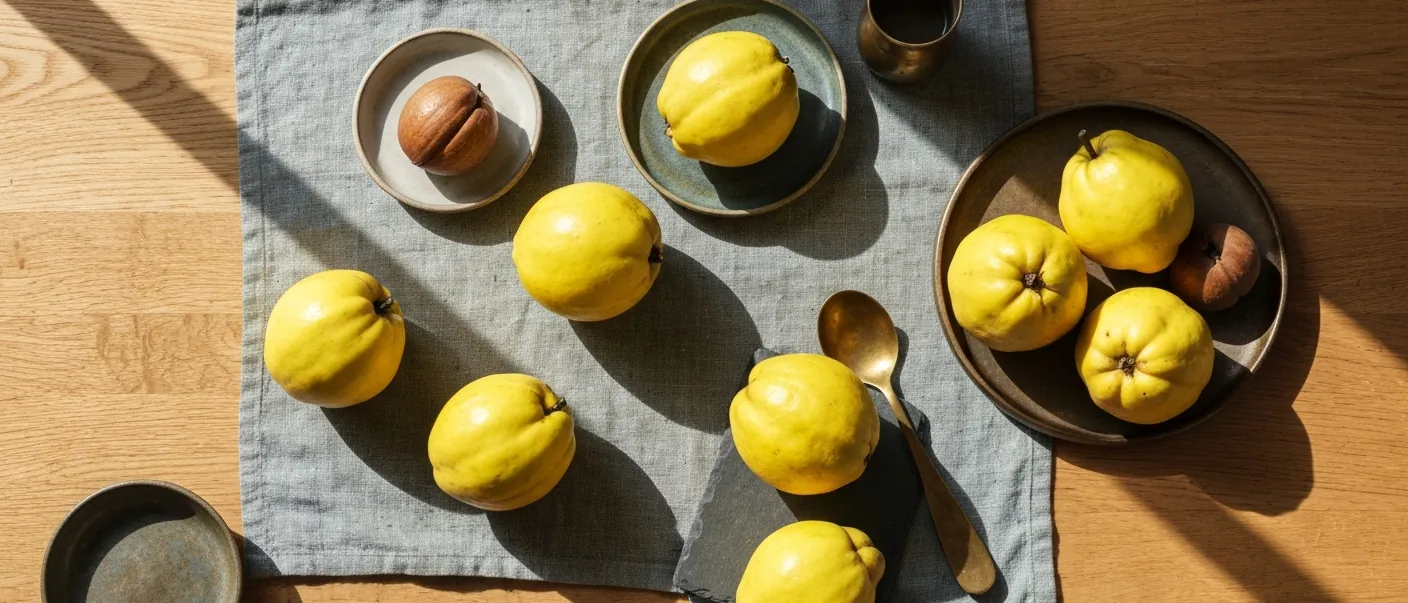
Quince arrives in October, just as the apple harvest winds down, and makes no attempt to charm you on first acquaintance. Pick one up and it feels almost woody — dense, unyielding, pale yellow, occasionally furred with a fine down. Bite into it raw and you'll find it astringent to the point of unpleasant. This is not a fruit designed to be eaten off the branch.
What quince demands is heat. In return, it offers something genuinely remarkable: flesh that starts out cream-coloured and chalky slowly turns rose-pink during cooking — a blush that deepens the longer it spends over the flame. The transformation isn't just visual. The raw fruit's faint floral scent concentrates into something richer and more complex, somewhere between apple and pear but distinctly its own, with a perfume that can fill a kitchen.
October and November: the brief window
The season is short. British quinces are generally ready from October through November, and finding them in any quantity takes effort — they rarely appear on supermarket shelves. Farm shops and specialist greengrocers are more reliable sources, and a number of independent growers sell them at farmers' markets during autumn weekends. If you spot a tree in a neighbour's garden, it's worth asking: quince trees are generous bearers, and many households find themselves with more fruit than they know what to do with.
Even leaving a few quinces in a bowl on the kitchen counter has its pleasures. The fruit perfumes the surrounding air without any encouragement, which goes some way to explaining why quinces have been prized for so long — their scent alone made them seem special.
Quince cheese and membrillo
The most enduring way to preserve quince is to cook it down into a thick, sliceable paste. In Spain this is called membrillo; in Britain the equivalent is quince cheese — the word cheese referring to texture rather than any dairy content. The principle is the same: quince flesh is cooked until completely soft, pushed through a sieve, then combined with sugar and reduced until dense enough to set firm when cooled. Packed into a tin or mould, it keeps well and develops further in flavour over time.
Quince cheese has been made in British kitchens for centuries. It sits beautifully alongside hard, salty cheeses — the sweetness and acidity of the quince cutting through rich, aged dairy. Membrillo, imported from Spain, is now widely available in delicatessens and cheese shops, and many British artisan producers make their own versions under both names. Look for ones with a deep amber-to-brick colour and a firm, slightly glossy set; these tend to have the most concentrated flavour.
The medlar: an even stranger cousin
If quince tests your patience, its botanical cousin the medlar tests it further. A small, russet-brown fruit with an appearance that attracted some unflattering historical nicknames, the medlar cannot be eaten until it has undergone bletting — a controlled softening that is, plainly, a form of partial decay. After picking, it must be left somewhere cool until the flesh collapses inward and turns brown and soft, with a texture somewhere between very ripe banana and spiced apple sauce.
Only then is a medlar edible — and the flavour rewards the wait. Sweet, slightly winey, complex in a way that resists easy comparison. Like quince, the medlar was once a common sight in British orchards and kitchen gardens; like quince, it fell from fashion as more convenient fruit took its place. A small number of artisan growers and orchard revival projects still cultivate both, and autumn is when they make their fleeting appearance.
Finding and using quince
The simplest starting point for anyone new to quince is a good quince cheese or membrillo from a British artisan producer — no cooking required, and it immediately shows what the fruit becomes when handled with care.
When buying fresh quinces, look for ones that are fully yellow with no green patches remaining; green fruit is under-ripe and harder than usual. A little surface russeting or blemishing is normal and doesn't affect flavour. Store them somewhere cool and away from other fruit — the perfume they release can transfer, which isn't always welcome.
Quince cheese keeps for months in a cool, dark cupboard, then in the fridge once opened. Serve it in thin slices alongside a firm, aged British territorial — a well-aged cheddar or crumbly Lancashire works particularly well — and you have one of the simplest, most satisfying things the season produces.
_jpgq80.webp)