When the season actually runs
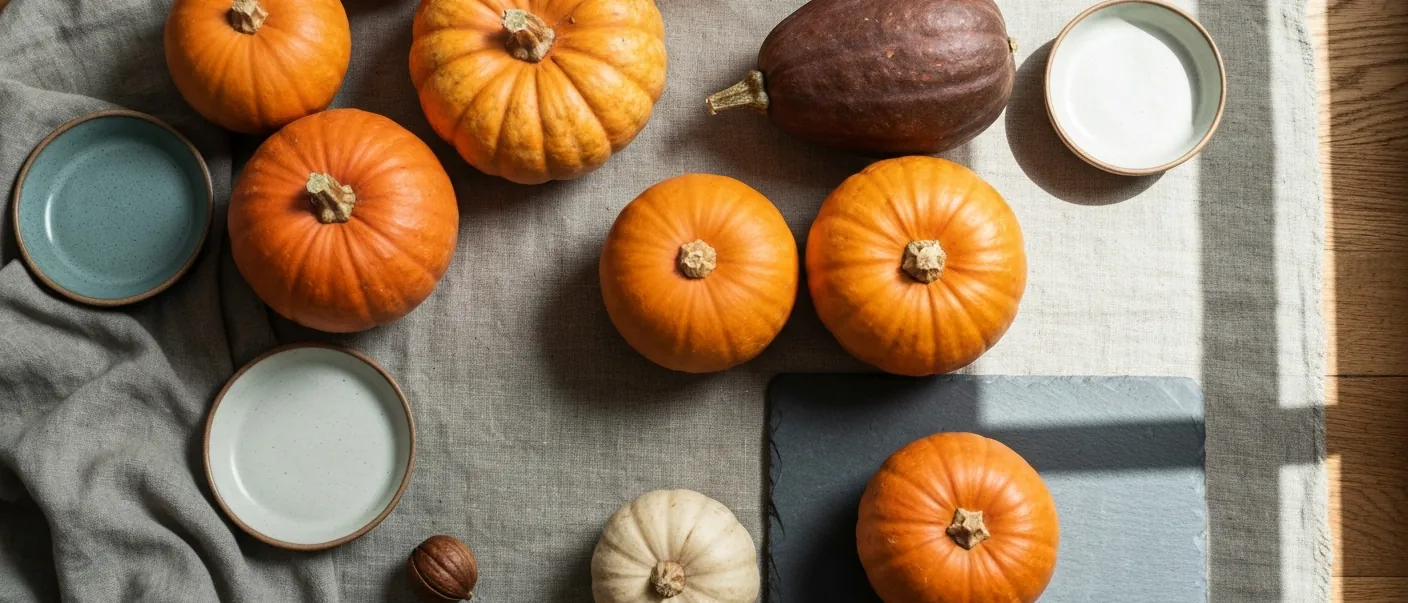
Squash harvest begins in early autumn, but many varieties — Crown Prince, Hubbard, Kabocha — have thick skin and dense flesh that stores for months in a cool, dry place. What you buy in October may keep perfectly until January or February. This is one of the oldest forms of seasonal eating on the British calendar: crops harvested before the first frosts, drawn down through the darker months.
Treating autumn squash as a Halloween prop and forgetting about it means missing the best of the season. The varieties worth eating arrive around the same time as carving pumpkins but keep far longer and taste incomparably better.
Crown Prince and the flavour varieties
Crown Prince has become something of a benchmark for British growers interested in eating quality. Its blue-grey skin is distinctive; the flesh is deep, almost burnt orange — dense and dry in a way that suits long roasting, where natural sweetness concentrates rather than steams away.
Other varieties grown for flavour rather than size include Kabocha, sometimes sold as Uchiki Kuri or red onion squash, and Delicata, whose striped skin is thin enough to eat. What these share is a higher ratio of flavour to water than the large, pale-fleshed pumpkins bred for carving. Those are chosen for thin flesh that hollows out easily — useful for lanterns, not for the table.
Independent greengrocers and farm shops are usually the best places to find less common varieties. A supermarket Crown Prince is a fine thing, but a farm shop in October might have four or five different eating squashes on display, each with a distinct character. It is worth asking which were grown locally.
The carving surplus problem
Every October, Britain produces and imports a large quantity of carving pumpkins. A significant proportion are hollowed out, displayed, and discarded without anyone eating them — a straightforward waste issue.
The flesh scooped from a carving pumpkin is watery and relatively bland, which puts people off. It is not inedible, though. Roasted slowly to drive off moisture and seasoned assertively, it becomes serviceable — better in a spiced soup than anywhere its mild flavour has nowhere to hide. The seeds, rinsed and dried, are worth roasting with salt and a little oil; they're genuinely good and routinely thrown away without a thought.
Some farm shops and market traders now sell the flesh ready-prepped to reduce waste. A few community organisations run pumpkin collection schemes after Halloween — worth looking out for locally if you find yourself with more than you can use.
How to cook eating squash
British cooking has not historically been squash-forward in the way Italian or North American traditions are, but that is changing. Slow-roasting in halves or wedges, flesh-side down, is the simplest approach and concentrates flavour in a way that boiling never can. Squash appears increasingly in British restaurant kitchens alongside game and aged cheeses — combinations that make sense given the earthiness of all involved.
Harder varieties like Crown Prince work well stuffed and baked whole, their skin becoming a natural serving vessel. Softer-fleshed types suit soups and purées, particularly with warm spicing. In both cases, heat that drives off moisture and deepens the sweetness is the point.
Across southern Europe, Japan, and the Americas — wherever squash has been a staple — the approach is broadly similar: fat and heat, salt and time. The British tradition leans towards butter and sage, harvest combinations with apple or celeriac. None of it is complicated. The squash does most of the work.
Finding good squash in Britain
Farm shops and farmers' markets are the most reliable source for eating varieties through October and November. After that, good greengrocers tend to carry Crown Prince and Butternut well into winter. Organic box schemes often include squash throughout the season, sometimes with varieties unavailable on the high street.
Buy what is heavy for its size, with no soft spots or cuts in the skin, and store it somewhere cool and dark. A whole, uncut squash in good condition will outlast almost any other fresh vegetable in your kitchen — which is the entire point of the thing.