A season measured in candlelight
Somewhere between January and March, in low wooden sheds scattered across a patch of West Yorkshire, workers harvest rhubarb by candlelight. Not as an affectation — any stronger light would disrupt the forcing process. Deprived of sunlight, the stalks grow fast and pale towards the nearest flicker, producing something slender and shocking pink rather than the thick, fibrous stems that appear in gardens come summer. It is one of the more quietly extraordinary food traditions Britain has held onto.
The area responsible — commonly called the Yorkshire Rhubarb Triangle, roughly bounded by Wakefield, Morley and Rothwell — has been producing forced rhubarb on a significant scale for generations. It holds Protected Designation of Origin status, meaning that authentic Yorkshire forced rhubarb has a legal geography as specific as Champagne or Stilton.
How forcing actually works
The process begins long before the sheds come into it. Crowns are grown outdoors for around two years, accumulating energy through repeated cycles of frost and thaw. That cold exposure is not incidental — it is what makes forcing possible. The plant builds up enough stored starch that, when brought inside into total darkness and warmth, it converts those reserves into rapid, almost frantic growth.
Inside the sheds, no photosynthesis happens. The stalks that emerge are reaching for any light source they can find, which is why harvesters work by candle rather than electric light — to avoid signalling a direction. You can apparently hear the rhubarb growing in the quiet: a faint creaking as the stalks push upward. Whether or not you believe that detail, the yields appear within weeks, and what comes out is nothing like what you would pull from a garden bed in June.
What forced rhubarb is actually like
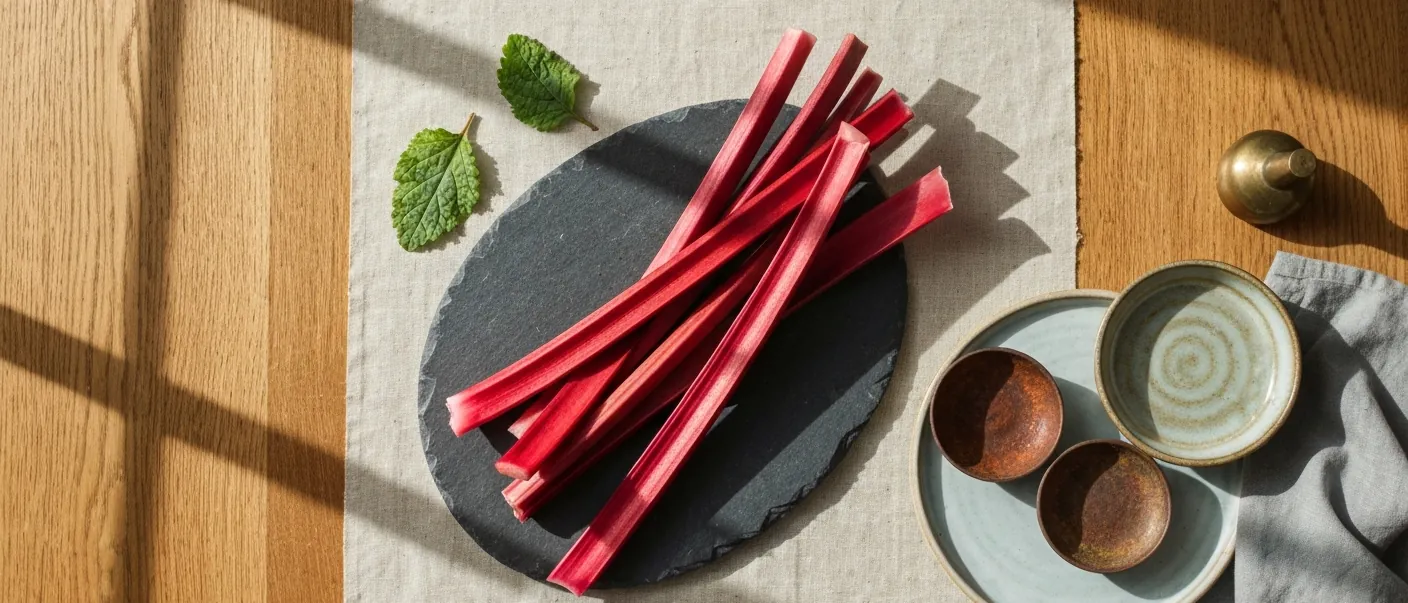
The difference is not subtle. Forced rhubarb is far more tender, with a thinner skin that needs no peeling. The flavour is sharper and more floral, less coarse than outdoor-grown stems. The colour — deep, almost magenta pink running through pale yellow-green — makes it one of the more visually arresting things available in the winter produce aisle. It cooks down quickly, which makes it more delicate to work with and more immediately rewarding.
Outdoor rhubarb, harvested from late spring onwards, is a different ingredient for different purposes. Both have their place, but forced rhubarb's brief window is what gives it value. It is not a premium version of something you can get year-round — it is a seasonally specific thing with its own character, and once the sheds are cleared, it is simply gone until the following January.
Finding it and knowing what you are buying
The PDO designation matters here. Yorkshire forced rhubarb with that status must be grown within the designated area using traditional methods — the two-year outdoor preparation included. What you find in a supermarket without that provenance may be forced rhubarb from elsewhere, which is not inherently inferior, but it is a different supply chain with fewer guarantees about crown preparation or how recently it was cut.
For the best of it, look to farm shops and independent greengrocers in Yorkshire, or specialist online suppliers working directly with growers in the Triangle. At markets, it often appears still with its pale leaves attached — a sign of very recent harvest, since the leaves wilt fast. Stems should feel firm rather than rubbery, and the colour is a reasonable guide to freshness: deeper and more even pink, not washed-out or streaky.
The season is short enough that it pays to be attentive. By April it is effectively over, and the outdoor crop will not be ready until later in spring. That gap is part of what makes the forced season feel like what it is.
Why it belongs on a winter table
Winter eating in Britain leans heavily on roots, citrus and preserved things — all good in their place, but little of it is growing fresh and domestic right now. Forced rhubarb is a genuine exception. It arrives when almost nothing else does, and it asks to be used simply: stewed with a little sugar, eaten with cream or thick yoghurt, or laid over rice pudding. The sharpness is the point.
There is also something worth pausing over in the sheer oddness of its production — a food grown in darkness, harvested by candlelight, in sheds that have been doing the same thing for generations. British food culture does not always celebrate its own eccentricities well, but this one deserves more attention than it usually gets outside Yorkshire.