A particular patch of England
Draw a triangle between Wakefield, Morley and Rothwell in West Yorkshire and you have mapped one of the more unusual agricultural zones in Britain. This small area — known as the Rhubarb Triangle — produces forced rhubarb with Protected Designation of Origin status, placing it in the same legal category as Champagne or Parma ham. The designation is not ceremonial. It means that rhubarb bearing the name Yorkshire Forced Rhubarb can only come from this specific region, grown by specific methods.
The heavy clay soils of the West Riding suit rhubarb well, and the local coal-mining industry once made cheap heating available to the forcing sheds that give the crop its character. That industrial connection has largely gone, but the growing tradition remains — concentrated, specialist and largely unchanged in its essentials.
What forcing actually means
Rhubarb is a perennial. The crowns are grown outdoors for a couple of years, accumulating energy in their roots. Then, usually in late autumn, they are lifted into long, low, heated sheds. In the dark and the warmth, the crowns are tricked into thinking spring has arrived early, pushing up stems rapidly towards a light that is not there.
That darkness is the point. Without light, the plant cannot produce chlorophyll, so the stems stay a deep, saturated pink rather than turning green. They are also notably tender, with a finer texture and sharper, more delicate flavour than outdoor-grown rhubarb. The energy stored over two years goes entirely into those stems — the result is something more concentrated and fragrant than its summer counterpart.
Harvesting is done by hand, by candlelight — not for romance, but because electric light would encourage the stems to green up. Workers move through the sheds in near-silence; you can reportedly hear the rhubarb growing, a faint creaking as the stems push upward in the warmth. It is one of those agricultural details that sounds invented and is entirely real.
A winter crop in a winter landscape
Forced rhubarb arrives precisely when British produce is at its most sparse. The season runs from the depths of winter into early spring, which gives it a significance on the seasonal calendar that outdoor rhubarb — available much later and far more widely — does not have. For cooks thinking about what is genuinely in season in January or February, Yorkshire forced rhubarb is one of very few answers.
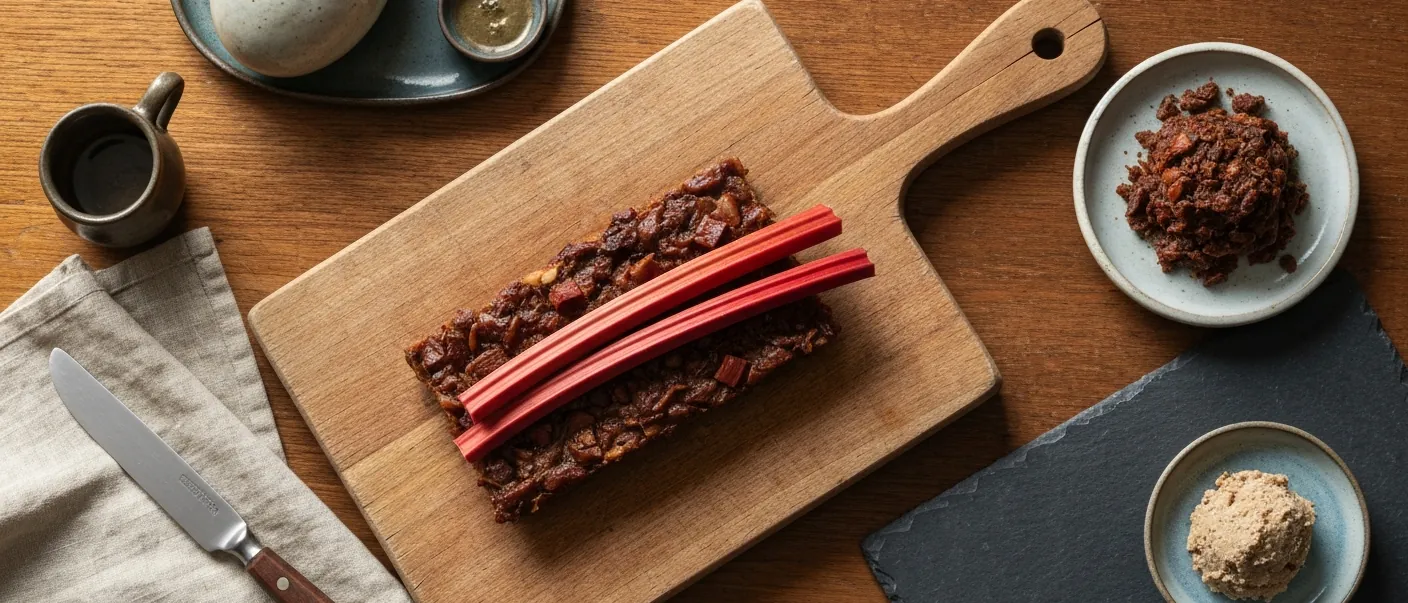
The colour is part of its appeal. Long, slender stems in shades from pale blush to deep magenta are striking in a way that green-tinged summer rhubarb is not. Traditionally paired with warming spices, custard, or simply poached with sugar, the sharp, floral flavour needs very little intervention. It sits well alongside rich, fatty things — cream, butter, oily fish — the acidity doing the work.
Protected status and what it preserves
The PDO designation gives producers a legal framework to defend the name and the method, and makes traceability straightforward for buyers who want to know exactly what they are getting. For a crop this regionally specific, that protection also functions as cultural preservation — an acknowledgement that the knowledge of how to do this, and where to do it, has genuine value.
The number of growers working within the Triangle has fallen significantly over the decades. But those who remain are producing something that cannot be replicated elsewhere, at least not legitimately under that name. Buying genuine Yorkshire forced rhubarb in season is one of the more direct ways to support a food tradition that is fragile but still very much alive.
Look for it at good greengrocers, farm shops and independent delis during the winter months. The stems should be firm and bright, with fresh-cut ends. If they look limp or the colour is faded, they have been sitting around too long — forced rhubarb at its best is a perishable thing, and should be treated accordingly.
_wsct-0q_pngq80.webp)