What the PDO actually covers
Protected Designation of Origin — PDO — is the strictest category of European-derived food protection still recognised in UK law. For a cheese to be sold as Stilton, it must be produced within a tightly defined geographical boundary: the counties of Derbyshire, Leicestershire and Nottinghamshire. That's it. A cheesemaker with identical methods working one county over cannot call their product Stilton, regardless of how closely it follows tradition.
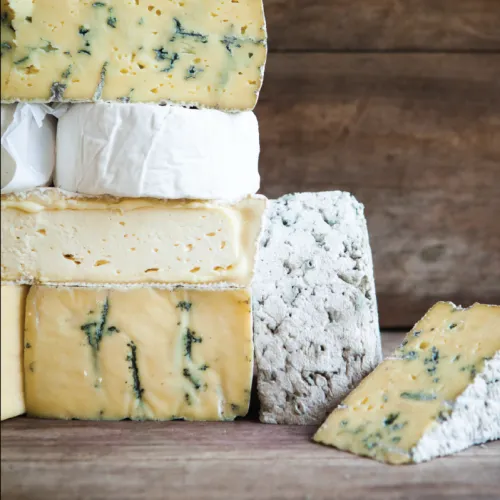
The protection covers two distinct cheeses. Blue Stilton, the better-known of the pair, is what most people picture — a tall cylinder threaded with blue-grey veins. White Stilton is less celebrated but equally protected: a younger, creamier cheese without the veining, often sold plain or with fruit stirred through. Both fall under the same PDO rules, and both must meet the same geographical and production requirements.
The Stilton village paradox
The village of Stilton sits in Cambridgeshire. The cheese almost certainly takes its name from that village, where it was historically sold to travellers stopping on the Great North Road. Yet Cambridgeshire is not among the three permitted counties, which means no cheesemaker in Stilton itself can legally produce Stilton cheese. It is one of the more quietly absurd outcomes of geographical food protection, and it tends to stop people short when they first hear it.
The reasoning is straightforward, even if the result feels odd. PDO protection anchors a product to where it is actually made, not to where it was sold or where it got its name. By the time formal protection was sought, the established dairies and the accumulated craft knowledge were concentrated in the three East Midlands counties — so that is where the boundary was drawn.
How the cheese is made
Beyond geography, the PDO sets specific rules about production. Stilton must be made from pasteurised milk sourced locally — that regional milk supply is considered part of what gives the cheese its character. It must be formed into a cylinder, allowed to develop a natural rind rather than a treated or waxed exterior, and left to mature until the distinctive blue veining has formed throughout.
The veining comes from Penicillium roqueforti, the same mould used in Roquefort and Gorgonzola. In Stilton, the mould is introduced and then the cheese is pierced with fine needles during maturation — the air channels that result allow the mould to grow inward from those points, creating the characteristic marbled pattern. The flavour this produces is pungent and complex, but with a particular creaminess that a well-made Stilton carries even at its most assertive.
Why protection like this is worth having
PDO status does several things at once. It protects the producers themselves from cheaper imitations that could undercut them on price while trading on the same name. It gives buyers a reliable guarantee about what they are purchasing. And — perhaps less obviously — it creates a strong incentive for producers within the zone to maintain standards, because the reputation of every Stilton maker is partly tied to the others.
For a cheese like Stilton, which requires significant time and skill to make well, that collective reputational stake matters. A shoddily made Stilton reflects on the designation as a whole. The rules are not just about geography; they encode a minimum standard of craft.
How to buy and eat it well
Stilton is at its best bought from a cheesemonger who can tell you about the specific dairy it came from — there are only a small number of licensed producers, so provenance is unusually traceable. Look for a cheese that has a firm, slightly wrinkled natural rind and a pale interior with generous, evenly distributed blue veining. Avoid anything that looks dried at the edges or smells of ammonia rather than the usual rich, earthy sharpness.
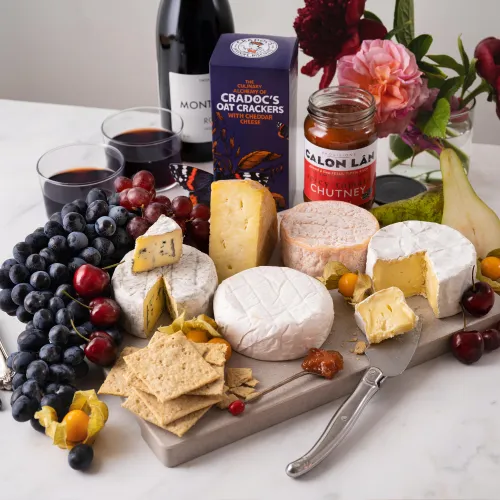
Traditionally served with port, oat biscuits or both, Stilton also works well with pears, walnuts or a good chutney. White Stilton suits a cheese board where you want something milder alongside stronger selections, or as a base for fruit-laced varieties — though those additions do not change its protected status. Both styles are best brought to room temperature before serving, which lets the full flavour develop rather than presenting the numbed, muffled version that comes straight from a cold fridge.