What the PDO actually means
Protected Designation of Origin status is not a marketing badge. For both Orkney beef and Orkney lamb, it is a legal guarantee that the animals were born, reared and slaughtered on the islands themselves. Nothing in the chain can happen on the mainland. That single requirement keeps the product genuinely tied to a place rather than simply named after one.
Very few British meats carry this level of protection. The island designation is particularly strict — the geography is hard-walled by the sea, with no ambiguity about where the animals spent their lives.
Grass, salt air and seaweed
Orkney sits off the northern tip of Scotland, and its climate is more oceanic than Highland. The islands are rarely warm, but they are also rarely frozen, which means the grass grows slowly and keeps growing for much of the year. Cattle grazing on that pasture put on condition gradually rather than rapidly, and slower growth tends to produce more developed flavour in the meat.
The lamb has an additional dimension. Some island flocks graze on coastal ground where seaweed forms part of the diet — particularly the brown wracks and kelps that wash onto the shoreline. The influence of mineral-rich coastal grazing reaches across the archipelago to varying degrees, producing a lamb with a saline edge that has nothing to do with the kitchen and everything to do with what the animal actually ate.
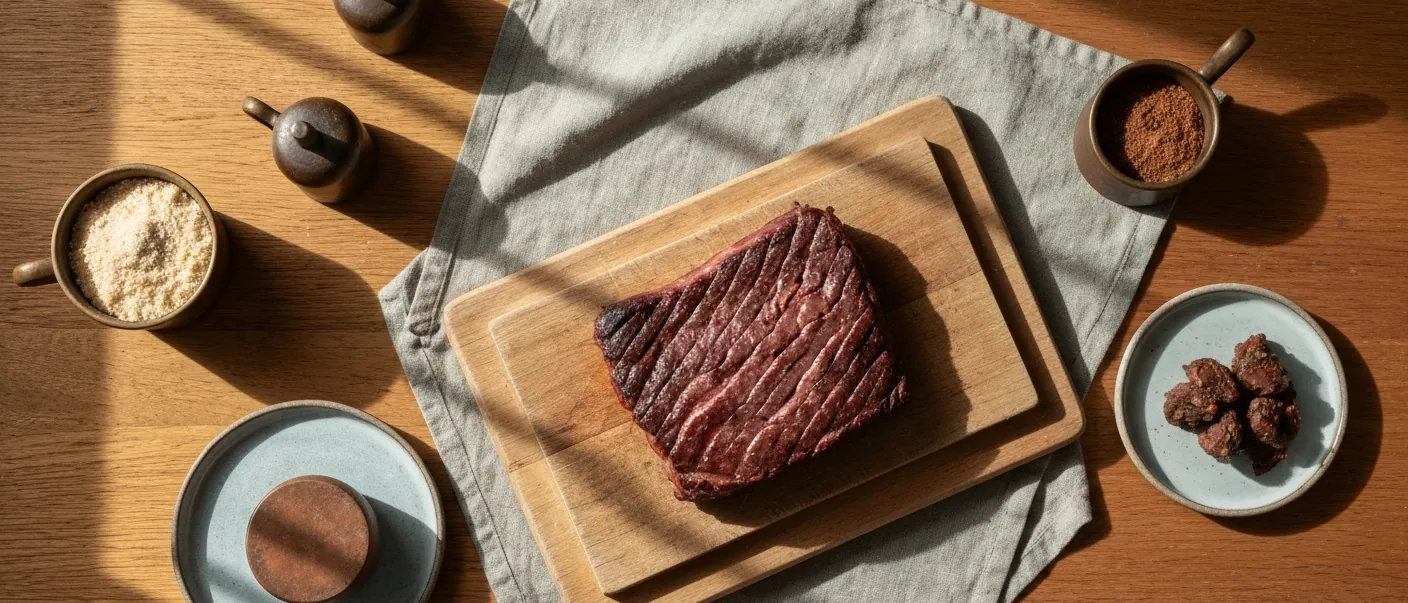
Orkney beef cattle develop the close-grained marbling that grassland finishing encourages. The fat is white rather than yellow, the texture is firm, and the flavour carries a quiet depth that comes from an animal given time and space rather than a forced programme of growth.
Why island slaughter matters
The requirement to slaughter on Orkney is not incidental. Transporting live animals off the islands adds stress, which raises cortisol levels and affects how muscle settles after death. Meat from stressed animals is measurably different — tighter, paler in places, with a shorter shelf life. Slaughtering on the islands removes that journey entirely.
It also means the local abattoir and the farming community remain interdependent. PDO status, in this sense, supports an infrastructure that would otherwise be vulnerable on a remote island economy.
How to cook it
Neither Orkney beef nor Orkney lamb needs elaborate treatment — producers and chefs who work with the meat tend to say the same thing. The beef suits long, slow cooking as well as a straightforward roast; the marbling holds the meat together through heat in a way that leaner, faster-reared beef does not. The lamb, particularly from animals with coastal grazing in their background, is good served simply with nothing stronger than its own juices, because the flavour is already doing something interesting.
On the islands themselves, this meat appears in everything from hotel dining rooms to community hall suppers. It is not a restaurant novelty; it is just what meat looks like.
Finding it on the mainland
Genuine Orkney beef and lamb can be ordered directly from island producers, some of whom ship to the mainland, and from specialist Scottish butchers and online meat suppliers who list provenance clearly. The PDO mark on the packaging is the only reliable confirmation — without it, you may be buying something inspired by Orkney rather than actually from it. Check that the labelling states the PDO designation explicitly, and be sceptical of anything vague about Scottish island origins without the formal protection named.
Supply is limited by geography. The islands are not vast, and the number of animals that can be properly reared there is finite. That scarcity is part of what makes the designation meaningful rather than merely nominal.