A name that actually means something
'Cheddar' can be made anywhere, by any method, from milk sourced from wherever the producer chooses. The name passed beyond protection long ago, becoming a descriptor rather than a designation. West Country Farmhouse Cheddar is different. It holds Protected Designation of Origin status, which means every stage of production — the sourcing of milk, the making of the cheese, the ageing — must happen within a defined area and follow a defined method. That combination of place and process is precisely what PDO status exists to protect, and here it draws a firm, meaningful line.
Where it comes from and what that requires
The four counties covered by the PDO are Somerset, Devon, Dorset, and Cornwall. Milk must come from those counties. The cheese must be made on the farm — not in a centralised creamery drawing in milk from elsewhere — and aged on that same farm.
That last requirement matters more than it might appear. Farmhouse ageing means the cheesemaker lives with the cheese through its development, tasting and turning it rather than dispatching it to a warehouse. The conditions of each farm — ambient temperature, the particular culture of bacteria present — become part of the cheese. Two West Country Farmhouse Cheddars from neighbouring farms can taste noticeably different from one another, in a way that industrially produced blocks do not.
What cheddaring by hand actually involves
The PDO requires cheddaring to be done by hand. After the curds are cut and cooked, they are drained, then stacked and restacked — slabs of curd piled on top of one another, turned and repositioned repeatedly as whey drains out and the texture becomes increasingly dense and fibrous. It is physical work that takes time and judgement. The cheesemaker reads the curd as they go, not a timer.
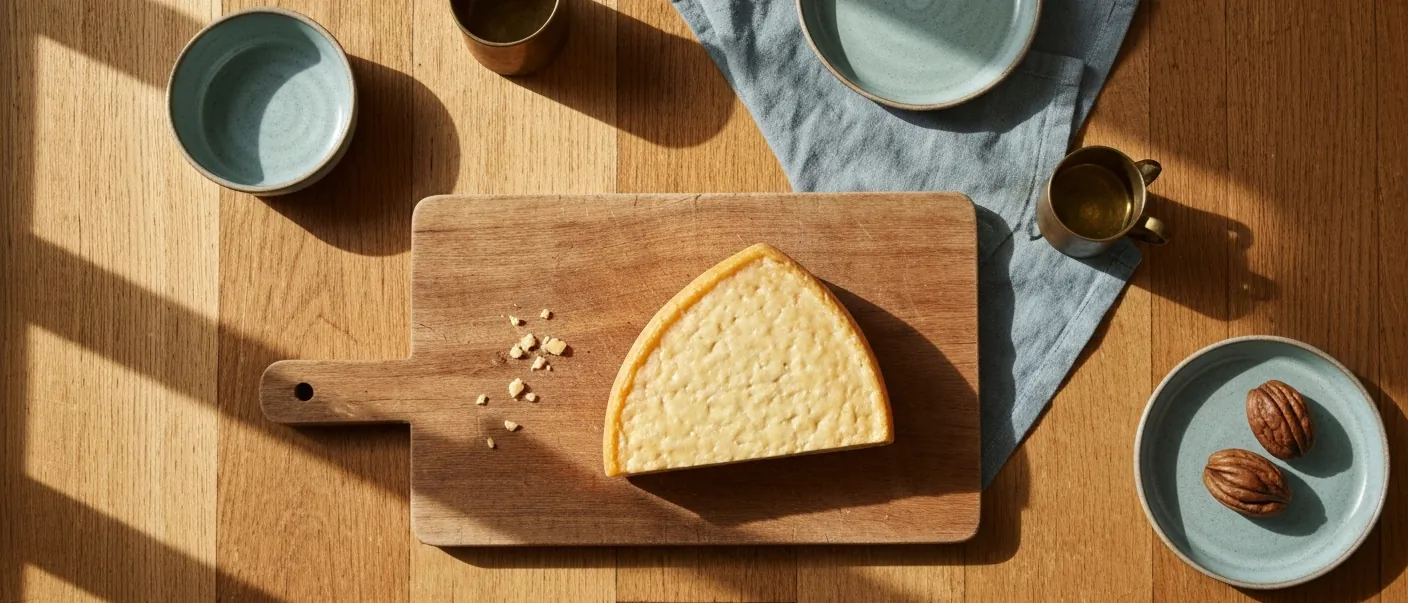
Hand-cheddaring is central to why the finished cheese has that firm, slightly granular texture and why it develops complexity with age. The structure created by hand-stacking behaves differently over months of maturation from curd that has been mechanically processed. Experienced tasters note that a well-aged West Country Farmhouse Cheddar breaks with a short, clean snap rather than bending — a difference that is as much felt as seen.
How to tell you're buying the real thing
The PDO logo — a red and yellow symbol required on all protected products sold in the UK — is the clearest indicator. The label must also state 'West Country Farmhouse Cheddar' in full. Any cheese simply called 'farmhouse cheddar' or 'West Country cheddar' falls outside the designation and carries no guarantee of method or origin.
Good cheesemongers and farm shops in the south-west often stock it cut to order, which gives you the chance to ask about the specific farm and the age of the batch. Younger examples tend toward a buttery, milky flavour with a supple texture; longer-aged versions develop sharper, more savoury depth — sometimes with a slight crystalline crunch from tyrosine. Neither is more authentic than the other; they represent the same tradition at different points in its development.
Why the distinction is worth caring about
The PDO framework is sometimes dismissed as bureaucratic box-ticking, but for West Country Farmhouse Cheddar it protects something the market, left to itself, would struggle to sustain. Farmhouse production is slower and more labour-intensive than factory manufacture. Without a clear, protected category that buyers and retailers can identify, there would be little to stop the name drifting further into meaninglessness.
There is also a broader argument about landscape and farming practice. The milk for this cheese comes from herds grazing specific land in specific counties. Those farms, and their pastures, are maintained in a particular way because there is a market for what they produce. The cheese and the countryside it comes from are not separate things.