What PGI actually means here
Protected Geographical Indication ties a food to a place by law. For Welsh Lamb, that means the animal must be born and reared in Wales — not reared elsewhere and finished in Wales for a few weeks, nor Welsh-bred stock raised across the border. The connection is complete and continuous.
The protection is not decorative. It tells you something verifiable about how the animal lived and where — which, with lamb more than almost any other meat, has direct consequences for what ends up on the plate.
What the landscape is actually doing
Much of Wales is upland. The terrain is steep, the weather changeable, and the grazing far removed from the ryegrass monocultures of lowland farms. Sheep here move across heather moorland, rough grasses, and herb-rich upland pasture — foraging rather than simply eating what is placed in front of them.
This is credited with giving Welsh Lamb its particular character: a depth of flavour that is pronounced without being aggressive, and a fat that carries aromatic complexity rather than mere richness. The meat tends to be finer-grained too, partly because the animals work harder across harder ground. That physical effort, sustained over a full season rather than a finishing period in a pen, shapes the muscle differently.
Heather is worth pausing on. It is a tough, low-nutrient plant, and sheep that browse it are doing something nutritionally quite different from sheep on improved pasture. The compounds in heather — and in the wild grasses and herbs growing around it — find their way, in small but meaningful amounts, into the fat of the animal. This is the same principle behind the prized flavour of salt marsh lamb or the particular quality of meat from mountain breeds elsewhere in Europe. The land speaks through the fat.
The breeds behind the designation
Wales has several native breeds shaped by this environment over generations. The Welsh Mountain sheep is the most widespread: a compact, sure-footed animal built for high ground, selected not for rapid weight gain on supplementary feed but for resilience in difficult conditions with minimal intervention. That breeding history is inseparable from the flavour profile the PGI protects.
Lambs produced for market are often crosses, with native ewes put to terminal sires to produce animals with better conformation for butchery. The foundation — native ewe, upland environment, slow season — remains constant.
One of Wales's most significant food exports
Welsh Lamb is one of the country's largest food exports, placing it in unusual company. Most geographically protected foods are produced in small volumes and consumed close to home. Welsh Lamb operates at genuine scale while retaining the conditions — breed, land, husbandry — that the PGI requires. Maintaining that is not straightforward; it requires the farming community to keep working in ways that are harder and often less immediately profitable than intensive alternatives.
That export reach means Welsh Lamb arrives in markets across Europe and beyond, where the PGI designation distinguishes it from generic lamb of unknown origin. For the buyer, whether in Wales or abroad, it is the most reliable signal available that the product is what it claims to be.
How to buy and what to look for
Ask for the PGI mark when buying from a butcher or at a farmers' market, and do not assume all Welsh lamb carries it — some producers choose not to register. The mark is the guarantee. Beyond that, look for meat with a good covering of creamy-white fat (yellow fat can indicate age or certain feeds) and a deep rose-to-red colour in the flesh.
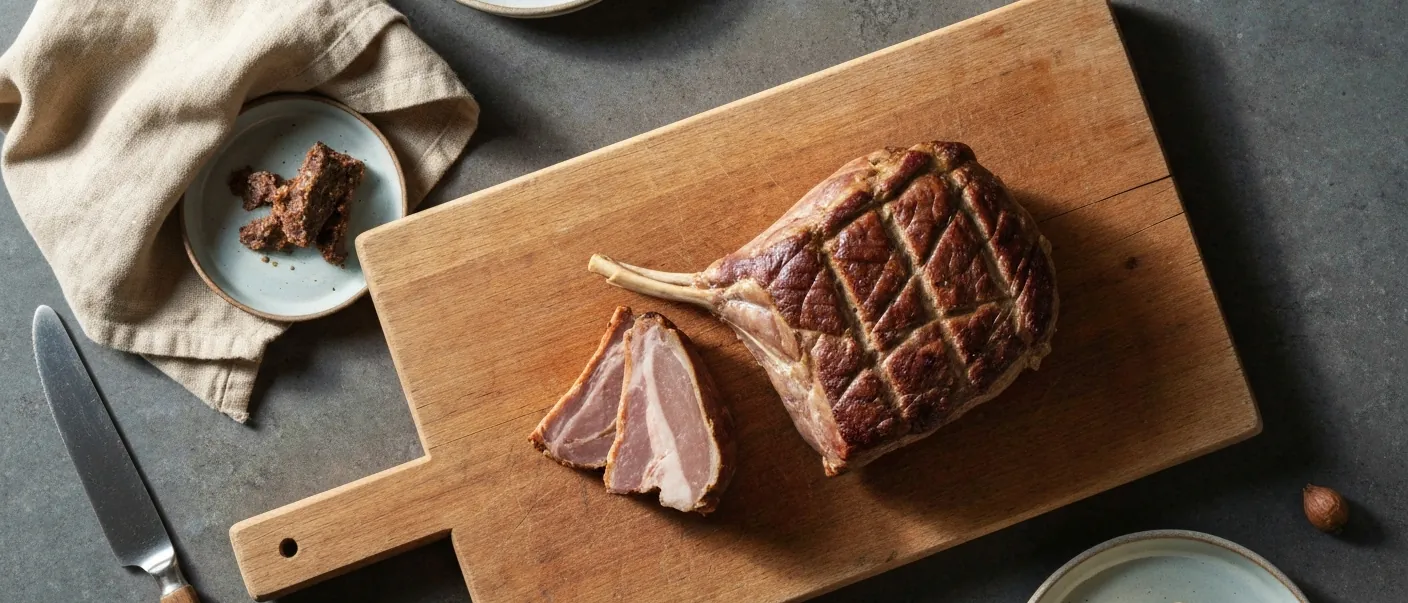
Welsh Lamb is traditionally served simply — roasted on the bone, or braised slowly in ways that let the flavour of the meat lead. It does not need heavy saucing. The upland grazing has already done the seasoning.