What the PGI actually guarantees
Protected Geographical Indication is a European-derived status that Britain has carried forward into its own scheme, and Welsh Beef is one of the products it covers. The rule is straightforward: cattle must be born and reared in Wales. That's not a claim a producer can apply loosely — it's a condition of use, verified through the supply chain before the name can appear on a label.
For the shopper, this matters because provenance is otherwise easy to obscure. Beef can travel considerable distances between farm, abattoir and supermarket shelf, and labelling doesn't always make that journey legible. The PGI cuts through that. When you see Welsh Beef marked and certified, the animal lived its life in Wales, on Welsh land, under Welsh weather.
The land behind the flavour
Wales is not one landscape but many — upland moorland, river valleys, coastal pasture — and cattle raised across these environments graze on grass that reflects where they are. Pasture-rearing, which suits the wet, mild Welsh climate well, tends to produce beef with a particular depth of flavour and a fat that colours well on the bone. These aren't characteristics you can manufacture; they accumulate slowly, over the life of the animal and the character of the ground beneath it.
The Welsh hill farms that supply a significant proportion of this beef operate at altitudes and on terrain that would defeat most arable ambitions. Cattle farming here isn't a default — it's what the land is suited to, and that fit between animal, breed and place is part of what the PGI is designed to recognise.
The Welsh Black and the native breed tradition
Among the breeds contributing to Welsh Beef, the Welsh Black stands apart. It is one of Britain's oldest cattle breeds — hardy, dual-purpose in its origins, and shaped over centuries by the same upland conditions that define much of Wales. The Welsh Black carries weight well on rough grazing and matures without the intensive inputs that commercial crossbreeds often require. Its beef has a quiet intensity of flavour rather than the blankness that can come from rapid, grain-finished production.
Other traditional and native breeds also fall within the PGI's scope. What connects them is adaptation to the Welsh environment: slower growth, greater hardiness, a relationship with pasture rather than feedlot. The PGI doesn't specify breed, but the farming culture that underpins it favours animals suited to the land rather than animals engineered for throughput.
How to find and buy it well
Certified Welsh Beef is available through independent butchers across Wales and through online mail-order butchers who work directly with Welsh farms. The certification mark is the thing to look for — not simply the word "Welsh" on packaging, which can appear without the same guarantees, but the official PGI designation alongside it.
A good independent butcher will often be able to tell you which farm or region the beef has come from, and sometimes the breed. That level of traceability supports the farmers and farming practices the status exists to protect.
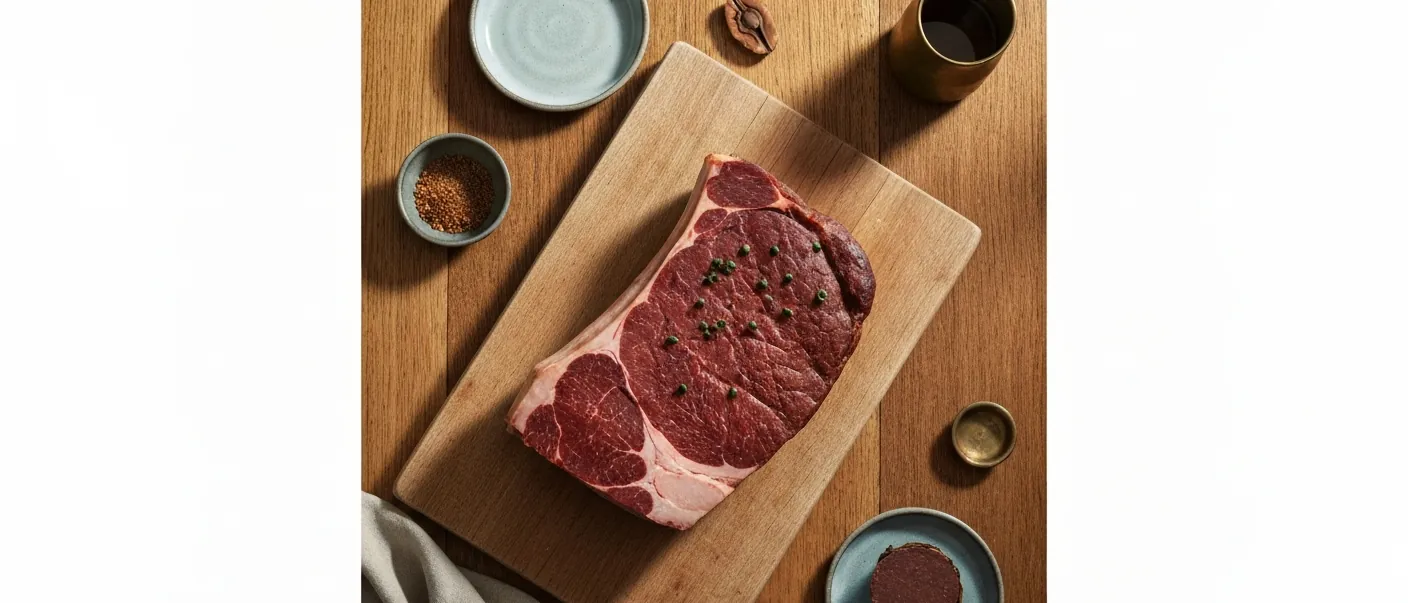
Consider cuts that suit slower methods: Welsh Black in particular rewards time. Shin, brisket, short rib — these reflect the animal's working life and carry the depth of flavour that pasture-rearing builds. They are also, typically, among the more affordable parts of the carcase, which makes buying well-sourced Welsh Beef more accessible than it might first appear.
Why provenance protections are worth understanding
PGI is sometimes dismissed as bureaucracy, but for small-scale producers it functions as something more practical: protection against imitation and a framework for telling a true story. Without it, there's little to stop a producer elsewhere applying the "Welsh" label to beef with no connection to Wales. With it, the name carries legal weight.
These protections are also a map for consumers. They don't guarantee that every certified product will be exceptional — quality still varies within any protected category — but they establish a floor. The animal was raised where the label says. The farming happened in a particular landscape. That's a meaningful start.