The short version everyone gets wrong
Ask around and you'll hear two confident, opposing claims. One: the ploughman's lunch is an ancient rural tradition, the honest sustenance of working men in the fields. Two: it was dreamed up by the Cheese Bureau and the Milk Marketing Board in the mid-twentieth century as a way to sell more cheese in pubs. Both are partly true, which is what makes the story worth telling properly.
The marketing campaign is well documented. Promotional material pushed the combination of bread, cheese and pickle onto pub menus with considerable force, giving the meal a name that conjured images of muddy boots and honest toil. It worked. The ploughman's became a fixture of the British pub lunch in a way it hadn't quite been before — at least not under that name, and not as a standardised thing you could simply order.
Cold food in the fields is as old as farming
What the Milk Marketing Board could not have invented is the habit of taking cold provisions into the field. Bread and hard cheese travel well, keep without refrigeration, and need no preparation on arrival. Ale — lower in alcohol than modern bitter, closer to what we might call small beer — was safer to drink than water from many sources, and cheaper to produce. A farm worker carrying these things at midday was not following a marketing brief.
Household accounts and literary references across several centuries describe cold collations of this general character. None call it a ploughman's lunch. The name is almost certainly a twentieth-century coinage, quite possibly the marketing industry's own. But the absence of a name does not mean the thing didn't exist. We don't conclude that sandwiches didn't exist before the Earl of Sandwich gave them his name.
Why the tension matters
It would be easy to dismiss the ploughman's as a confection — a nostalgic fiction sold to city dwellers wanting to feel connected to a rural past. And yet that reading is too tidy. The Cheese Bureau and Milk Marketing Board were not creating something from nothing; they were packaging something recognisable, tidying its edges and putting it on a chalkboard.
This is how a great many British food traditions have been transmitted and stabilised. Someone formalises what was previously informal. The formalisation changes things — standardises them, sometimes impoverishes them — but it also preserves them. The ploughman's survived the twentieth century partly because it was marketed. Without that, it might have dissolved into the general background of cold pub snacks and never acquired a name at all.
There is a further irony. The version on the marketing material — a generous wedge of hard British cheese, crusty bread, proper pickle, perhaps a pickled onion or two, a knob of butter — is genuinely good. Whatever the commercial motives behind its promotion, the logic of the combination is sound: sharp, fermented pickle cuts through the fat of the cheese; bread gives it ballast; ale provides bitterness to clean the palate. The plate makes sense and requires no apology.
What a good one looks like now
The modern pub version varies enormously. At its worst, it is a limp wedge of cheddar, two crackers from a cellophane packet and a scraping of brown sauce standing in for pickle. At its best — and British pubs, delis and farmhouse producers do still produce the best — it is a serious thing: properly aged county cheese, bread with some character, a good quantity of chutney or pickle made with patience and vinegar, and enough of everything so that no element runs out before the others.
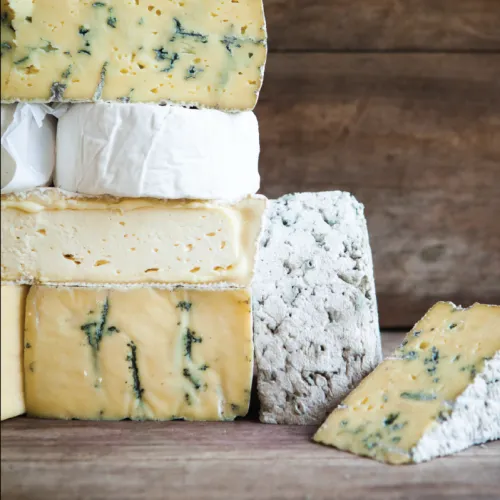
The cheese is arguably the most important variable. A clothbound territorial — a well-aged Cheshire, a crumbly Lancashire, a properly made farmhouse cheddar — brings a depth that processed block cheese cannot replicate. Commercially made pickle is fine, but a good, dark, slow-cooked chutney from a small producer makes the difference between something perfunctory and something worth returning for.
- Cheese: hard, aged and ideally British — clothbound territorials reward the combination particularly well.
- Pickle: the real thing, not brown sauce; a chutney with acidity and body rather than sweetness alone.
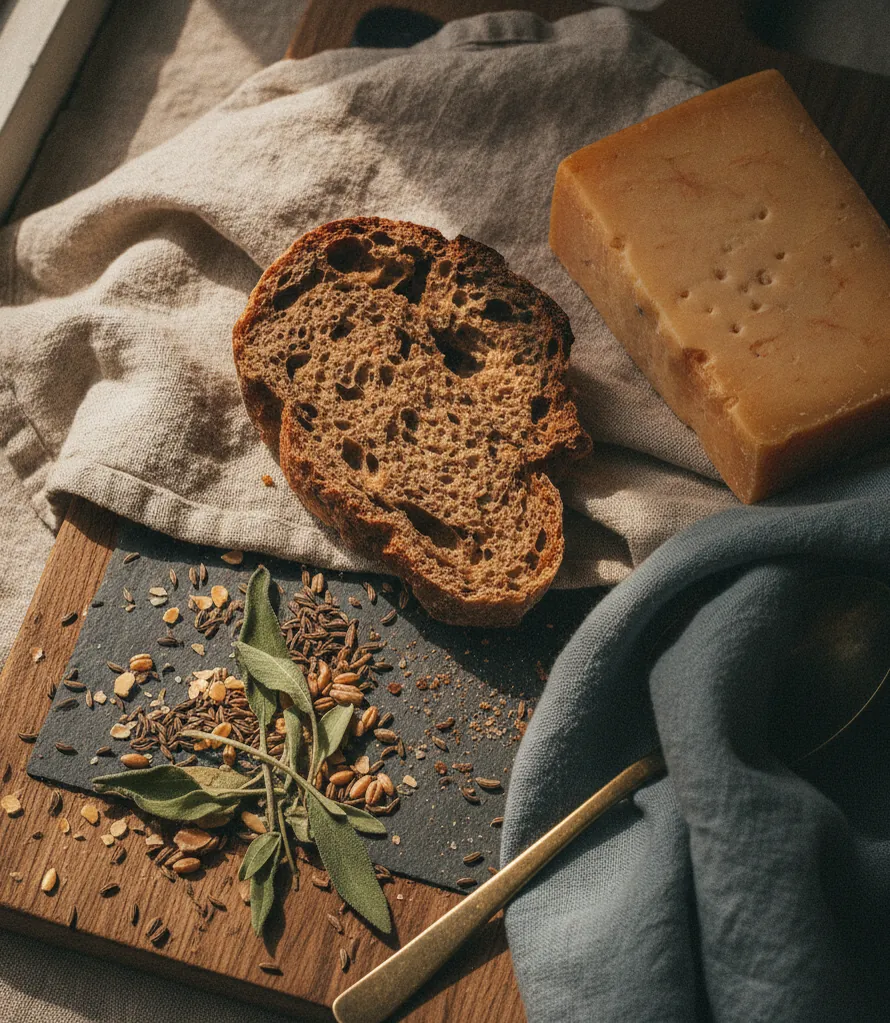
- Bread: something with crust and density — sourdough, a good farmhouse white, or a malted loaf all work where a soft sandwich slice does not.
- Ale: not mandatory, but the traditional pairing; a bitter or mild with some bitterness will do what the combination was always meant to do.
Older than its name, younger than its myth
The honest answer to whether the ploughman's lunch is ancient or invented is: both, depending on which part of the question you're asking. The name and the standardised form are modern. The instinct behind it — cold food, good cheese, something sharp, something to drink — runs much deeper through British food culture than any marketing campaign. Food traditions are almost never as pure as their most enthusiastic defenders claim, and almost never as hollow as cynics suggest. The ploughman's sits comfortably in that honest middle ground, which is also, it turns out, a very good place to eat lunch.