A sausage with a paper trail
Most traditional British sausages exist in folk memory rather than in print. The Oxford sausage is different. Recipes appear in old cookery books going back centuries — specific, detailed, describing something well-known enough to need no introduction. That kind of documentation is rare. This was not a local curiosity or a butcher's marketing invention; it was a recognised type with a character distinct enough to carry a place name.
What set it apart was the meat. Where most British sausages were pork-only affairs, the Oxford sausage combined veal with pork — a pairing that produces a finer texture and a flavour between the richness of good pork and the mildness of veal. The seasoning leant into herbs and warm spice rather than the blunt saltiness that defines many cheaper sausages.
No skin in the game
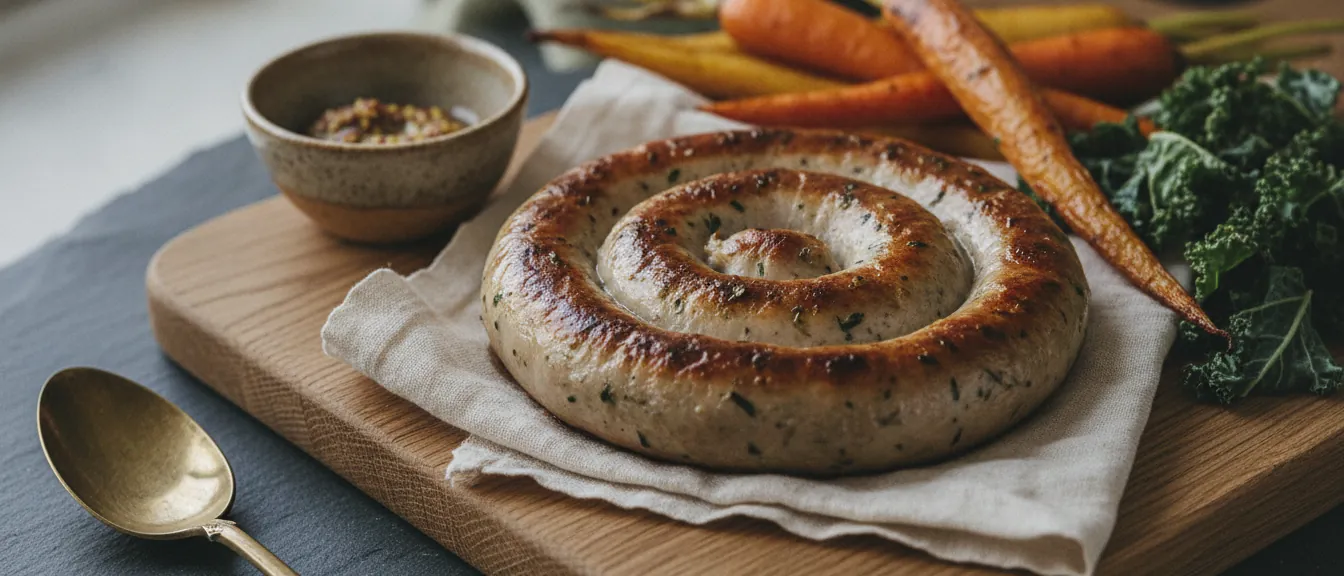
The Oxford sausage is formed and cooked without a casing — more like a hand-shaped patty or roll than a link sausage. Skinless sausages appear throughout historical British recipe writing, but the format does mean the mixture needs to be well-made and properly rested before cooking; without a skin to hold everything together under heat, handling matters.
That skinless quality also affects how it eats. There is no snap or chew to work through; herbs and spice come forward quickly. It sits closer in spirit to a good faggot or a well-seasoned meat patty than to a Cumberland coil, and it rewards slow cooking over a hot pan.
How it disappeared
The Oxford sausage's decline is not mysterious. Veal became increasingly unpopular in Britain over the twentieth century, largely due to concerns about calf-rearing practices. A sausage that depended on veal as a core ingredient was always going to suffer when that ingredient fell out of favour.
There was also the broader homogenisation of the British sausage market. As mass production took hold, regional variation collapsed. The Oxford sausage did not disappear in a single moment — it simply thinned out until it was almost impossible to find.
The revival gathering pace
British rose veal — from calves raised to higher welfare standards, often outdoors — has made a steady return to independent butchers and farmers' markets. Consumers willing to seek it out now have more options than at any point in recent memory, and that has reopened the door for preparations that depend on it.
A small number of artisan butchers have taken the Oxford sausage on as something worth reviving properly. These are not novelty products. The butchers making them work from historical recipes and treat the Oxford sausage as what it always was — a specific, well-defined product with a logic to it. The veal-and-pork balance, the skinless form, the herb-forward seasoning: all of it is present in the best contemporary versions.
It has not become widely available. You are unlikely to find it in a supermarket, and even at farmers' markets it takes some asking around. That is, in a way, fitting. The Oxford sausage was always made by people who cared about the craft, and the producers reviving it today are the same kind of people.
Beyond nostalgia
There is a temptation to frame the revival of a forgotten food purely as heritage preservation. The Oxford sausage deserves more than that reading. It represents something genuinely distinct within British butchery: a sausage tradition that used a different protein, a different structure, and a different flavour profile from the mainstream. Losing it entirely would mean losing a branch of the British butchery tradition with its own clear aesthetic.
It is also, by most accounts of those who have eaten a well-made version, simply very good. The combination of veal and pork, seasoned with herbs and a touch of spice, has a lightness and depth that the standard pork banger — fine as that often is — does not offer. The history makes it interesting; the flavour is what makes it worth seeking out.