What makes a Lincolnshire sausage
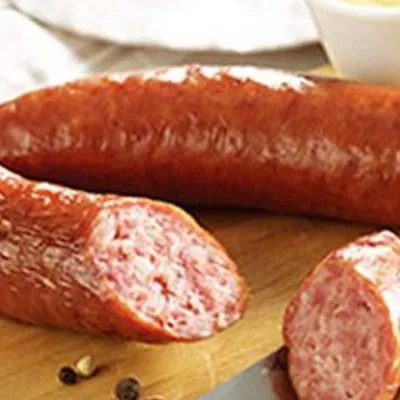
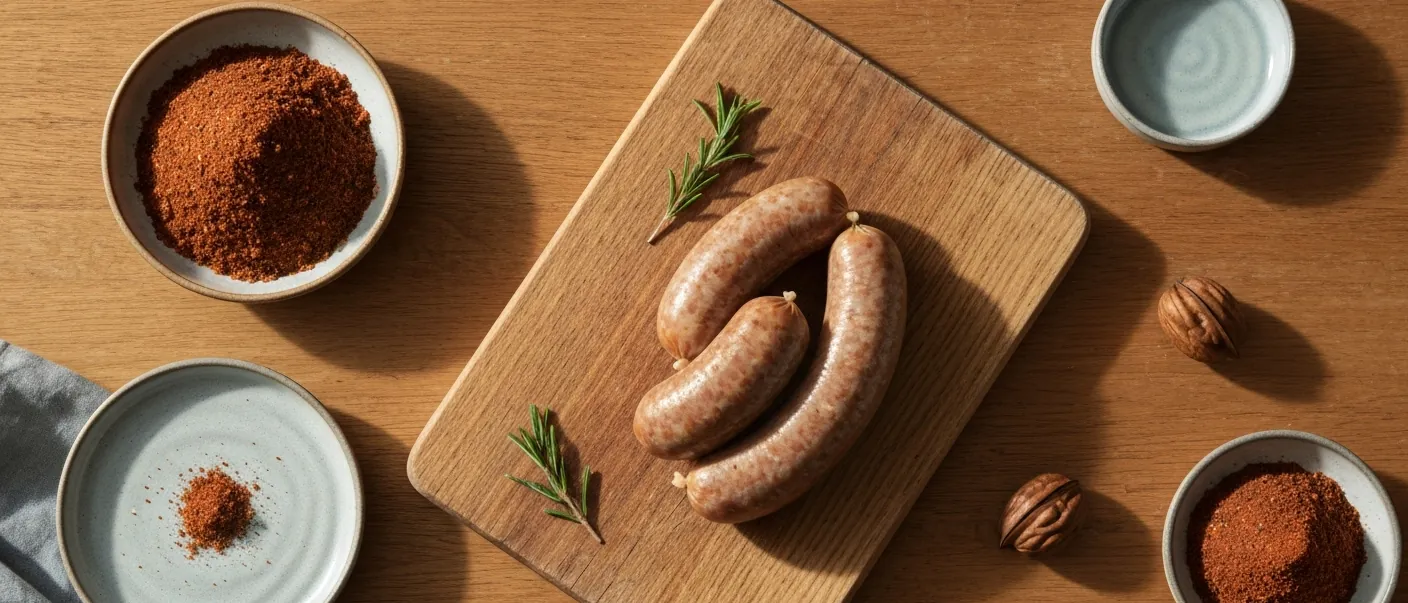
The character of a Lincolnshire sausage comes down to two things: the cut and the herb. The pork is chopped rather than finely minced, giving the finished sausage a coarse, open texture that holds its shape in the pan but has none of the dense, uniform springiness of a mass-produced banger. Running through it, unmistakably, is sage — not as a background note but as the dominant flavour. This is not a sausage that hides behind seasoning blends or smoked casings. The sage leads.
That combination — coarse-cut pork, pronounced sage — is what butchers and producers across Lincolnshire have long understood to define the thing. The county has a strong tradition of pig farming, and its sausage-making heritage reflects that: straightforward, meat-forward, with a seasoning philosophy rooted in the herb garden rather than the spice rack.
The case for protection, and why it was refused
Geographical Indication protection — the PGI and PDO designations covering everything from Stilton to Cornish pasties — exists to bind a food's name to its place of origin and, usually, to a defined method of production. For producers, it means the name cannot legally be used by anyone outside the protected area making the product to a different standard. For shoppers, it functions as a guarantee of authenticity.
The Lincolnshire sausage did apply for PGI status and was refused. The grounds for any such refusal can be complex, but the broad challenge facing regional sausages is a recurring one: demonstrating that the character of the product is sufficiently linked to the geography itself, rather than simply to a tradition that happens to have grown up in a particular place. A cheese can point to the mineral qualities of local milk or the specific moulds in a particular cave. A sausage, even one with a long history, must work harder to make that case.
The refusal was not a judgement on quality. It was a procedural outcome — and an instructive one about where the boundaries of geographical protection lie.
What the refusal actually means
Without PGI status, the name 'Lincolnshire sausage' belongs to no one. Any producer anywhere in the country — anywhere in the world, in fact — can sell a sausage under that name. There is no requirement to use pork from Lincolnshire, no obligation to include sage, no stipulation on the coarseness of the cut. A factory in another county producing a fine-minced, herb-free sausage could, entirely legally, label it Lincolnshire.
This is not a hypothetical concern. Supermarket shelves carry sausages bearing the name that bear little resemblance to what a Lincolnshire butcher would recognise. The name has become loosely descriptive — shorthand for a sage-flavoured sausage — rather than a meaningful provenance marker.
Compare this with the Cumberland sausage, which did secure PGI protection and must by law be produced in Cumbria to a coiled, specified form. The contrast is sharp: protection is not automatic, and its absence has consequences that compound over time as the name drifts further from its origins.
Finding the genuine article
Genuine Lincolnshire sausages — made to the coarse-cut, sage-forward tradition — do still exist. Finding them is largely a matter of going to the right source. Independent butchers in Lincolnshire, and those elsewhere who have maintained the tradition honestly, are where the real thing is most reliably found. A few markers worth looking for:
- Visible texture: the cut pork should be apparent in the finished sausage, not a homogenous paste.
- Sage prominence: if the herb is indistinct or absent, it is not a traditional Lincolnshire recipe.
- Honest sourcing: a butcher who can tell you where the pork came from is a good sign, even if Lincolnshire origin is not legally required.
The sausage is traditionally eaten simply — grilled or fried, in a sandwich, or alongside eggs with brown sauce or mustard. Its robust seasoning holds up well to those accompaniments in a way that a blander sausage cannot.
Why it matters beyond the sausage
The Lincolnshire case illustrates the limits of a system that, at first glance, seems straightforward. Geographical protection is powerful when it works, but the criteria are strict, the process is slow, and failure leaves producers with no recourse. The name remains in common use, the tradition continues in some places, but the two are no longer tied together by anything enforceable.
For anyone who cares about regional food — not as nostalgia, but as a living part of what British producers still make well — that gap between tradition and legal protection is worth understanding. The Lincolnshire sausage is genuinely good. It deserves to mean something specific. At the moment, whether it does depends entirely on who made it.