A cake that is not really a cake
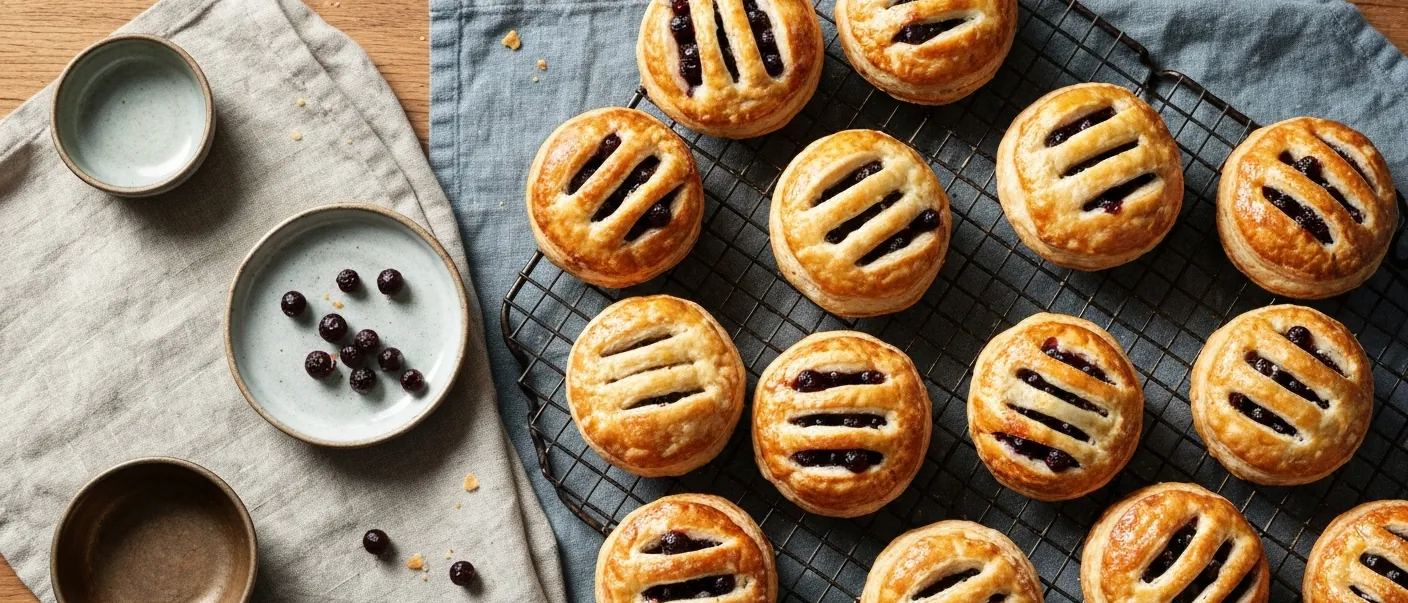
The name misleads. An Eccles cake contains no sponge, no eggs beaten with sugar, nothing you would recognise from a birthday. What you get is a small, roughly circular parcel of flaky butter pastry, pinched shut over a filling of currants — dark, sticky and dense — with the top slashed to show what lies beneath and glazed until it caramelises at the edges. By any reasonable definition, it is a pastry. Lancashire, characteristically, calls it what it likes.
The town of Eccles sits just west of Manchester, and the cake takes its name directly from the place. That tight geographic identity matters: this is not a style of bake that evolved across a region and got named retrospectively. It belongs, by origin and reputation, to a specific corner of Lancashire, and the recipe has stayed remarkably consistent across the generations.
What makes the filling
Currants are non-negotiable. Not raisins, not sultanas — currants, which are smaller, sharper and less sweet, holding their character inside the buttery pastry rather than dissolving into it. The filling is typically spiced, with warm spices working quietly in the background, and sweetened, though the overall effect is less sugary than you might expect.
The pastry is the other half of the equation. Properly made, it shatters when you bite into it, sending flakes in several directions. That contrast between the crisp, laminated exterior and the dense, jammy interior is the whole point. Affectionately known in some parts as dead fly pie — the currants, glimpsed through the pastry slashes, being the source of this slightly grim nickname — the Eccles cake has never tried to be refined. It is a robust, honest thing, and all the better for it.
The Lancashire cheese pairing
Eating an Eccles cake with a wedge of Lancashire cheese is one of those regional traditions that sounds improbable until you try it. Lancashire cheese — crumbly, mild and faintly acidic — cuts through the sweetness of the currants and the richness of the butter pastry in a way that makes both things taste more like themselves. It is the same instinct that puts Wensleydale with fruitcake, or a sharp cheddar with apple pie: fat, fruit, salt and tang in balance.
This pairing deserves far wider recognition than it gets. It turns a teatime snack into something that sits comfortably alongside a glass of something. The cheese should be cool; the cake ideally still slightly warm.
Where the Eccles cake sits in British baking
Britain has a particular tradition of small, filled pastries that are intensely regional and stubbornly individual — the Cornish pasty, the Chorley cake, the singing hinny. The Eccles cake belongs to this family. Its closest relative is the Chorley cake, also from Lancashire, which uses shortcrust rather than flaky pastry and is plainer in character. The two are distinct enough that Lancastrians will tell you firmly they are not the same thing, and they are right.
What the Eccles cake shares with the best regional bakes is a resistance to reinvention. Versions with added ingredients appear from time to time, and bakeries have occasionally experimented with the format, but the original holds its ground. The combination of flaky pastry and spiced currants is so well-balanced that most attempts to improve it end up making the case for leaving well alone.
Finding a good one
The best Eccles cakes come from bakeries that still make the pastry properly — laminating butter through the dough with care rather than using a commercial shortcut. The result should feel light despite being rich, and the base should be fully cooked, not pale and doughy. A good one will have a defined, slightly uneven shape: the pinched pastry seams visible on one side, the slashed and glazed surface on the other.
Supermarket versions exist, and some are decent, but the gap between a mass-produced Eccles cake and one made by a bakery that takes the pastry seriously is considerable. Independent bakers across the north-west are the obvious place to start, though good examples do travel — some specialist food retailers and online producers ship them, and they hold up reasonably well. If you come across them freshly baked, eat them that day.