The problem with a name everyone owns
'Cheddar' is, legally speaking, almost meaningless as a geographical indicator. The name long ago escaped any boundary and can now appear on cheese made in any country, by any method, using milk from any herd. This makes Orkney Cheddar's Protected Geographical Indication status genuinely unusual. Among cheddars, only a handful carry any protected designation — West Country Farmhouse Cheddar holds a PDO, and Orkney holds its PGI. Everything else called cheddar is simply a style.
PGI status is not awarded on sentiment. It requires a demonstrable link between the food and its place of origin — the geography, the farming practices, the production itself. For Orkney Cheddar, that link runs through the islands' milk.
What the islands bring to the milk
Orkney sits further north than most people picture when they think of British dairy farming, and the landscape shapes everything. The archipelago's summers bring extraordinarily long daylight hours — not the intense heat of southern Europe, but a slow, extended light that keeps grass growing well into the evening. Cattle graze on pasture that benefits from this rhythm, and that grazed milk is the foundation of the cheese.
Island herds tend to be smaller and more self-contained than those supplying large mainland creameries, keeping the milk supply close-knit and traceable. The requirement that milk be produced on Orkney itself is the clause that gives the PGI its teeth — you cannot truck in milk from elsewhere and call the result Orkney Cheddar.
A dairying tradition with deep roots
Cheese and butter have been leaving Orkney for the Scottish mainland for a very long time. The islands developed a reputation for dairy exports well before protected status was ever a consideration, which suggests the quality was evident long before anyone thought to formalise it. This is not a niche product invented to attract a premium, but a continuation of something the islands have done for generations.
The cheddar itself is typically moist and close-textured — characteristics that set it apart from the drier, more crumbly styles associated with long-aged West Country cheddars. Sold at a range of maturities, the flavour profile shifts with age, but the underlying texture tends to remain distinctively smooth rather than granular.
How to approach it at the table
Orkney Cheddar earns its place on a board without needing to shout. Its mellow, milky character at younger ages makes it approachable alongside oatcakes — the natural pairing in Scotland. Older versions develop enough depth to hold their own against something more assertive: a good chutney or a dark, malty ale from one of Scotland's smaller breweries.
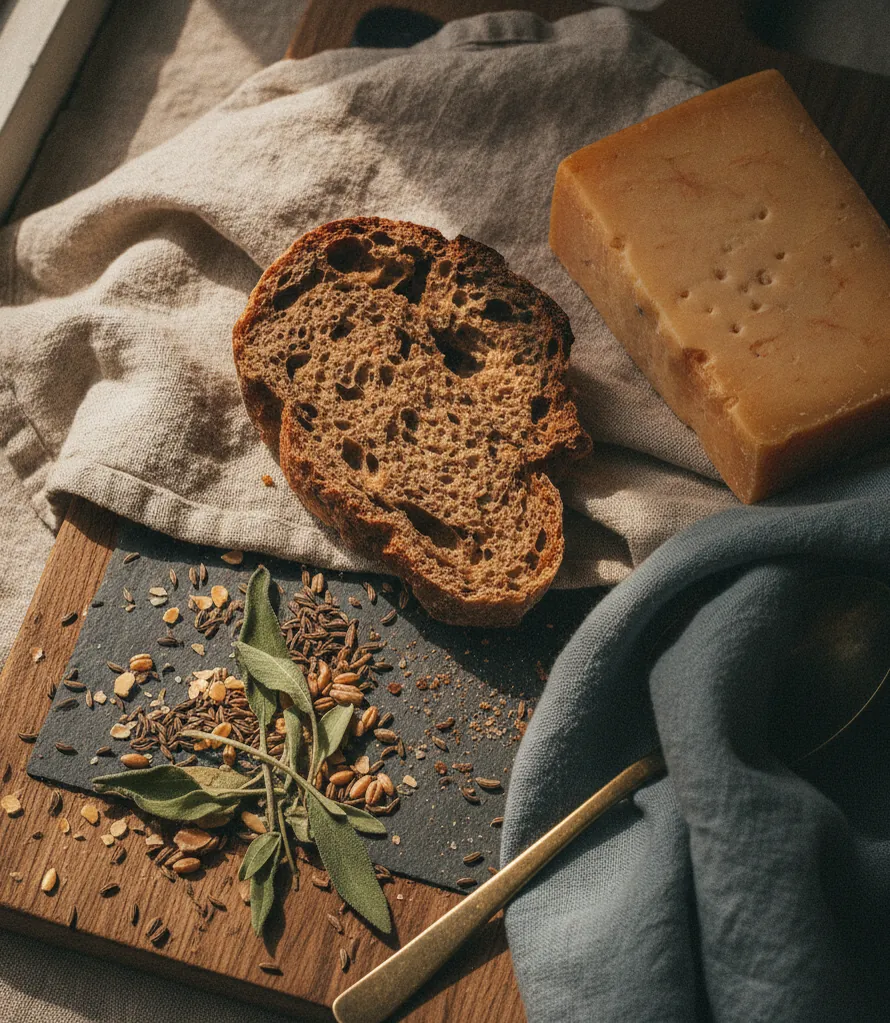
It melts well and has long been used as a cooking cheese in Scottish kitchens. The most straightforward way to appreciate what the PGI is protecting, though, is to eat it simply, with bread and perhaps a little butter, where the clean dairy quality of island milk comes through without distraction.
Why protected status is worth caring about
It is easy to be cynical about geographical designations — the system is imperfect and not every PGI or PDO product is automatically superior. But in the case of cheddar specifically, where the name offers the consumer no protection whatsoever, Orkney's designation does something useful. It guarantees that the cheese in the packet was made where it says it was made, from milk produced there. In a category where geographical fraud is effectively legal, that is a more meaningful promise than it might sound.
For anyone interested in where British food actually comes from — the specific places, the specific animals, the specific land — Orkney Cheddar is a rare case where the label is doing honest work.