What the PGI mark actually means here
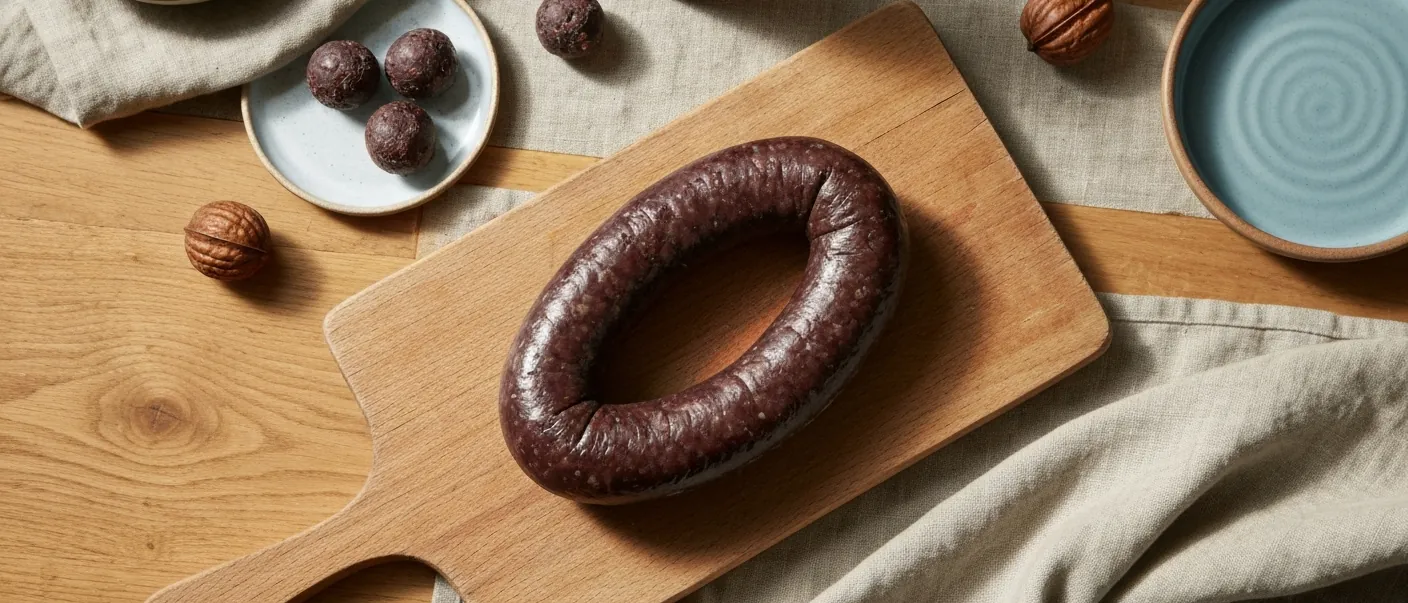
Protected Geographical Indication — PGI — is not a quality badge in the marketing sense. It is a legally enforced link between a food and a specific place, meaning that no producer outside the designated area can call their product by that name, regardless of how closely they follow the recipe. For Stornoway black pudding, that place is the Stornoway area of the Isle of Lewis in the Outer Hebrides. Move the production to the mainland, use the same ingredients in the same proportions, and the result is simply black pudding — not Stornoway black pudding.
This matters because the name had already acquired genuine meaning long before formal protection arrived. Visitors to Lewis returned home talking about the pudding. Butchers in Stornoway built reputations around it. The PGI status codified something that was already understood locally: this is a specific thing, made in a specific place, and the two cannot be separated.
What sets it apart on the plate
British black pudding varies considerably by region. Some versions are dense and heavily spiced; others lean towards a looser, crumblier texture. Stornoway sits firmly in its own category. The texture most people notice first is moist and substantial without being claggy — it holds its shape when sliced but gives way cleanly when eaten. Oatmeal is central to this, used in a proportion that gives the pudding body and a mild, slightly nutty depth that balances the richness of the blood and fat.
The spicing is relatively restrained compared to some English or Irish counterparts, leaving the base ingredients — blood, fat, oatmeal — room to speak for themselves. It is a pudding that tastes of what it is, rather than of what has been added to disguise it.
The Lewis connection
The Isle of Lewis is remote in the most literal sense: reaching Stornoway means either a long ferry crossing from Ullapool or a flight from a handful of Scottish airports. That isolation preserved local food traditions that elsewhere were gradually absorbed into more homogenised production. The craft butchers of Stornoway continued making black pudding as they always had — not as a conscious act of heritage preservation, but because it worked and people wanted it.
The island's food culture is broadly one of practical, ingredient-led cooking. Lamb, seafood, game, oats — these are the staples of a place shaped by its landscape. Black pudding fits that pattern exactly. Oats thrive in the cool, damp Hebridean climate and have been a dietary cornerstone for centuries. Using them generously in black pudding is not a quirk; it is the logical outcome of cooking with what the land provides.
How it is eaten
The full Scottish breakfast is the obvious context — fried or grilled alongside eggs, bacon, tattie scones and perhaps a slice of haggis. Framing Stornoway black pudding purely as breakfast food, though, undersells it considerably. It appears in warm salads, alongside scallops in restaurant cooking, and on cold platters where its richness provides contrast to lighter elements. Sliced thickly and cooked until the outside crisps while the centre stays yielding, it needs little accompaniment beyond good bread or eggs.
What it does not need is heavy sauce or elaborate preparation. The pudding has enough character that the cook's main job is simply not to get in the way.
Buying the real thing
The PGI designation gives buyers a reliable signal: if the label reads Stornoway Black Pudding and carries the PGI mark, it was made in the qualifying area. Specialist online butchers and some supermarket counters stock it, and it travels well chilled. Buying directly from Lewis butchers — several of whom sell by post — is the most direct route and often means getting the pudding at its freshest. Whatever the source, look for the PGI mark rather than simply the name, as the designation is what guarantees the provenance.