A name borrowed from history
The name Stichelton comes from an early recorded spelling of the village we now call Stilton — a piece of linguistic archaeology that carries its own quiet argument. If this cheese reaches back to a form of the place that predates the modern name, the makers seem to be saying, then perhaps it also reaches back to a form of the recipe that predates the modern rules.
Those rules are set by the Stilton PDO — the Protected Designation of Origin that defines exactly what Stilton is and how it must be made. Stilton must come from the three counties of Leicestershire, Derbyshire, and Nottinghamshire; it must be made to a specific method; and, critically, it must use pasteurised milk. Stichelton is made in Nottinghamshire and follows the Stilton style in almost every other respect, but uses raw, unpasteurised milk. That single deviation puts it outside the PDO, and outside the name.
Why raw milk changes the cheese
Pasteurisation heats milk to destroy potentially harmful bacteria, but it also alters the microbial landscape in ways that affect flavour. Raw milk carries the native bacteria of the herd, the land, and the season — organisms that survive into the finished cheese and continue to shape it as it matures. As we explore in our article on raw milk cheeses, this is where much of what cheesemakers call terroir actually lives: not in romantic abstraction, but in the biology of unpasteurised milk.
In a blue cheese, that matters considerably. The bacterial cultures introduced during making interact with the Penicillium roqueforti spores responsible for the blue-green veining, and the combined effect on flavour is complex and variable in ways that pasteurised-milk blues rarely are. Stichelton tends to be earthier and more mineral, with a depth that shifts between batches and across the months of maturation. The texture is often creamier and more yielding than most Stiltons — raw milk fat behaves differently as its enzymes break down during ageing.
What the PDO protects, and what it closes off
Protected food names exist for good reasons. They stop producers in other regions from trading on a reputation they haven't earned, and they give consumers reliable information about provenance and method. The Stilton PDO has done exactly that.
But Stichelton illustrates a tension running through many protected food systems. The pasteurisation requirement was written into the specification at a point when raw milk production was considered commercially impractical for large-scale Stilton making. The result is that a method almost certainly older than the PDO — Stilton was made with raw milk for most of its history — is now excluded from the protected category. Rules designed to preserve a tradition inadvertently ruled out an older strand of that same tradition.
This is not a flaw unique to Stilton. Across Europe, PDO specifications often codify the practices of a particular moment rather than the full historical range of a cheese's making. Whether protection should be defined by geography alone, or by geography plus a fixed method, is something producers, regulators, and food historians continue to argue about.
Buying and serving it
Stichelton is made in relatively small quantities and tends to appear through specialist cheesemongers and good farm shops rather than supermarkets. It is sold at various stages of maturity: a younger cheese is milder and more yielding, while an older one develops a more pronounced blue character and a slightly granular paste near the rind.
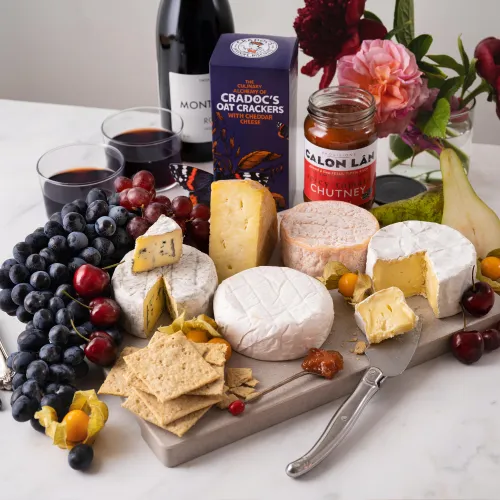
Temperature matters. Serving it straight from the refrigerator suppresses everything that makes it interesting — allow at least an hour at room temperature before eating. It pairs well with foods that carry their own sweetness or acidity: pears, walnuts, good honey, oatcakes.
At Christmas, the pairing with port that we describe in our separate piece on that tradition sits naturally here. The wine's sweetness and the cheese's mineral bite work against each other as good pairings should — neither simply agreeing with the other, but both made more interesting by the contrast. A tawny port, with its oxidised nuttiness, tends to complement the earthier notes that the raw milk brings.
Where it sits
Stichelton is sometimes framed as a challenger to Stilton, but that framing misses the point. The two cheeses are doing different things from the same geographical and stylistic starting place. Stilton, made by larger creameries to a consistent specification, offers reliability and scale. Stichelton offers variability, rawness in both senses of the word, and a connection to a way of making that largely disappeared from this corner of Nottinghamshire. The name difference tells you something real about what is on the board — which is exactly what a well-functioning food system should deliver.