
A pie built around a legend
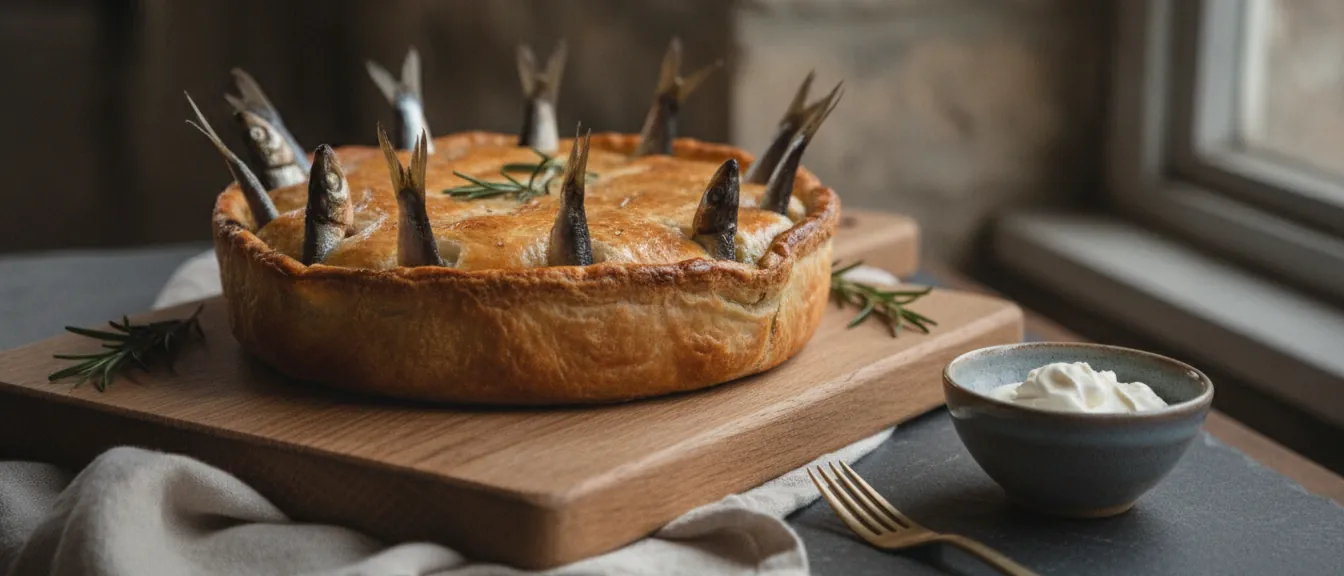
Stargazy pie is an unusual sight. Whole pilchards are laid beneath a pastry lid with their heads left to emerge through it, faces upturned as if scanning the night sky. The drama is deliberate, and it belongs entirely to one place: Mousehole, a small fishing village on the far western edge of Cornwall.
The pie is eaten on Tom Bawcock's Eve, a night in December kept alive by the village as a communal celebration. Tom Bawcock is legendary rather than strictly historical — tradition holds that he was a fisherman who, during a period of terrible winter storms, put out to sea alone when all others had been driven ashore. He returned with a catch large enough to end a local famine. The fish he brought back were baked into a pie, heads proudly on show to prove to the hungry village that the boats had come home loaded.
Whether Bawcock existed in the way the legend describes is beside the point. What the story carries is real enough: the mortal dependence of a fishing community on the sea, and the particular courage required to go out when the weather says otherwise.
Why the heads stay on
The exposed pilchard heads are not mere theatre, though they have become the pie's most recognisable feature. Leaving the heads visible was a practical way of demonstrating the quality and abundance of a catch — proof of what lay beneath the crust. In the context of the legend, it reads as a declaration: look what was brought back for us.
Pilchards, the fish traditionally used, are the adult form of the sardine, once caught in enormous quantities off the Cornish coast. Their oily, assertive flavour holds up well under pastry, and they were historically a staple of the region rather than a delicacy. Using them in stargazy pie is as much an act of remembrance as anything else — the pilchard fishery that once defined much of Cornwall's economy has long since declined.
Some versions include eggs and a mustard or cream sauce beneath the pastry; recipes vary from kitchen to kitchen. What stays constant is the arrangement of the fish and the occasion that calls for it.
The village and its night
Mousehole — pronounced Mow-zul by those who know it — draws visitors across the year, but Tom Bawcock's Eve is something different from tourism. It is a night that belongs to the village itself. The Ship Inn serves the pie to locals and those who have made a point of coming for it. The atmosphere is that of a community marking its own story, not performing it for an audience.
The timing in December places the feast close to the darkest point of the year, which feels apt. Midwinter traditions across Britain tend to carry the same undercurrent — a gathering against the cold, a communal act that insists on warmth and continuity. Stargazy pie fits that pattern, even if its specific character is entirely Cornish.
A living tradition
Tom Bawcock's Eve has not been invented for visitors or reconstructed from old records. It is simply something Mousehole does, year after year, in the way that villages hold onto the things that define them. The pie is strange-looking, the legend is unverifiable, and neither of those facts diminishes it.
If you plan to go, check ahead with the Ship Inn and the village — details around the evening can shift, and it is worth knowing what to expect before making the journey down the Penwith peninsula in December. The village is small and the roads are narrow. Usually held in December, check the official site for this year's dates and arrangements.
Stargazy pie is not something you will find recreated with any fidelity far outside Cornwall. The pilchards, the legend, the harbour, the December dark — they are inseparable from each other, which is precisely what makes it worth seeking out.
_jpgq80.webp)