What piccalilli actually is
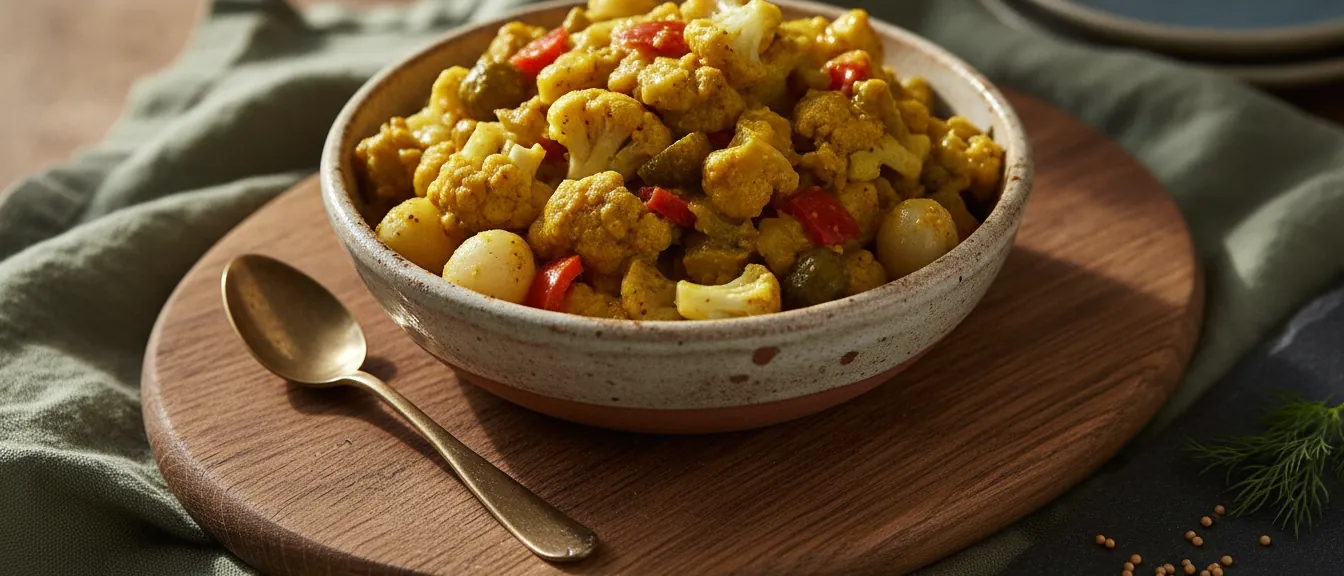
Piccalilli is a British pickle made from chopped vegetables — cauliflower almost always, with combinations of gherkin, onion, green beans, marrow or courgette depending on the maker — preserved in a sharp, mustard-heavy brine coloured vivid yellow by turmeric. The result sits somewhere between a relish and a chutney: chunkier than the former, more acidic and less sweet than the latter. It is pungent, bracing and completely its own thing.
The flavour is defined by the interplay of vinegar heat, mustard warmth and the faint earthiness of turmeric. Good piccalilli has crunch in the vegetables even after pickling, and a sauce that coats rather than drowns them. Mass-produced versions tend to lean on sweetness; small-batch makers are more likely to keep the acid sharp and the mustard prominent, which is where the character lives.
Where it came from
The story begins in the 18th century, when British trade and empire brought Indian spicing — particularly mustard seed and turmeric — into domestic kitchens. Period cookbooks record recipes for pickles clearly influenced by the Indian practice of pickling vegetables in spiced brines, and the word itself appears to echo that colonial encounter, though its exact etymology has never been fully resolved.
What those early recipes share with modern piccalilli is the mustard-and-turmeric base and the mixed vegetable character. The British kitchen absorbed the technique, stripped it of some complexity, and adapted it to vegetables growing in English kitchen gardens. By the time piccalilli appeared regularly in print, it was already recognisably the thing we know today — a domestic staple rather than an exotic import.
Few people eating it now would think of it as anything other than a thoroughly British condiment, which in its current form it essentially is.
The ploughman's connection
Piccalilli's association with the ploughman's lunch is deep-rooted enough that the two feel inseparable. The ploughman's — a pub plate of bread, cheese and pickles — gave piccalilli its most prominent stage, alongside the sweeter, darker Branston-style pickle that has its own following. The mustard heat of piccalilli cuts through a dense, fatty cheese in a way that brown pickle does not; it cleans the palate rather than adding another layer of sweetness.
That function — acid and heat as a foil to richness — explains why piccalilli keeps appearing alongside cold meats, pork pies, ham sandwiches and cheese boards. It is not decorative. It does a specific job, and does it particularly well with aged Cheddar, crumbly Lancashire or a sharp Cheshire.
How independent makers approach it
Among Britain's small-scale pickle and preserve makers, piccalilli is a proving ground. The core formula is well understood, so what distinguishes one producer from another is restraint and balance: how much vinegar, which mustard (powder, seed or both), how long the vegetables are brined before the sauce is added, whether the sauce is cooked briefly or allowed to mature in the jar.
Some makers adjust the vegetable mix seasonally, using what the kitchen garden or a local farm offers in late summer — the classic moment for pickling, when cauliflower and courgettes overlap. Others keep to a fixed recipe year-round for consistency. The best examples have a sauce with real body, not a watery afterthought, and vegetables that have absorbed the spicing without collapsing into mush.
Turmeric quantity matters more than it might seem. Too little and the colour is pallid, the flavour flat; too much and an almost medicinal bitterness comes forward. The yellow of a well-made piccalilli signals that the spicing has been taken seriously.
How to eat it well
Piccalilli is at its best when given something substantial to work against. Alongside a thick slice of cold roast ham or a wedge of mature hard cheese, it earns every inch of space on the plate. It belongs in a proper sandwich — built with good bread and real cheese — and is excellent with a sausage roll or a slice of pork pie, where the fat in the pastry needs exactly the kind of sharp interruption piccalilli provides.
Serve it at room temperature rather than straight from the fridge. Cold dulls the mustard's sharpness and flattens the vinegar. A jar kept in the larder, once opened and used within a sensible period, will give a better result than one chilled throughout. Small producers often note this on the label; it is worth following.