What rationing nearly took away
The Second World War was not kind to British cheese. Government controls on milk use effectively mandated that most milk go towards a single standardised product. Farmhouse cheese — made on individual farms, tied to particular herds and particular places — was largely suspended. Some of it was never revived. Cheesemakers who had kept regional styles alive for generations left the trade, taking with them accumulated knowledge that had never been written down.
By the time rationing ended, the damage was done. The infrastructure of small-scale, place-specific cheesemaking had been dismantled, and industrial production had stepped into the gap. For a generation or more, 'British cheese' meant something plastic-wrapped and uniform, and the idea that this country had once produced a wide range of distinctive regional styles felt more like folklore than living practice.
The people who brought it back
The revival was slow and came from several directions at once. Through the 1980s and into the 1990s, a determined generation of producers began making farmhouse cheese again — often on small farms, often drawing on traditions that had only just survived. Some revived named cheeses with documented histories. Others created new ones using older craft methods: raw milk, animal rennet, cellar ageing, small batches.
What these producers shared was a willingness to work against the grain of an industry that rewarded consistency and scale. Making cheese this way is slow, physically demanding, and commercially precarious. Ageing rooms require constant attention. Raw-milk cheeses carry regulatory complexity. The margins are thin. That so many persisted is partly down to conviction, and partly down to the specialist cheesemongers who began, around the same period, to seek this cheese out and put it in front of curious customers.
Those cheesemongers — mostly independents, often in cities, sometimes attached to markets — did something that goes beyond retail. They educated. A good cheesemonger explains why one truckle of Cheddar tastes of grass and another of nuts, what clothbound ageing does to the rind, why a cheese made in spring differs from one made in autumn. That kind of conversation builds the appetite for quality that producers need in order to survive.
What makes British cheese distinct
Britain's cheesemaking tradition is not a pale version of France or Italy's. It has its own logic. The country's climate and pasture produce milk with particular characteristics, and its cheesemakers developed techniques suited to that milk. The great territorial cheeses — Cheddar, Cheshire, Lancashire, Wensleydale, Stilton among them — are each genuinely different in method, not just in name. Clothbound Cheddar, properly aged, develops a flavour profile unlike anything made in a block or a vat. A good crumbly Lancashire made by hand has a texture that industrial versions cannot replicate.
Protected status under PDO (Protected Designation of Origin) and PGI (Protected Geographical Indication) schemes covers a number of British cheeses, tying their production to specific regions and, in some cases, specific methods. Stilton can only be made in three English counties. West Country Farmhouse Cheddar must come from milk produced and processed within a defined area. These protections preserve the link between a cheese and its place — the thing that makes provenance meaningful rather than decorative.
Where the revival stands now
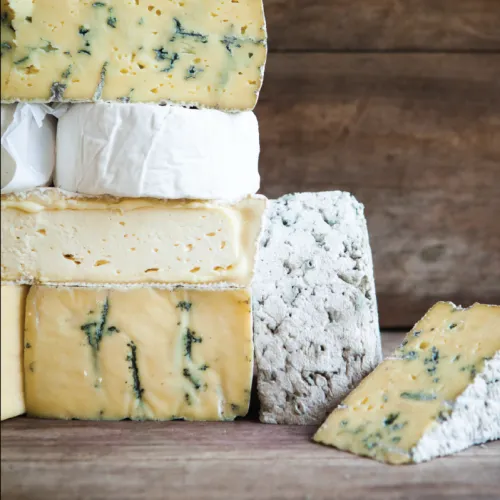
There are now hundreds of named British cheeses in production. The range covers fresh cheeses and long-aged ones, washed rinds and natural moulds, cow's milk and sheep's and goat's, cheeses with centuries of history and cheeses invented within living memory. Some are made by farms with just one or two cheesemakers; others by slightly larger operations that have grown carefully without sacrificing method.
A good specialist cheese shop will stock cheeses at different points in their ageing, explain the seasonal variation in what's available, and be candid about which producers they rate and why. Farmers' markets offer direct access of a different kind — buying from a maker rather than a retailer changes what you learn and who you're supporting.
None of this means the revival is complete or comfortable. Small producers remain vulnerable to farming economics, regulatory change, and the difficulty of finding skilled cheesemakers to train and retain. Knowledge lost during rationing has not been fully recovered; some regional styles are made by very few hands. What has been rebuilt is real, but it is not robust in the way that a century of unbroken tradition would be. The appetite for good British cheese, though, does seem to have changed — genuinely and durably — in ways the revival generation could only have hoped for.