What a Glamorgan sausage actually is
There is no meat in a Glamorgan sausage, and there never has been. The name refers to the shape — a fat, cylindrical roll, crisped to gold in the pan — not to any kinship with pork or beef. Inside, the filling is a close, savoury mixture of Caerphilly cheese, leek and breadcrumbs, bound with egg and seasoned well. It holds together with conviction, browns beautifully, and delivers a satisfying resistance when you cut into it: nothing watery or apologetic about it.
Caerphilly is the right cheese here because of what it does under heat. Crumbly and fresh when cold, it softens without fully melting, keeping the interior dense rather than molten. The leek brings mild sweetness and just enough moisture. The breadcrumbs are structural — they absorb and bind — but they also give the finished sausage a lightness that a heavier batter would kill.
Where it comes from
The sausage takes its name from the old county of Glamorgan in south Wales, historically associated with both leek cultivation and Caerphilly cheese production. The writer George Borrow encountered and praised it during his Victorian walking tour of Wales — which tells us it was already established enough to be worth remarking on, and well-regarded enough to stick in a traveller's memory.
Borrow was writing about Welsh rural life as he found it: real food, eaten by real people, in a country with its own distinct culinary character. The Glamorgan sausage wasn't a curiosity to him; it was simply part of the landscape. That ordinariness is, in retrospect, the point. This was everyday Welsh cooking, not a novelty.
Meat-free before it was fashionable
Welsh farmhouse cooking didn't need a plant-based movement to tell it that cheese and leeks could carry a meal. The sausage existed because it was good, affordable and made from what was readily available locally. It predates any such moment by a very long stretch.
Its position in the modern food landscape is, nonetheless, rather fortunate. At a point when many meat-free products lean hard on novelty ingredients or elaborate processing, the Glamorgan sausage offers a short, recognisable ingredient list and a technique unchanged in its essentials for generations. It sits alongside Welsh rarebit in a category of dishes that never needed rescuing — only rediscovering.
How it is traditionally eaten
The sausage is most commonly served as a main course at lunch or supper, alongside something sharp and pickled — a spoonful of chutney, a few capers, or good mustard. Its richness pairs well with something acidic. It also appears as part of a cooked breakfast in Wales, holding its own without being overwhelmed by the other elements.
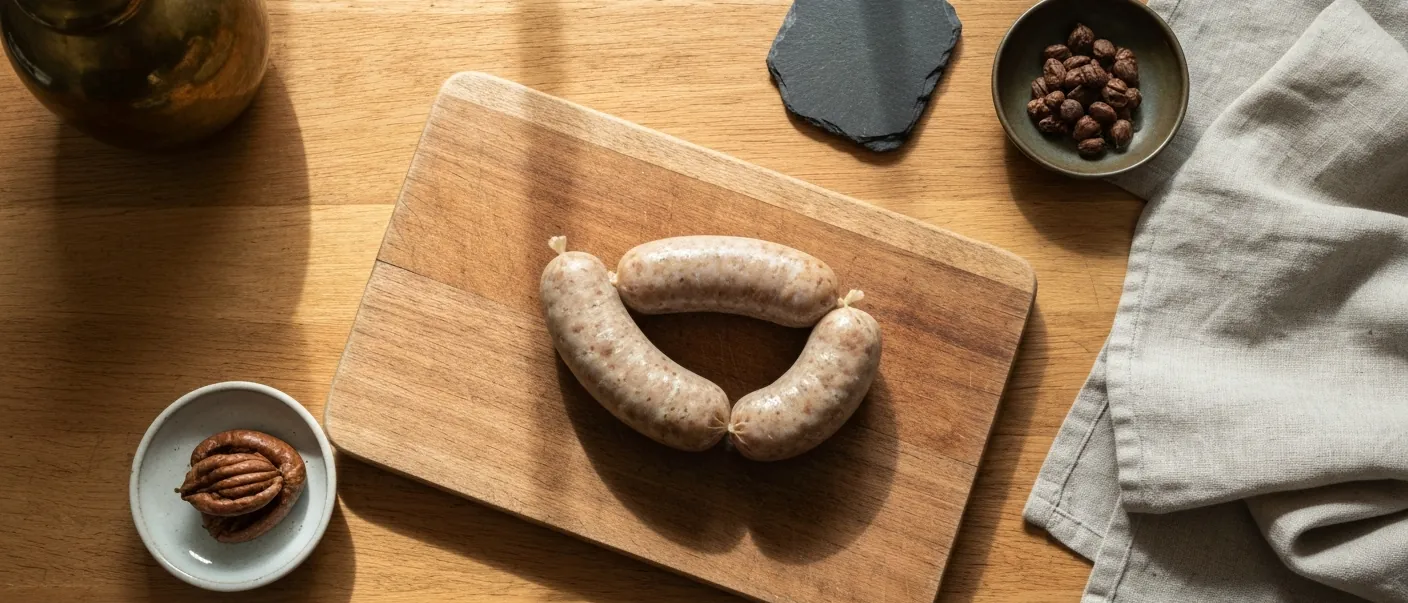
Despite the name, it has no casing and requires no sausage-making equipment. The shaping is done entirely by hand. Some makers roll the finished sausages in extra breadcrumb before cooking to get a more pronounced crust; others cook them plain. Either way, the characteristic exterior — pale gold to deep amber, slightly uneven in the way handmade things always are — is part of what makes it visually distinctive.
Finding a good one
The Glamorgan sausage carries Protected Geographical Indication status in the UK, tying the name to a defined recipe and method. That protection limits how loosely the name can be applied and gives buyers a reasonable expectation of what they are getting.
Independent Welsh food producers and Welsh butchers — a slightly counterintuitive source, but a reliable one — are often the best places to find them made with genuine Caerphilly rather than a milder substitute. Farmers' markets across Wales stock them regularly, and a number of producers sell online and by post. The quality difference between a well-made Glamorgan sausage and a rushed one is immediately apparent: the interior of a good one will be cohesive and properly seasoned, not dry, not sodden, not bland.
For anyone interested in the broader story of Welsh food and its place in British culinary heritage, the Glamorgan sausage is as good a starting point as any. It is specific, old, and quietly excellent.