A small cheese with serious legal standing
Exmoor Blue is one of those protected foods that earns its designation quietly. Made near Exmoor using local milk, it holds PGI — Protected Geographical Indication — status, placing it in the same legal category as Stilton, Melton Mowbray pork pies and a handful of other British classics. Almost nobody has heard of it.
PGI means the cheese's geographical link is legally recognised and protected across the UK. As our PDO/PGI explainer sets out, the designation doesn't guarantee a single producer or a single recipe — it guarantees a defined connection to place, giving buyers confidence that what's on the label is genuine. For Exmoor Blue, that means milk and making rooted in the moorland landscape of the West Country, where the grazing, the climate and the dairying tradition all shape what ends up in the rind.
The interesting question isn't just what the cheese tastes like. It's why so few people know it exists, and what that obscurity tells us about how protected status works in practice.
Why single-farm protected foods stay rare
Stilton is made by several creameries and has had a dedicated marketing operation behind it for generations. Exmoor Blue comes from a much smaller base of production. When a protected food depends on one farm, or a tiny cluster of producers, the designation offers legal security but no commercial engine. The cheese is protected from imitation; it is not promoted by anyone except the people who make it.
This is the quiet paradox of Britain's longer tail of protected foods. The mechanism that rewards authenticity can end up preserving obscurity instead, because the resources needed to build awareness don't scale down to single-farm level. Exmoor Blue wins the same status as a cheese sold in every supermarket, but reaches the public through specialist cheesemongers and farm shops rather than national distribution.
There's an argument that this is exactly as it should be. A cheese tied to a specific landscape and a small production base should be harder to find — scarcity is part of what the protection preserves. But it does mean buyers have to go looking rather than stumbling across it.
The West Country's blue tradition
Exmoor Blue doesn't stand alone. The West Country has a blue-cheese tradition that runs deeper than most people realise, encompassing very old cheeses alongside a more recent wave of farmhouse revival.
Dorset's Blue Vinney — covered in its own article — is the region's most historically rooted blue: a hard, sharp cheese made from skimmed milk with a character entirely unlike the buttery, crumble-and-cream style of many modern blues. It nearly disappeared before being revived by committed local producers.
Devon Blue and various Cornish blues represent a different strand — cheeses that emerged from the farmhouse renaissance of the late twentieth and early twenty-first centuries, when small dairies began experimenting seriously with blue styles that suited their own milk and palates. These cheeses don't carry PGI or PDO protection; they're defined by their producers rather than a legally bounded geography. Even so, they share a seriousness of purpose with Exmoor Blue. The milk tends to come from grass-fed herds on well-drained but reliably green land, and that shows in a flavour profile that leans towards the creamy and relatively gentle rather than the sharp and pungent.
What unites these cheeses is a rejection of the idea that British blue begins and ends with Stilton. Stilton is magnificent, and there's no quarrel with it here. The West Country's contribution, though, is worth knowing on its own terms.
What to look for and where to find it
Exmoor Blue is best sought through specialist cheesemongers, good farm shops in the South West, or producers who sell directly. Stock can be inconsistent — the nature of small-batch, geographically protected production — so buy it when you see it.
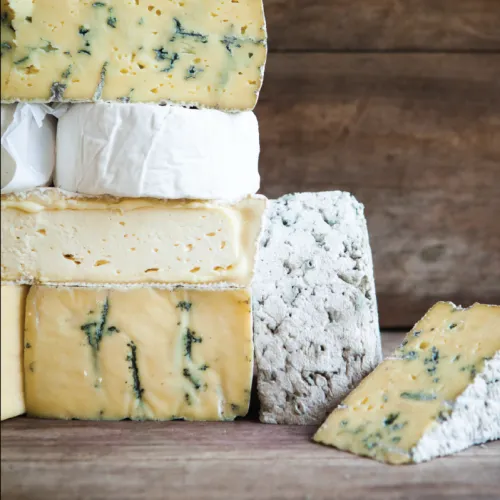
The cheese is typically a soft to semi-soft blue with a moist, open texture and a flavour that reflects the richness of local milk. It is generally milder than a Roquefort or a strong Stilton at its peak, which makes it approachable for those who find heavily pungent blues a step too far.
For Devon and Cornish blues, the same logic applies: use specialist retailers, ask questions when you buy, and accept that availability varies with the season and the herd. These are living cheeses — they change, they're limited, and that's what makes them worth tracking down.